
June 14, 2026
In this edition:
- Last Call – Candidate Nominations for 2026 AMSAT Board of Directors Election Due June 15, 2026
- 2026 AMSAT Field Day – Update
- CardSat: A Pocket Satellite Tracker and Doppler Controller
- NASA Honors AMSAT-DL for Contribution to Artemis II Mission
- Changes to AMSAT TLE Distribution
- Ambassador Events
- ARISS News
- Satellite Shorts from All Over
The AMSAT(R) News Service bulletins are a free, weekly news and information service of AMSAT, the Radio Amateur Satellite Corporation. ANS publishes news related to Amateur Radio in Space including reports on the activities of a worldwide group of Amateur Radio operators who share an active interest in designing, building, launching and communicating through analog and digital Amateur Radio satellites.
The news feed on http://www.amsat.org publishes news of Amateur Radio in Space as soon as our volunteers can post it.
Please send any amateur satellite news or reports to: ans-editor [at] amsat.org .
Sign up for free e-mail delivery of the AMSAT News Service Bulletins via the ANS List. Join this list at: https://mailman.amsat.org/postorius/lists/ans.amsat.org/ .
Last Call – Candidate Nominations for 2026 AMSAT Board of Directors Election Due June 15, 2026
The nomination period for the AMSAT 2026 Board of Directors election, which will take place during the third quarter of the year, ends on June 15, 2026.
Three director positions are set to expire in 2026. The current board members whose seats are up for election are:
- Mark Hammond, N8MH
- Bruce Paige, KK5DO
- Paul Stoetzer, N8HM
In addition to these three full Director roles, up to two Alternate Directors may also be elected to serve one-year terms.
To nominate a candidate, a written submission is required. Nominations must include the nominee’s name, call sign, and contact information, along with the same details for either five AMSAT members in good standing or one Member Society endorsing the candidate.
Nominations should be directed to the AMSAT Secretary:
Douglas Tabor, N6UA
1133 Verlan Way
Cheyenne, WY 82009
Per AMSAT’s bylaws, all nominations must follow the format specified by the Secretary. Doug Tabor has indicated that nominations will be accepted in both hard copy (via postal mail) and digital formats (including email or scanned documents). However, fax submissions are not permitted.
Email nominations should be sent to: dtabor [at] amsat [dot] org
All nomination petitions must be received by the Secretary no later than June 15. After the submission deadline, the Secretary will confirm the eligibility of each candidate and the supporting members or societies, with final notification to candidates provided by the end of June.
[ANS thanks Doug Tabor, N6UA, AMSAT Secretary, for the above information]
The 2026 President’s Club Coin is Now Here!
Help Support GOLF and FoxPlus.
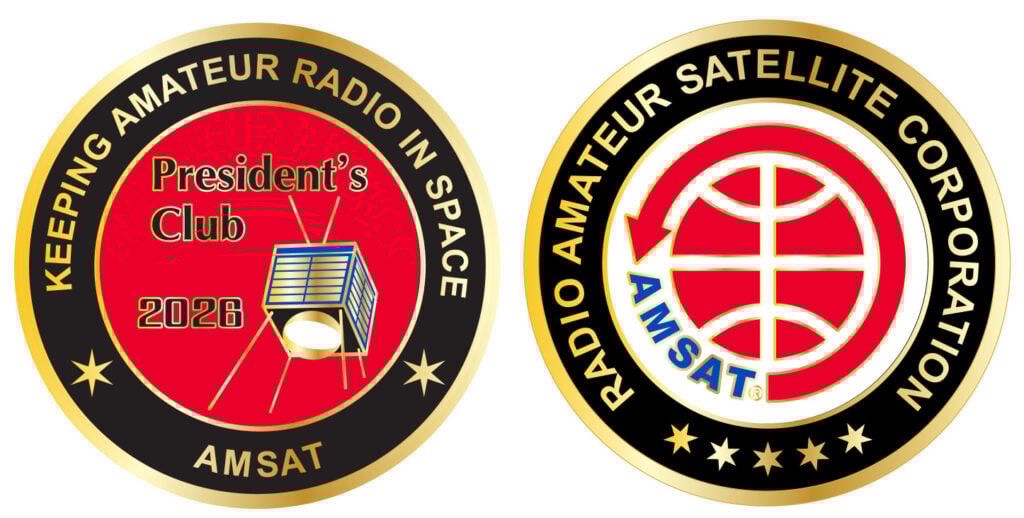
Annual memberships start at only $120
Join the AMSAT President’s Club today and help
Keep Amateur Radio in Space!
https://www.amsat.org/join-the-amsat-presidents-club/
2026 AMSAT Field Day Update
It’s that time of year again; summer and Field Day! Each year the American Radio Relay League (ARRL) sponsors Field Day as a “picnic, a campout, practice for emergencies, an informal contest and, most of all, FUN!” The event takes place during a 27-hour period on the fourth weekend of June.
For 2026 the event takes place from 1800 UTC on Saturday June 27, 2026 through 2100 UTC on Sunday June 28, 2026. Those who set up prior to 1800 UTC on June 27 can operate only 24 hours. The Radio Amateur Satellite Corporation (AMSAT) promotes its own version of Field Day for operation via the amateur satellites, held concurrently with the ARRL event.
This year should be as much fun as last year since we have more than 10 transponders and repeaters available. For AMSAT purposes, a transponder on a satellite would count as two if you could do phone and CW. We count them by modes, not the satellite names.
Users should check the AMSAT status page at http://www.amsat.org/status/ and the pages at https://www.amsat.org/two-way-satellites/ for what is available in the weeks leading up to field day. To reduce the amount of time to research each satellite, see the current FM satellite table at https://www.amsat.org/fm-satellite-frequency-summary/ and the current linear satellite table at https://www.amsat.org/linear-satellite-frequency-summary/ .
If you are considering ONLY the FM voice satellites, there are ISS and SO-50. It might be easier this year to make that one FM contact for the ARRL bonus points with so many FM birds. The congestion on FM LEO satellites is always so intense that we must continue to limit their use to one-QSO-per-FM-satellite. This includes the International Space Station. You will be allowed one QSO if the ISS is operating Voice.
It was suggested during past field days that a control station be allowed to coordinate contacts on the FM satellites. There is nothing in the rules that would prohibit this. This is nothing more than a single station working multiple QSO’s. If a station were to act as a control station and give QSO’s to every other field day station, the control station would still only be allowed to turn in one QSO per FM satellite while the other station would be able to submit one QSO.
The format for the message exchange on the ISS or other digital packet satellite is an unproto packet to the other station (3-way exchange required) with all the same information as normally exchanged for ARRL Field Day, e.g.:
W6NWG de KK5DO 2A STX
KK5DO de W6NWG QSL 5A SDG
W6NWG de KK5DO QSL
If you have worked the satellites on Field Day in recent years, you may have noticed a lot of good contacts can be made on some of the less-populated, low-earth-orbit satellites like AO-7, RS-44, AO-73, FO-29 and JO-97. During Field Day the transponders come alive like 20 meters on a weekend. The good news is that the transponders on these satellites will support multiple simultaneous contacts. The bad news is that you can’t use FM, just low duty-cycle modes like SSB and CW.
[ANS thanks Bruce Paige, KK5DO, AMSAT Director of Contests and Awards for the above information.]
AMSAT Remove Before Flight Key Tags Now Available
Yes, These are the Real Thing!
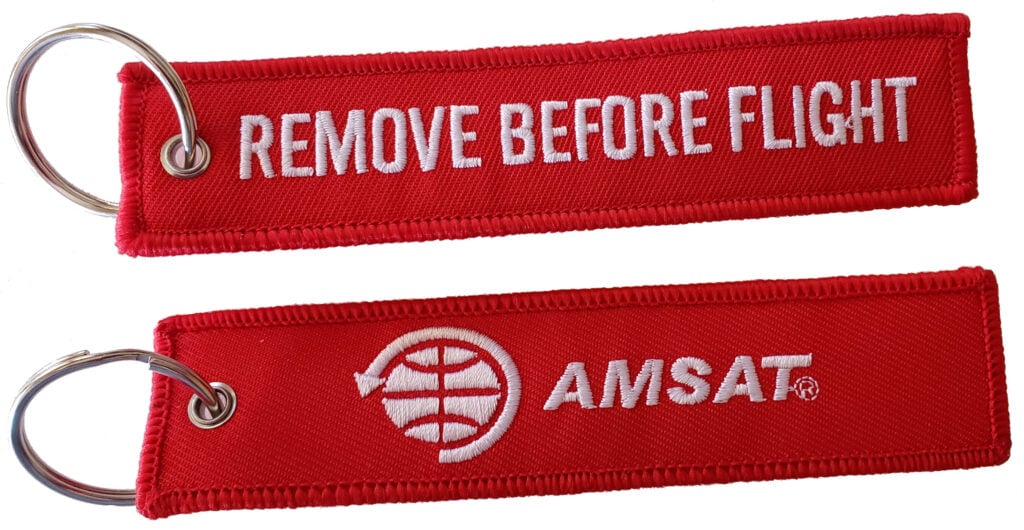
Your $20 Donation Goes to Help Fly a FoxPlus Satellite
Includes First Class Postage (Sorry – U.S. Addresses Only)
Order Today at https://www.amsat.org/product/amsat-remove-before-flight-keychain
CardSat: A Pocket Satellite Tracker and Doppler Controller
Paul Stoetzer, N8HM, has released CardSat, a free, open-source amateur satellite ground station controller that runs on the M5Stack Cardputer ADV – a credit-card-sized ESP32-S3 computer with a built-in keyboard, color display, and microSD slot. The project lives at https://github.com/prstoetzer/CardSat.
CardSat downloads GP orbital and transponder data over WiFi, predicts passes locally with SGP4, and drives a radio over CAT with real-time Doppler correction. It works fully offline once data is cached and deep-sleeps between passes to save battery.
Its Doppler engine uses the AMSAT “One True Rule” correcting both uplink and downlink so your signal holds the same spot in the passband for the whole pass. You can tune with the Cardputer keys or the radio’s own knob – CardSat follows the dial and re-applies correction with nothing drifting.
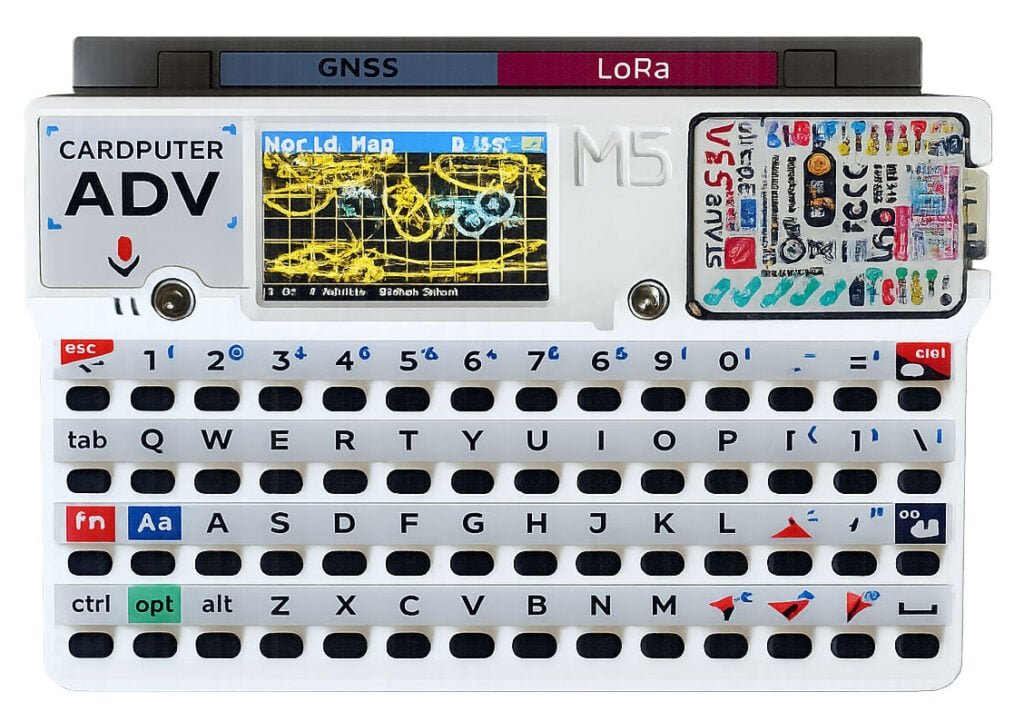
Radios: Ten rigs across three CAT families – Icom CI-V (IC-820/821/910/970/ 9100/9700), Yaesu (FT-847, FT-736R), and Kenwood (TS-790, TS-2000) – plus native Icom LAN (RS-BA1) control of a networked Icom IC-9700 over WiFi. Linear-transponder passband tracking, automatic sideband selection, and automatic FM CTCSS tones are included. CardSat can also act as a rigctld/rotctld server for a PC, or as a rigctl client to a remote rig.
Operating and planning: An all-favorites Next Passes schedule, an AOS alarm, deep-sleep until AOS, elevation and polar plots with ground track, sun/eclipse status, a mutual-window finder for co-visibility with a remote station, a 10-day pass overview, a 60-day illumination raster, a time-step simulation, and a multi-page orbital analysis (including beta angle and decay).
Award chasing: CardSat lists what’s under the footprint right now – workable grid squares (VUCC), US states (WAS), and the full 340-entity DXCC list (major countries as polygons, island/micro-entities by reference point from cty.dat) – live or as a per-pass union.
Plus: Az/el rotator control (GS-232, rotctl, PstRotator, or direct Yaesu) with park, pre-position, per-pass flip, and manual jog; Sun/Moon pointing for sun-noise and EME aiming; QSO logging with ADIF export that doesn’t interrupt Doppler; AMSAT OSCAR Status activity marks; a world map with all footprints; a GPS sky plot; selectable element sources; on-device help; and screenshots.
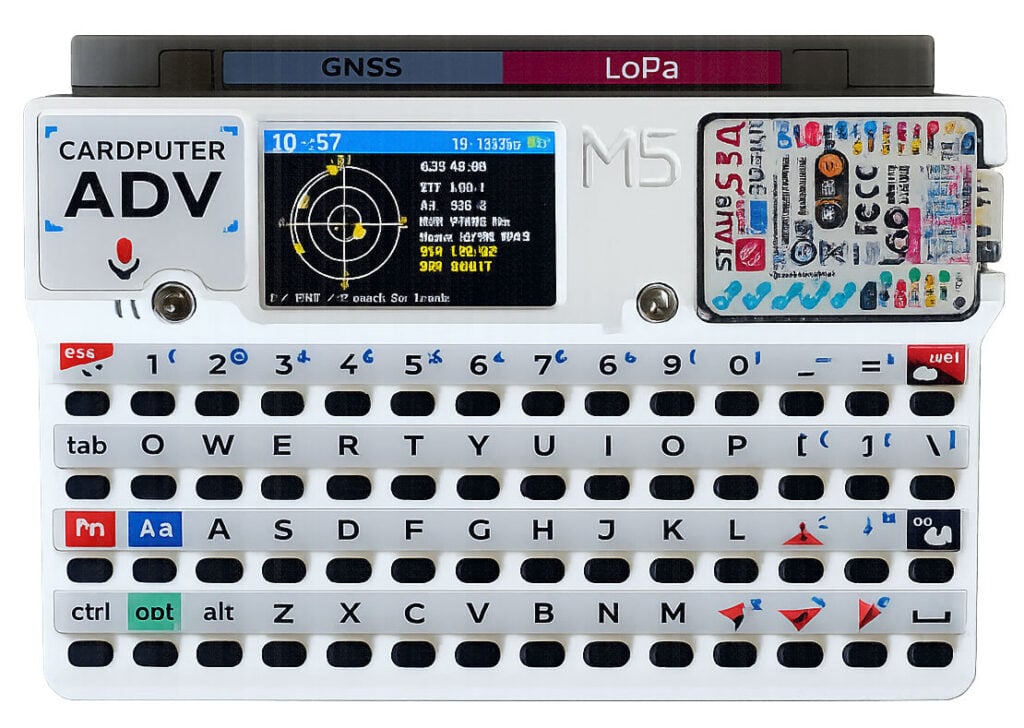
The Cardputer ADV uses an ESP32-S3 (4 MB flash, no PSRAM, 240×135 LCD, 56-key keyboard). Controlling a radio requires a CAT interface suited to the rig; the 3.3 V GPIO is not 5 V tolerant, so CAT lines must never be wired direct.
Status: CardSat builds and runs on the Cardputer, with pass prediction, the plots, mutual-window search, GPS, the AOS alarm, deep sleep, and the offline caches all confirmed on hardware. The CAT frequency encoders, the Icom LAN backend, the rotator backends, and the network server/client paths are implemented and host-tested but have not yet driven a real radio or rotator on the air. Operators willing to test these paths and report results are encouraged to do so.
The repository includes firmware, a full manual, wiring guides, and a printable key-reference card.
[ANS thanks Paul Stoetzer, N8HM, AMSAT Executive Vice President for the above information.]
NASA Honors AMSAT-DL for Contribution to Artemis II Mission
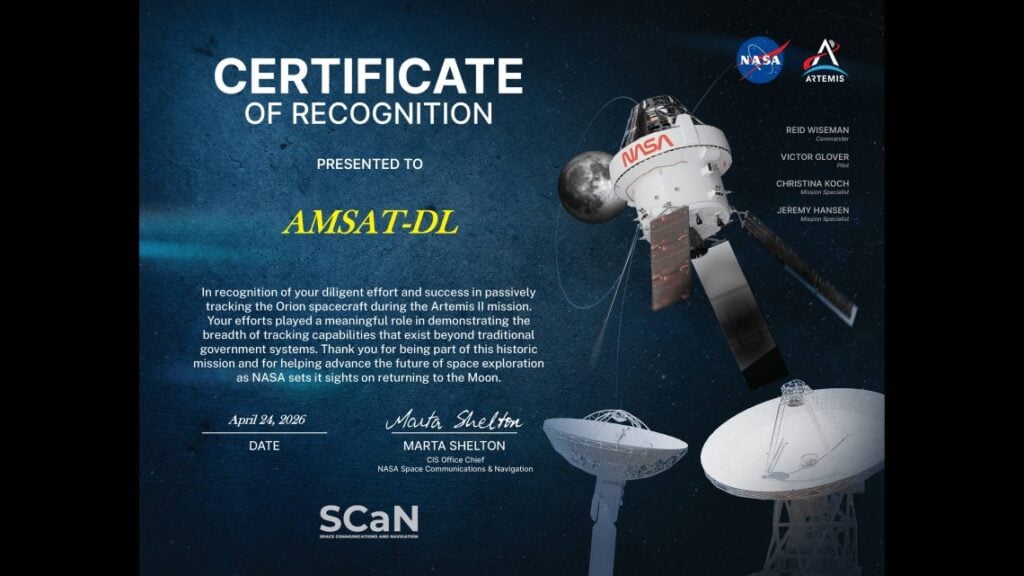
AMSAT-DL was pleased to announce that it had received a Certificate of Recognition, an official certificate of appreciation, from NASA for its participation in the Artemis II mission.
Passive Tracking of the Orion Spaceship
As part of the historic Artemis II mission, the AMSAT-DL and Bochum Observatory successfully tracked the Orion spacecraft passively throughout. Over 6 TB (terabytes) of IQ data and Doppler measurements were recorded. This achievement was expressly acknowledged by NASA, as it impressively demonstrates the contribution that radio amateurs and civil society organizations can make to modern space travel – far beyond the capabilities of traditional government systems.
An Award for the Entire Community
The certificate, signed by Marta Shelton, CIS Office Chief of NASA Space Communications & Navigation (SCaN), is dated April 24, 2026 and recognizes AMSAT-DL’s “diligent efforts and success in the passive tracking of the Orion spacecraft.” Most significantly, the certificate also names the crew of the Artemis II mission: Commander Reid Wiseman, Pilot Victor Glover, and Mission Specialists Christina Koch and Jeremy Hansen. This honor belongs not only to AMSAT-DL as an organization – it belongs to all the members, supporters and volunteers whose passion for amateur radio and spaceflight made this success possible.
Amateur Radio and Space Travel – A Strong Connection
The award from NASA is impressive proof that amateur radio continues to play an important role in space communication and monitoring in the 21st century. AMSAT-DL and Observatory Bochum remain true to their shared mission: to promote the link between amateur radio and space exploration and to inspire the next generation of radio amateurs and space enthusiasts.
Peter Gülzow DB2OS, AMSAT-DL comments, “We would like to thank NASA and the SCaN team for this great recognition of our work – and look forward to accompanying future missions on the way back to the moon!”
[ANS thanks Peter Gülzow DB2OS, AMSAT-DL for the above information.]
Need a New Satellite Antennas?
Purchase M2 LEO-Packs from the AMSAT Store.
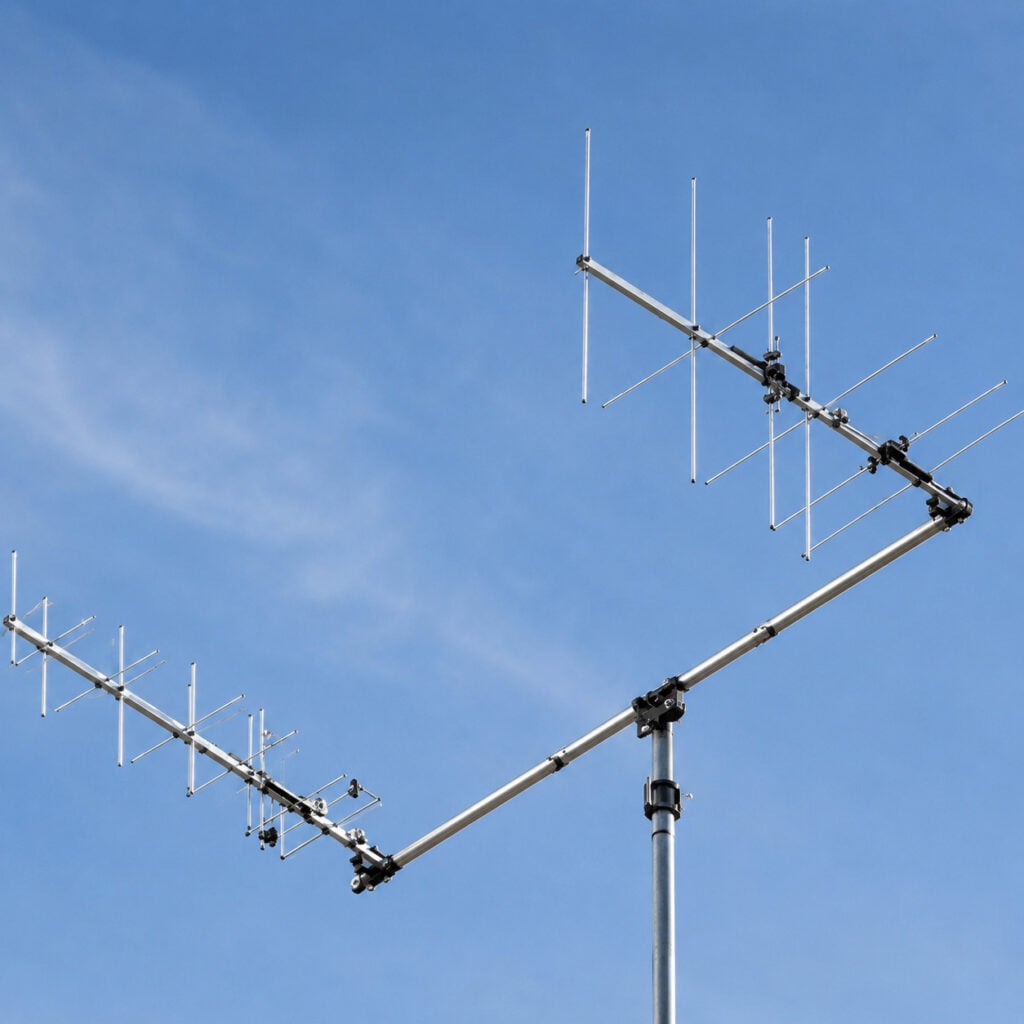
When you purchase through AMSAT, a portion of the proceeds goes towards
Keeping Amateur Radio in Space. https://amsat.org/product-category/hardware/
Changes to AMSAT TLE Distribution for June 12, 2026
Two Line Elements or TLEs, often referred to as Keplerian elements or keps in the amateur community, are the inputs to the SGP4 standard mathematical model of spacecraft orbits used by most amateur tracking programs. Weekly updates are completely adequate for most amateur satellites. TLE bulletin files are updated daily in the first hour of the UTC day. New bulletin files will be posted immediately after reliable elements become available for new amateur satellites. More information may be found at https://www.amsat.org/keplerian-elements-resources/.
The following satellite has been added to this week’s AMSAT TLE Distribution:
LO-19 NORAD Cat ID No. 20442 Began transmitting telemetry again
[ANS thanks Joe Fitzgerald, KM1P, AMSAT Orbital Elements Manager for the above information.]
ARISS NEWS
Amateurs and others around the world may listen in on contacts between amateurs operating in schools and allowing students to interact with astronauts and cosmonauts aboard the International Space Station. The downlink frequency on which to listen is 145.800 MHz worldwide.

- Successful Contacts
Collège Louis Aragon, Imphy, France, direct via F5KCH.
The ISS callsign was OR4ISS.
The crewmember was Sophie Adenot, KJ5LTN.
The ARISS mentor was Joseph Lemoines, F6ICS.
Contact was successful on Monday, June 8, 2026 at 13:29 UTC. - Scheduled Contacts
Youth on the Air Camp 2026 (YOTA Camp 2026), Huntsville, AL, direct via W4Y.
The ISS callsign is presently scheduled to be NA1SS.
The scheduled crewmember is Chris Williams, KJ5GEW.
The ARISS mentor is Daryl Young, K4RGK.
Contact is for Thursday, June 18, 2026 at 16:36 UTC.
The crossband repeater continues to be active (145.990 MHz up {PL 67} & 437.800 MHz down). If any crewmember is so inclined, all they have to do is pick up the microphone, raise the volume up, and talk on the crossband repeater. So give a listen, you just never know.
As always, if there is an EVA, a docking, or an undocking; the ARISS radios are turned off as part of the safety protocol.
Note, all times are approximate. It is recommended that you do your own orbital prediction or start listening about 10 minutes before the listed time.
The latest information on the operation mode can be found at https://www.ariss.org/current-status-of-iss-stations.html
The latest list of frequencies in use can be found at https://www.ariss.org/contact-the-iss.html
[ANS thanks Charlie Sufana, AJ9N, one of the ARISS operation team mentors for the above information.]
FREE WITH MEMBERSHIP – LIMITED TIME OFFER!
Free Digital Copy of Getting Started with Amateur Satellites
For New and Renewed AMSAT Memberships!
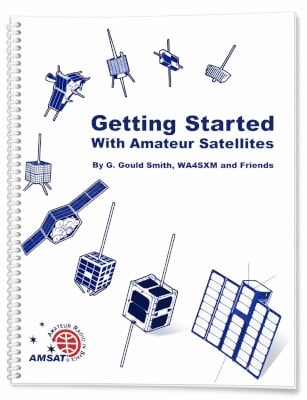
Join or renew your AMSAT membership during the promotional period and receive a download link for the latest edition of Getting Started with Amateur Satellites. Remember! Students join for FREE!
JOIN TODAY at https://launch.amsat.org/
AMSAT Ambassador Activities
AMSAT Ambassadors provide presentations, demonstrate communicating through amateur satellites, and host information tables at club meetings, hamfests, conventions, maker faires, and other events.
June 27, 1800 UTC – June 28, 2100 UTC, 2026
ARRL Field Day
https://www.amsat.org/field-day/
July 11, 2026
Moon Day
Frontiers of Flight Museum
6911 Lemmon Ave.
Dallas, TX 75209
https://flightmuseum.com/events/moonday/
N5HYP
October 8-11, 2026
44th AMSAT Space Symposium and Annual Membership Meeting
Crowne Plaza JAX Airport
14670 Duval Road
Jacksonville, FL 32218
Details to follow
[ANS thanks Bo Lowrey, W4FCL, Director – AMSAT Ambassador Program, for the above information.]
Satellite Shorts From All Over
- California Polytechnic State University has received frequency coordination for a mission named “Additively Manufactured Deployable Radiator with Oscillating Heat Pipes. The primary objective of the AMDROHPSat mission is to perform an on-orbit technology demonstration of the Additively Manufactured Deployable Radiator with Oscillating Heat Pipes (AMDROHP). This 3U CubeSat experiment seeks to validate the ability of a novel, student-integrated thermal system to reject up to 50W of heat in Low Earth Orbit. The mission’s secondary objective is to facilitate learning by doing and self-training for the student team. After the launch and early operations phase has concluded, payload deployment will occur and a digipeater will be enabled. A UHF downlink using 9k6 GFSK will be set for 436.860. The launch is planned from KSC on NG25 NET in December 2026 to the ISS. More info at https://www.polysat.org/. [ANS thanks AMSAT-UK and the IARU for the above information.]
- The crew of NASA’s next Artemis moon program mission was announced Tuesday, setting the stage for a flight to Earth orbit next year to test rendezvous and docking procedures with moon landers being built by SpaceX and Blue Origin, a critical milestone before sending astronauts back to the moon for landing in 2028. The Artemis III mission will be commanded by Randy “Komrade” Bresnik, 58, a former Marine fighter pilot and “TOPGUN” graduate who logged 149 days in space during a space shuttle flight in 2009 and a long-duration stay aboard the International Space Station in 2017. Joining him will be pilot Luca Parmitano, 49, KF5KDP, a European Space Agency astronaut and veteran of two long-duration stays aboard the space station; Andre Douglas, 40, a space rookie and backup crew member for the recently completed Artemis II around-the-moon mission; and Frank Rubio, 49, who spent a U.S.-record 371 days in space aboard the ISS in 2022-23. See the full article at https://spaceflightnow.com/2026/06/09/73614/. [ANS thanks SpaceFlight Now for the above information. ]
- Bureau 1440, the Russian company building the “Rassvet” low-Earth orbit satellite internet service, has confirmed the loss of one of its first operational satellites, launched in March. The remaining 15 satellites from the batch are functioning normally, the company said. The project – Moscow’s domestic alternative to SpaceX’s Starlink – is slated for commercial launch by 2027. See the full article at https://www.kyivpost.com/post/77850. [ANS thanks Kyiv Post for the above information.]
Join AMSAT today at https://launch.amsat.org/
In addition to regular membership, AMSAT offers membership to:
- Societies (a recognized group, clubs or organization).
- Students are eligible for FREE membership up to age 25.
- Memberships are available for annual and lifetime terms.
Contact info [at] amsat.org for additional membership information.
73 and remember to help Keep Amateur Radio in Space!
This week’s ANS Editor, Frank Karnauskas, N1UW.
f.karnauskas [at] amsat [dot] org
ANS is a service of AMSAT, the Radio Amateur Satellite Corporation, 712 H Street NE, Suite 1653, Washington, DC 20002.
AMSAT is a registered trademark of the Radio Amateur Satellite Corporation.




![[Valid RSS]](https://www.iz4wnp.it/wp-content/uploads/2026/04/valid-rss-rogers.png "Validate my RSS feed")