
AMSAT News Service
ANS-179
June 28, 2026
In this edition:
* Classic OSCARLOCATOR Returns as Browser-Based Tracking Simulator
* Katalyst Launches Spacecraft to Rescue NASA’s Swift Observatory
* Rocket Lab Launches Spacecraft for Space Force Orbital Exercise
* Researchers Propose StormWall System to Reduce Solar Storm Impacts
* Changes to AMSAT TLE Distribution for June 26, 2026
* ARISS News
* AMSAT Ambassador Activities
* Satellite Shorts from All Over
The AMSAT® News Service bulletins are a free, weekly news and information service of AMSAT, The Radio Amateur Satellite Corporation. ANS publishes news related to Amateur Radio in Space including reports on the activities of a worldwide group of Amateur Radio operators who share an active interest in designing, building, launching and communicating through analog and digital Amateur Radio satellites.
The news feed on https://www.amsat.org publishes news of Amateur Radio in Space as soon as our volunteers can post it.
Please send any amateur satellite news or reports to: ans-editor [at] amsat.org
You can sign up for free e-mail delivery of the AMSAT News Service Bulletins via the ANS List; to join this list see: https://mailman.amsat.org/postorius/lists/ans.amsat.org/
Classic OSCARLOCATOR Returns as Browser-Based Tracking Simulator
A new browser-based recreation of the classic OSCARLOCATOR satellite tracking aid is now online and free for all amateurs to use at: https://oscarlocator.n8hm.radio/
The OSCARLOCATOR Web Simulator is the work of AMSAT Executive Vice President Paul Stoetzer, N8HM, and is modeled on his OrbitDeck desktop application. It runs entirely in a web browser on desktop and mobile devices, with no login, installation, or plug-ins required.
For amateurs who came to satellite operating after the era of paper tracking devices, the original OSCARLOCATOR was a circular, azimuthal-equidistant map of one hemisphere paired with a rotating clear overlay. By aligning the overlay to a satellite’s equator crossing, an operator could determine where the spacecraft would appear in the sky and when it would be in range — all without a computer. N8HM’s web version preserves that look and method while adding the convenience of live, on-demand computation.
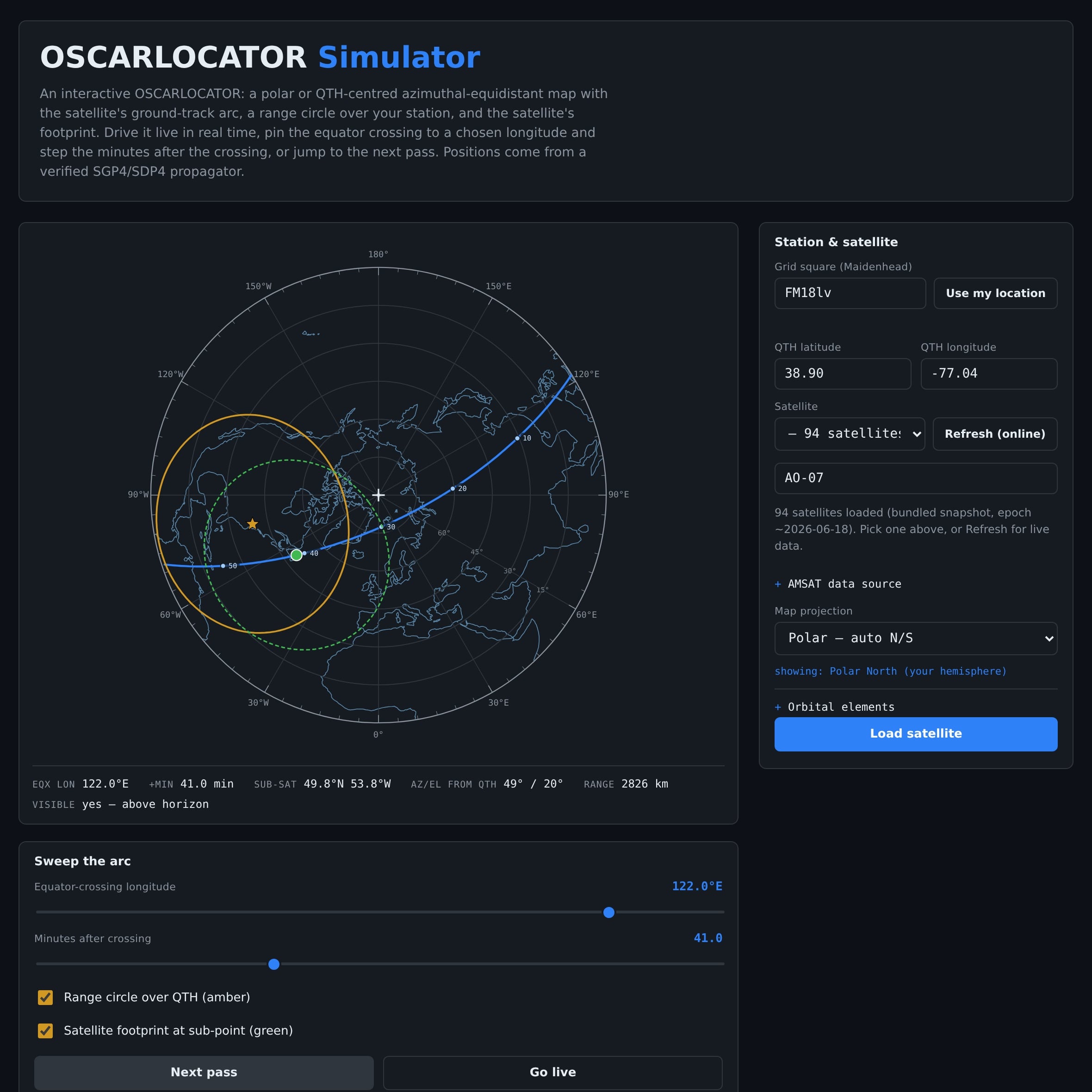
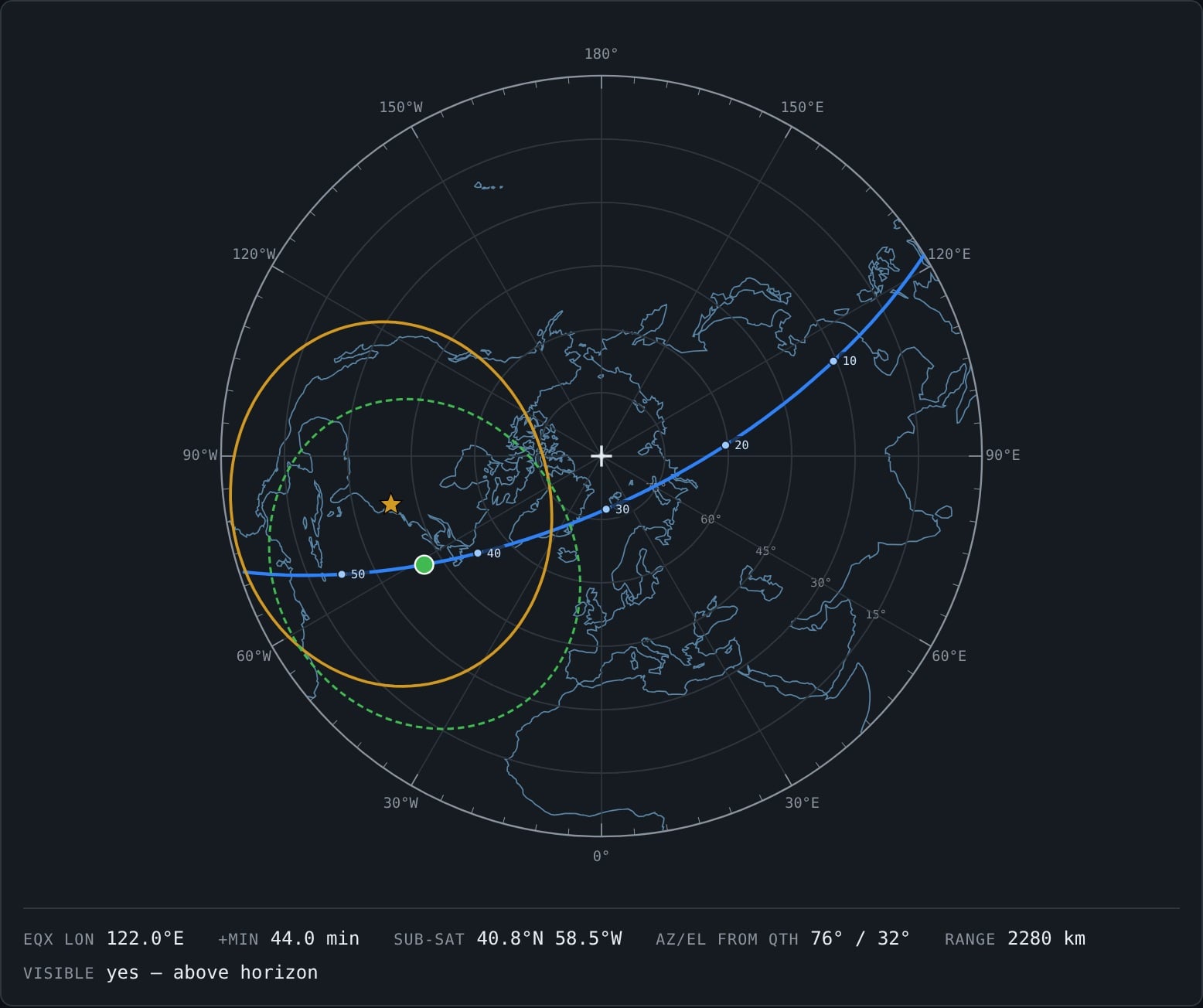
The simulator renders the familiar polar azimuthal-equidistant map as well as a QTH-centered version, automatically choosing the North or South polar sheet for the operator’s location. It draws the satellite’s ground track with 10-minute time marks, plots a range circle over the operator’s station, and shows the spacecraft’s instantaneous footprint. A live readout reports the sub-satellite point, azimuth and elevation from the station, slant range, and whether the satellite is above the horizon.
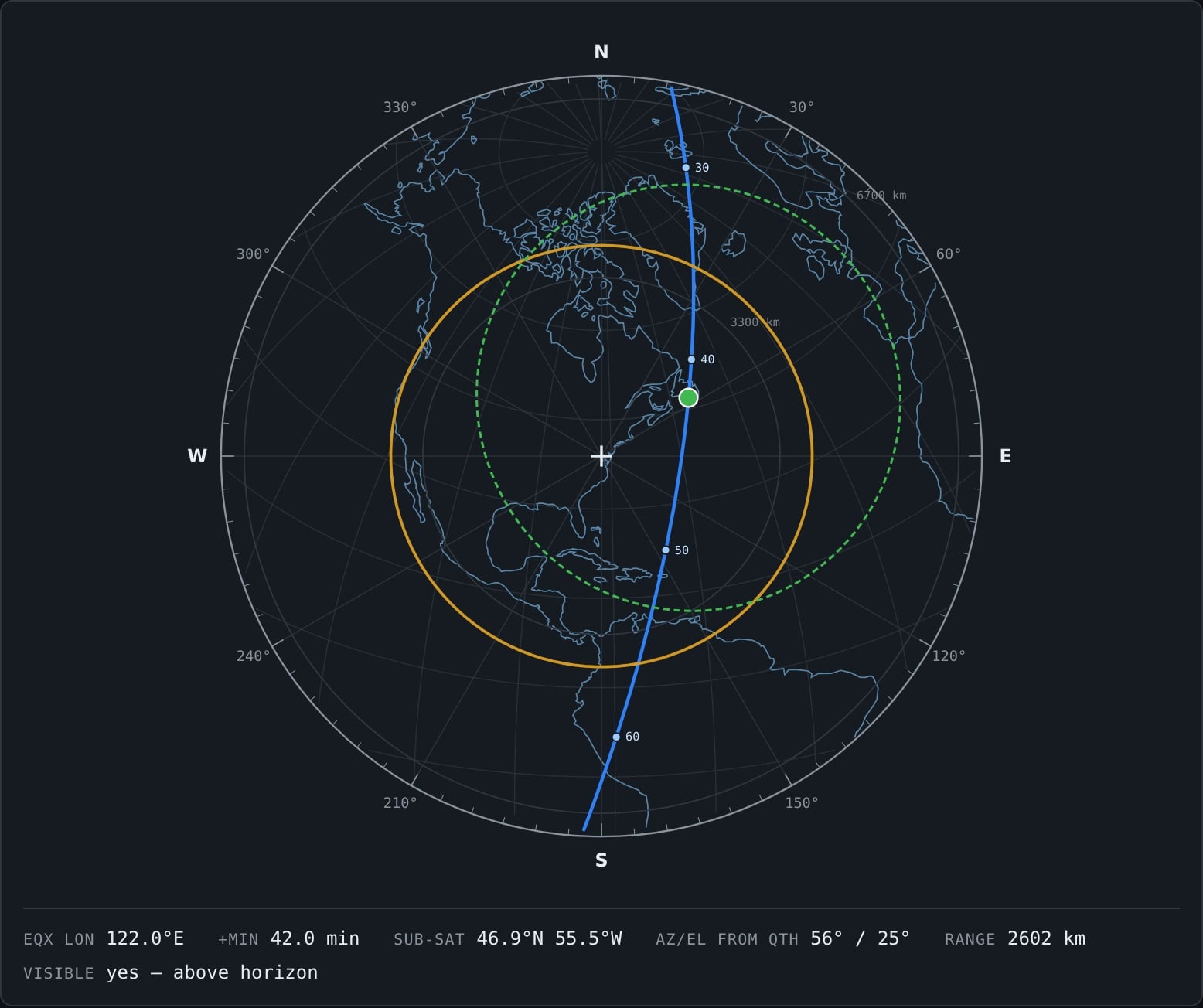
Operators can drive the display live in real time, pin an equator crossing to a chosen longitude and step forward minute by minute, or jump directly to the next visible pass over their location. A QTH-centered view places the operator’s station at the center of the map with azimuth bearings and great-circle distance rings — the same geometry used by a physical OSCARLOCATOR card.
A “Next Passes” panel lists the next ten visible passes over the operator’s QTH, with acquisition-of-signal, peak, and loss-of-signal times, pass duration, and maximum elevation and bearing. A single click seeds any listed pass onto the map. A separate reference-orbit table gives equator-crossing times and longitudes suitable for setting a physical OSCARLOCATOR.
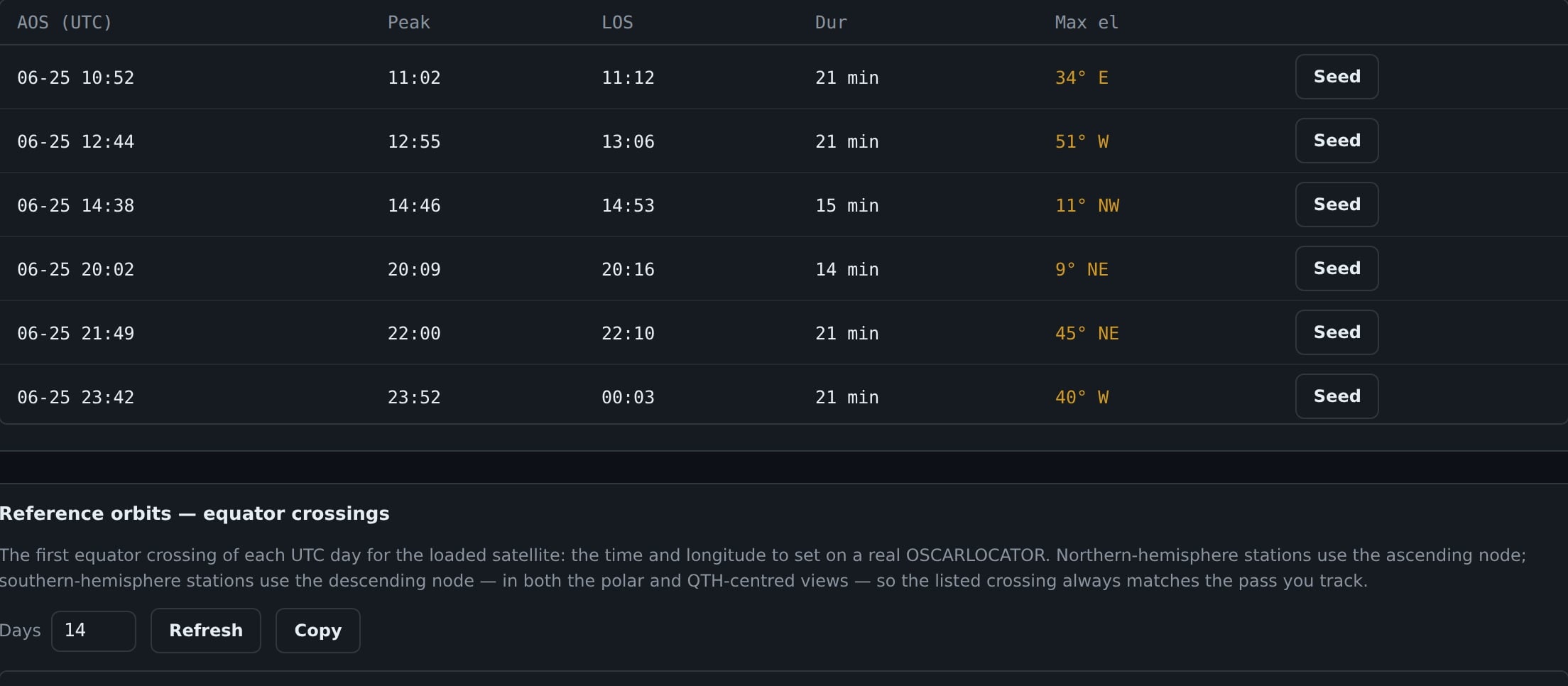
The satellite picker is fed from current AMSAT GP (General Perturbations) orbital element data, with a bundled offline snapshot so the tool remains usable if live data cannot be retrieved. The station can be set by Maidenhead grid square, by latitude and longitude, or automatically through the browser’s geolocation. During live tracking the display follows the satellite across the equator, switching between the North and South polar sheets as appropriate.
Position calculations use a from-scratch SGP4/SDP4 propagator validated against the published Vallado reference vectors, with correct deep-space handling so that high-altitude and geosynchronous satellites such as QO-100 are displayed at their true sub-satellite points.
The OSCARLOCATOR Web Simulator is free to use and available online at https://oscarlocator.n8hm.radio. Amateurs new to satellite work may find its visual, hands-on approach a useful way to build intuition for how amateur satellites move and when they can be worked from a given location.
[ANS thanks Paul Stoetzer, N8HM, AMSAT Executive Vice President, for the above information]
Katalyst Launches Spacecraft to Rescue NASA’s Swift Observatory
Katalyst Space Technologies is preparing to launch its LINK servicing spacecraft aboard Northrop Grumman’s Pegasus XL rocket no earlier than June 30. The mission will attempt to rendezvous with NASA’s Swift Observatory and raise its orbit, potentially extending the life of the 22-year-old space telescope. The launch is expected to mark one of the first operational attempts to capture and service an unprepared satellite already in orbit.
Swift was launched in 2004 to study gamma-ray bursts, among the most energetic events in the universe. Although the observatory remains scientifically productive, it was built without propulsion capable of maintaining its orbit. Atmospheric drag has gradually reduced Swift’s altitude over the past two decades, and increased solar activity accelerated that decay. NASA determined the spacecraft was at risk of descending too low for safe servicing operations later this year.
To preserve the observatory, NASA selected Katalyst Space Technologies in 2025 to develop a rapid-response rescue mission. The company designed and built the LINK servicing spacecraft in less than one year, an unusually short schedule for a mission of its complexity. LINK carries electric propulsion and a robotic capture system designed to attach itself to satellites that were never intended to be serviced in orbit.
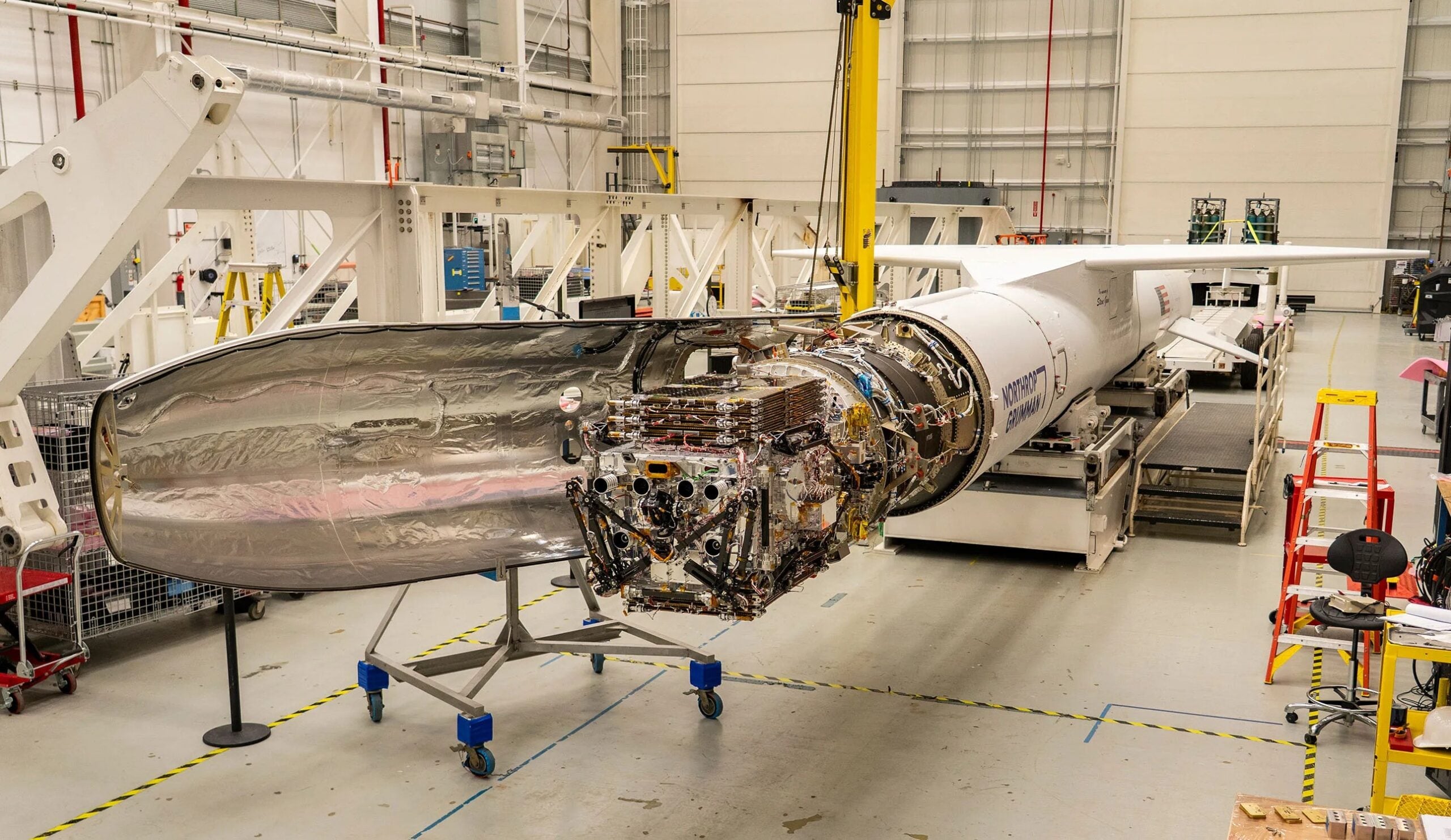
Following launch, LINK will enter orbit and begin initial spacecraft checkout and commissioning activities. In the coming weeks, the spacecraft is expected to perform a series of orbital maneuvers to match Swift’s orbit before attempting a close approach. Once in position, three robotic arms will be used to capture the observatory and establish a secure mechanical connection.
The mission is expected to mark the final flight of Northrop Grumman’s Pegasus XL launch vehicle. First flown in 1990, Pegasus pioneered commercial air-launched access to space and completed dozens of missions during its 36-year career. The launch will utilize the last Pegasus XL rocket remaining in inventory and will be conducted from the L-1011 carrier aircraft Stargazer, believed to be the last operational Lockheed TriStar aircraft still flying.
If successful, the Swift rescue mission could establish a new model for extending the lives of aging spacecraft. Beyond preserving a valuable scientific observatory, the mission will demonstrate technologies that may one day allow commercial operators and government agencies to service satellites rather than replacing them. The mission is being closely watched as a potential milestone in the growing field of commercial on-orbit satellite servicing.
Read the full article at: https://arstechnica.com/space/2026/06/a-bold-satellite-rescue-mission-came-together-in-record-time-but-will-it-work/
[ANS thanks Stephen Clark, Ars Technica, for the above information]
Buying from DX Engineering?
Add AMSAT’s Getting Started With Amateur Satellites to your order.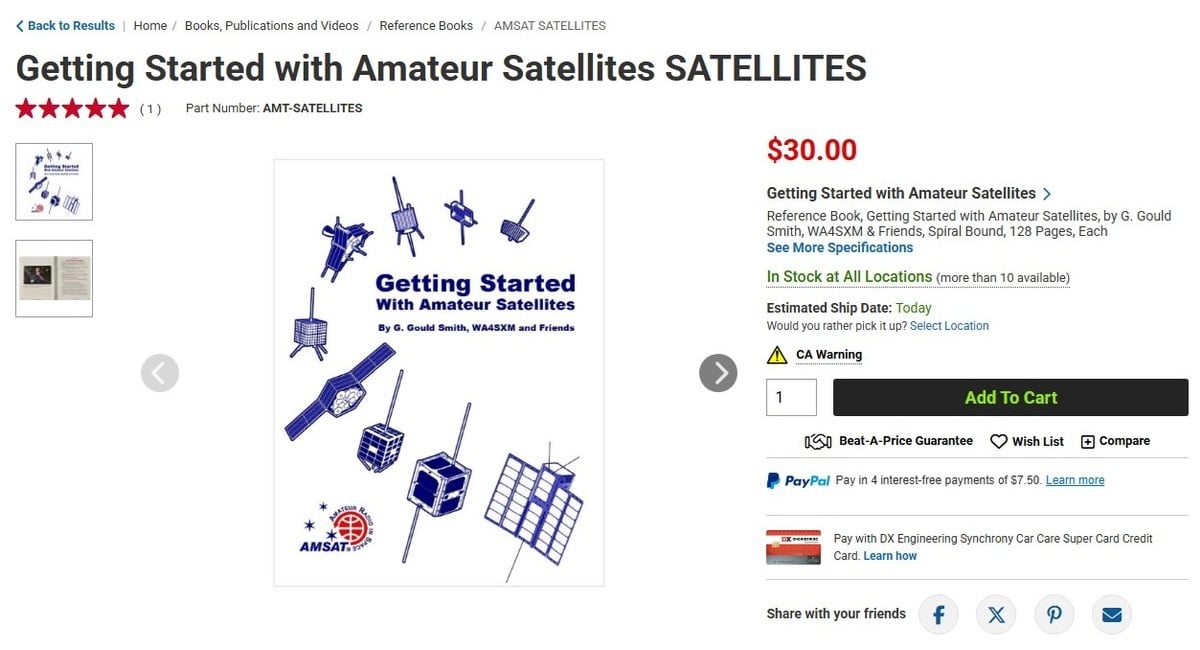 Available for $30 from DX Engineering (free shipping on most orders over $99)
https://www.dxengineering.com/parts/amt-satellites
Rocket Lab Launches Spacecraft for Space Force Orbital Exercise
Rocket Lab successfully launched a spacecraft for the U.S. Space Force’s Victus Haze mission on June 19, lifting off aboard an Electron rocket from the company’s Launch Complex 1 in Mahia, New Zealand. The spacecraft, known as Victus Haze Puma, was placed into a sun-synchronous orbit and will participate in a military demonstration designed to test rapid response capabilities and on-orbit spacecraft operations.
Victus Haze is the fourth mission conducted under the Space Force’s Tactically Responsive Space (TacRS) program. The initiative seeks to demonstrate how commercial launch providers and spacecraft manufacturers can rapidly deploy satellites when needed. Unlike earlier demonstrations that focused primarily on launch readiness, Victus Haze expands the concept by evaluating spacecraft operations after reaching orbit.
Following launch, the Puma spacecraft entered a commissioning phase before beginning rendezvous and proximity operations with another spacecraft already in orbit. The mission will pair Rocket Lab’s vehicle with True Anomaly’s Jackal-004 spacecraft, which launched in May aboard a SpaceX Falcon 9 rideshare mission. During the exercise, the spacecraft will perform a variety of maneuvers intended to demonstrate space domain awareness and the ability to characterize nearby objects in orbit.
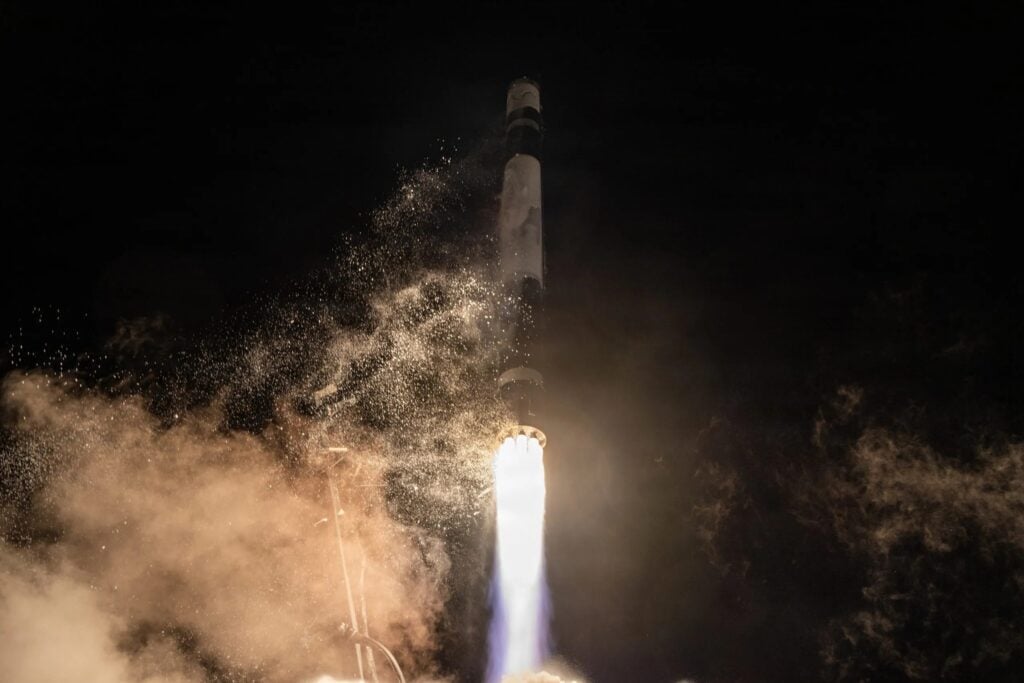
The mission also showcased the responsiveness of Rocket Lab’s launch system. After receiving a formal launch order from the Space Force, the company launched the Electron rocket within 16 hours and 42 minutes, surpassing the program’s 24-hour launch requirement. Rocket Lab reported that mission planners calculated a final trajectory to a previously undisclosed orbit, updated flight software, and coordinated ground station support within only a few hours of receiving the order.
Victus Haze builds on lessons learned from the Victus Nox mission conducted in 2023. That earlier demonstration proved that commercial providers could rapidly launch a satellite following a short-notice tasking. Victus Haze extends the concept by demonstrating that responsive space operations can continue after launch, including the ability to maneuver spacecraft, inspect nearby objects, and gather information about activities occurring in orbit.
Space Force officials view these capabilities as increasingly important as Earth orbit becomes more crowded and strategically significant. Future military and civil missions may require the rapid deployment of spacecraft to replace damaged satellites, investigate unusual activity, or provide additional sensing capabilities. Through partnerships with commercial companies such as Rocket Lab and True Anomaly, the Victus Haze mission aims to demonstrate that these capabilities can be delivered on operational timelines measured in hours and days rather than months.
Read the full article at: https://spacenews.com/rocket-lab-launches-satellite-for-u-s-space-force-victus-haze-responsive-space-exercise/
[ANS thanks Sandra Erwin, SpaceNews, for the above information]
Researchers Propose StormWall System to Reduce Solar Storm Impacts
Scientists have proposed a new concept called StormWall that could one day help protect satellites, communications systems, and power infrastructure from severe solar storms. The idea, described in a recent paper published in the journal Space Weather, would use a fleet of spacecraft to temporarily strengthen Earth’s natural magnetic defenses when dangerous space weather is approaching.
Earth is normally protected by its magnetosphere, a magnetic field that deflects much of the charged particle radiation emitted by the Sun. During powerful solar eruptions, however, interactions between the solar wind and Earth’s magnetic field can allow large amounts of energy to enter near-Earth space. These events can disrupt satellite operations, radio communications, navigation systems, and electric power grids.
The proposed StormWall system would deploy six spacecraft in geosynchronous orbit. Each spacecraft would carry stores of material such as barium, lithium, sodium, or calcium. When a major solar storm is detected, the spacecraft would release the material into space, where sunlight would ionize it and create an artificial cloud of plasma.
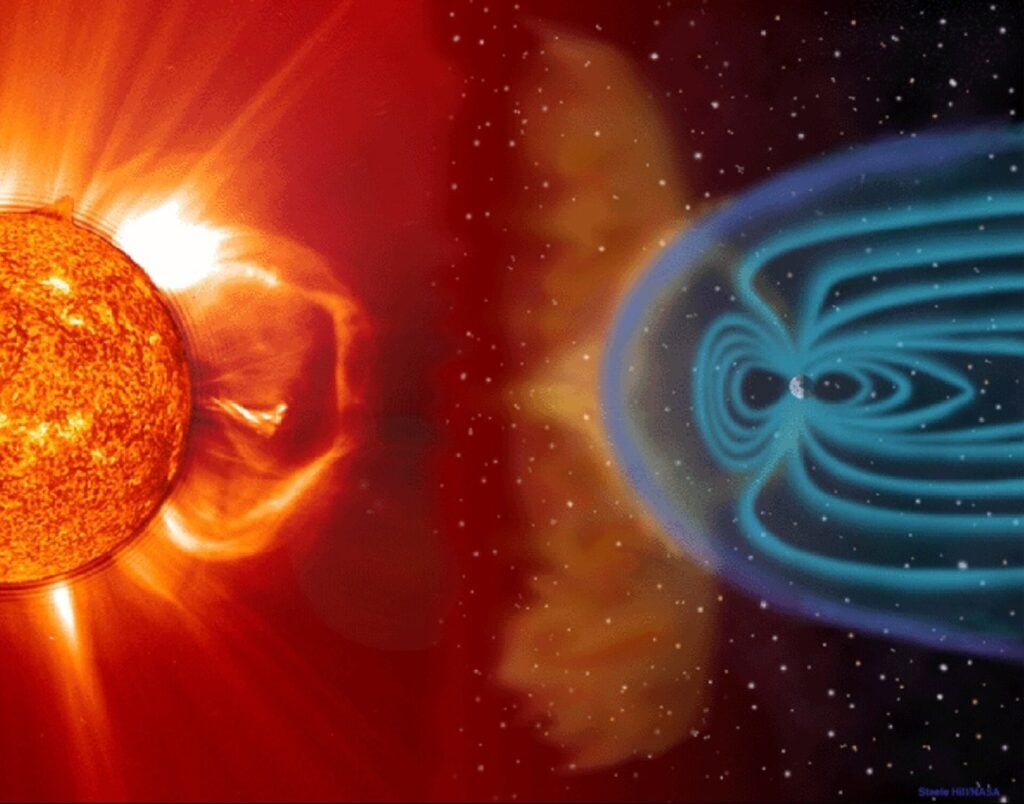
Researchers believe this plasma cloud could increase the mass density along the sunward boundary of the magnetosphere. Computer simulations suggest that the added material would reduce the efficiency of magnetic reconnection, the process that allows solar storm energy to penetrate Earth’s magnetic shield. By slowing this process, StormWall could lessen the severity of geomagnetic storms reaching Earth.
To evaluate the concept, the research team simulated the effects of the May 2024 “Mother’s Day” geomagnetic storm. Their results indicated that StormWall would not eliminate the storm entirely but could reduce key measures of storm intensity by more than 50 percent. The researchers also concluded that the amount of material required and the launch capabilities needed for the system are within the reach of current technology.
The concept remains a theoretical proposal and no StormWall mission has been approved or funded. Nevertheless, the study represents an unusual approach to space weather mitigation, shifting the focus from forecasting solar storms to actively reducing their impact. As satellite constellations and other orbital infrastructure continue to expand, researchers suggest that large-scale protective systems may become increasingly attractive in the future.
Read the full article at: https://www.space.com/astronomy/earth/scientists-propose-spraying-chemicals-into-earths-magnetic-field-to-protect-us-from-powerful-solar-storms
[ANS thanks Sharmila Kuthunur, Space.com, for the above information]
The 2026 Coins Are Here! Help Support GOLF-TEE and Fox-Plus.
Annual memberships start at only $120.
Join the AMSAT President’s Club today and help Keep Amateur Radio in Space!
https://www.amsat.org/join-the-amsat-presidents-club/
Changes to AMSAT TLE Distribution for June 26, 2026
Two Line Elements or TLEs, often referred to as Keplerian elements or keps in the amateur community, are the inputs to the SGP4 standard mathematical model of spacecraft orbits used by most amateur tracking programs. Weekly updates are completely adequate for most amateur satellites. TLE bulletin files are updated daily in the first hour of the UTC day. New bulletin files will be posted immediately after reliable elements become available for new amateur satellites. More information may be found at https://www.amsat.org/keplerian-elements-resources/.
+ This week there are no additions or deletions to the AMSAT TLE distribution.
General Perturbations Data Support
AMSAT is pleased to announce that modern forms of what are called General Perturbations data are being disseminated via modern formats including JSON, XML and KVN at https://newark192.amsat.org/gpdata/current/. The reason this change is being made is that we are running out of 5-digit catalog numbers and the TLE format is not viable for satellites launched after July of this year. See https://celestrak.org/NORAD/documentation/gp-data-formats.php for details.
These data are presently considered in beta test for the next two months while hosted on the test server newark192.amsat.org, and we are very open to community feedback at [email protected]. Testers may experience outages and errors while we make improvements. We intend to put this into production on our main web server in July as we expect that satellites launched after this summer will require one of the new formats to accommodate longer object numbers. AMSAT will continue to publish TLE bulletins for satellites launched before July 2026 indefinitely.
[ANS thanks Joe Fitzgerald, KM1P, AMSAT Orbital Elements Manager, for the above information]
ARISS News
Amateurs and others around the world may listen in on contacts between amateurs operating in schools and allowing students to interact with astronauts and cosmonauts aboard the International Space Station. The downlink frequency on which to listen is 145.800 MHz worldwide.
Scheduled Contacts
+ Recently Completed
National STEM Festival, Washington, DC, telebridge via VK6MJ
The ISS callsign was NA1SS
The scheduled crewmember was Chris Williams, KJ5GEW
The ARISS mentor was W4NTR/ KM4YHZ
Contact was successful: Thu 2026-06-25 13:31:42 UTC
Congratulations to the National STEM Festival students, Chris, mentor W4NTR/KM4YHZ, and ground station VK6MJ!
+ Upcoming Contacts
None currently scheduled
Many times, a school makes a last-minute decision to do a Livestream or runs into a last-minute glitch requiring a change of the URL, but we at ARISS may not get the URL in time for publication. You can always check https://live.ariss.org/ to see if a school is Livestreaming.
As always, if there is an EVA, a docking, or an undocking; the ARISS radios are turned off as part of the safety protocol.
The crossband repeater remains configured in the Columbus Module (145.990 MHz up {PL 67} & 437.800 MHz down). If a crewmember decides to pick up the microphone and turn up the volume, you may hear them on the air—so keep listening, as you never know when activity might occur. In support of an upcoming EVA: Power Down June 29 15:15 UTC | Power Up July 1 10:15 UTC
Kenwood D710GA in the Zvezda Service Module – Call sign RS0ISS. Please note we’re still in the process of troubleshooting and testing this radio. APRS is currently active on 437.825 MHz. Feel free to check out status reports at https://ariss-usa.org/ARISS_APRS/. In support of an upcoming EVA: Power Down June 29 15:20 UTC | Power Up July 1 10:20 UTC
HamTV in the Columbus Module (2395.00 MHz) is currently transmitting a test signal. The color bar test generator portion of the system is experiencing technical issues, and troubleshooting is underway. For more information, visit the ARISS Ham TV Live site at https://live.ariss.org/hamtv/.
Note, all times are approximate. It is recommended that you do your own orbital prediction or start listening about 10 minutes before the listed time.
The latest information on the operation mode can be found at https://www.ariss.org/current-status-of-iss-stations.html
The latest list of frequencies in use can be found at https://www.ariss.org/contact-the-iss.html
[ANS thanks Charlie Sufana, AJ9N, one of the ARISS operation team mentors for the above information]
AMSAT Ambassador Activities
AMSAT Ambassadors provide presentations, demonstrate communicating through amateur satellites, and host information tables at club meetings, hamfests, conventions, maker faires, and other events.
AMSAT Ambassador Clint Bradford, K6LCS, says,
“Think a 75-minute presentation on “working the easy satellites” would be appropriate for your club or event? Let me know by emailing me at k6lcsclint [at] gmail [dot] com or calling me at 909-999-SATS (7287)!”
Clint has NEVER given the exact same show twice: EACH of the 150+ presentations so far has been customized/tailored to their audiences.
Scheduled Events
Moon Day – July 11, 2026
Frontiers of Flight Museum
6911 Lemmon Avenue
Dallas, TX 75209
https://flightmuseum.com/events/moonday/
N5HYP
44th AMSAT Space Symposium and Annual Membership Meeting – October 8 thru 11, 2026
Crowne Plaza JAX Airport
14670 Duval Road
Jacksonville, FL 32218
https://www.amsat.org/2026-amsat-symposium/
For more information go to: https://www.amsat.org/ambassador/
[ANS thanks Bo Lowrey, W4FCL, Director – AMSAT Ambassador Program, for the above information]
Satellite Shorts from All Over
+ Bird Chaser Bingo Summer 2026 has its first Full Eclipse winner, with Mark KO6MBI of Sacramento, California, becoming the first participant to complete every square on the event’s satellite operating challenge card. Event organizer Sean Borgerson, KK7OVF, noted that KO6MBI is relatively new to amateur radio satellites and encouraged operators to listen for him on the air. Bird Chaser Bingo is a summer-long activity that challenges operators to complete satellite-themed operating objectives involving contacts, grids, satellites, and special operating situations. Participants can earn recognition for completing traditional bingo patterns or attempt the more difficult Full Eclipse by finishing the entire card. The event runs through August 31, 2026, with completed cards due by September 15, 2026. Additional information and downloadable bingo cards are available at https://borgersons.com/. (ANS thanks Sean Borgerson, KK7OVF, for the above information)
+ SpaceX launched its new Starfall reentry capsule on June 23 aboard a Falcon 9 rocket from Cape Canaveral Space Force Station in Florida. The spacecraft is designed to carry cargo and research payloads to low Earth orbit and safely return them to Earth for recovery. Starfall can accommodate up to 1,000 kilograms (2,200 pounds) of payload and is intended to support applications such as orbital manufacturing and scientific research. The capsule uses a carbon-fiber heat shield, nitrogen gas attitude-control system, and parachute-assisted splashdown recovery. During the June 23 flight demonstration, SpaceX targeted a recovery area in the Pacific Ocean approximately 1,300 kilometers (700 nautical miles) off the U.S. West Coast. The mission marked Starfall’s first flight test, with at least one additional demonstration mission planned. (ANS thanks Space.com for the above information)
+ Scale RF has launched a Crowd Supply campaign for its QuadRF 4×4 MIMO software-defined radio development kit. The QuadRF operates from 4.9 to 6.0 GHz in the C-band and provides four full-duplex transmit and receive channels with up to 1 watt of output power per antenna. The kit includes four dual-polarization antennas, an integrated Raspberry Pi 5, and open-source software for beamforming and phased-array experimentation. Scale RF says the design is intended as the building block for larger phased-array systems, including its planned MoonRF architecture for Earth-Moon-Earth communication and radio astronomy. The complete QuadRF kit is priced at $499 during the Crowd Supply campaign, with initial deliveries expected this fall. Additional information is available on the Crowd Supply campaign page at https://www.crowdsupply.com/scale-rf/quadrf#. (ANS thanks Scale RF for the above information)
+ Researchers at NASA’s Glenn Research Center in Cleveland, Ohio, are testing a regenerative fuel cell system that could provide long-duration energy storage for future Artemis missions to the Moon. The system generates electricity by combining hydrogen and oxygen into water, then recharges by splitting the water back into its original gases for repeated use. The technology could provide a lighter alternative to batteries while storing enough energy to power habitats, rovers, and other lunar systems through the Moon’s two-week-long nights. Engineers recently began testing the complete integrated system, including storage of the hydrogen and oxygen produced during recharge. Data gathered during the test campaign will help prepare the technology for future environmental testing under simulated lunar conditions. If successful, regenerative fuel cells could become an important part of the infrastructure needed to support sustained human exploration of the Moon. (ANS thanks NASA for the above information)
Join AMSAT today at https://launch.amsat.org/
In addition to regular membership, AMSAT offers membership to:
- Societies (a recognized group, clubs or organization).
- Students enrolled in at least half-time status are eligible for free membership to age 25.
- Memberships are available for annual and lifetime terms.
Contact info [at] amsat.org for additional membership information.
73 and remember to help Keep Amateur Radio in Space!
This week’s ANS Editor,
Mitch Ahrenstorff, ADØHJ
mahrenstorff [at] amsat.org
ANS is a service of AMSAT, the Radio Amateur Satellite Corporation, 712 H Street NE, Suite 1653, Washington, DC 20002
AMSAT is a registered trademark of the Radio Amateur Satellite Corporation.




![[Valid RSS]](https://www.iz4wnp.it/wp-content/uploads/2026/04/valid-rss-rogers.png "Validate my RSS feed")