
AMSAT News Service
ANS-228
August 16, 2026
In this edition:
* Call for Presentations: 44th AMSAT Space Symposium
* AMSAT CubeSatSim Featured in QST Magazine
* More AMSAT Contests and Awards
* Norwegian Amateurs Experiment with Satellite Voice Control
* ARISS Receives Challenger-7 Recognition
* Voting Still in Progress for Board of Directors
* Satellite DXpedition To The Bahamas This Week
* Changes to AMSAT TLE Distribution for August 14, 2026
* ARISS News
* AMSAT Ambassador Activities
* Satellite Shorts from All Over
The AMSAT® News Service bulletins are a free, weekly news and information service of AMSAT, The Radio Amateur Satellite Corporation.
ANS publishes news related to Amateur Radio in Space including reports on the activities of a worldwide group of Amateur Radio operators who share an active interest in designing, building, launching and communicating through analog and digital Amateur Radio satellites.
The news feed on https://www.amsat.org publishes news of Amateur Radio in Space as soon as our volunteers can post it.
Please send any amateur satellite news or reports to: ans-editor [at] amsat.org
You can sign up for free e-mail delivery of the AMSAT News Service Bulletins via the ANS List; to join this list see: https://mailman.amsat.org/postorius/lists/ans.amsat.org/
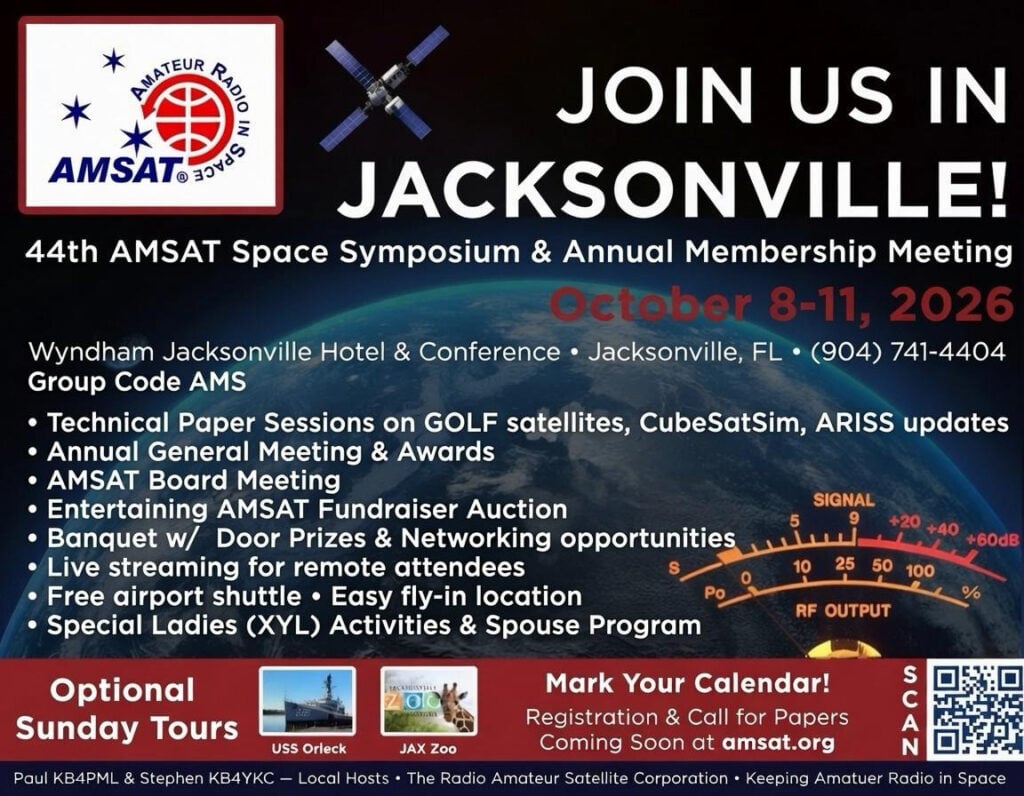
Call for Presentations: 44th AMSAT Space Symposium
Do you have a story to tell the amateur satellite community? AMSAT invites proposals for presentations at the 44th AMSAT Space Symposium and Annual General Meeting, to be held October 8-11, 2026, at the Wyndham Jacksonville Hotel & Conference Center in Jacksonville, Florida.
Presentations are welcome on any topic of interest to the amateur satellite community. Suggested subjects include current and future satellite projects such as the GOLF program and the CubeSatSim; ARISS and human spaceflight activities; ground station, antenna, and portable station design; software-defined radio; telemetry collection and analysis; satellite operating techniques and achievements; educational programs and youth outreach; and reports from DXpeditions and roving operations. Whether you have built it, flown it, coded it, taught it, or worked it through a satellite, your fellow attendees want to hear about it.
Prospective presenters should email a tentative presentation title and a brief abstract to symposium [at] amsat.org as soon as possible. Presentation time slots are limited, so early submissions are encouraged, and information on submitting final papers and presentation materials for inclusion in the Symposium Proceedings will be provided to presenters. A digital copy of the Proceedings is included with every Symposium registration.
Symposium presentations begin Friday afternoon, October 9, and continue through Saturday, October 10, leading into the Annual General Meeting. Live streaming will bring the sessions to members unable to attend in person – all the more reason to make sure your work is on the program.
Registration for the Symposium is now open at https://launch.amsat.org/event-6789663, with early bird pricing available through September 8. Hotel reservations at the Wyndham Jacksonville – the property formerly known as the Crowne Plaza Jacksonville Airport/I-95 – may be made through the booking link at https://www.amsat.org/2026-amsat-symposium/ or by phone at 1-800-227-6963 using group code AMS.
[ANS thanks the AMSAT Symposium Team for the above information.]
Registration is Now Open!
AMSAT CubeSatSim Featured in QST Magazine
The AMSAT CubeSatSim, the CubeSat Simulator, is a small, low-cost, spacecraft simulator that serves as a tool for academic education, public demonstrations, and theory and design disciplines. It can be used in a classroom, lab or training setting to introduce the basics of satellite operations, or it can be used to teach STEM (Science, Technology, Engineering, Math) exercises.
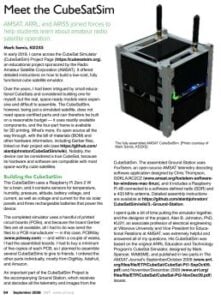
First page of the QST Magazine article by Mark Samis, KD2XS. (Image credit: QST Magazine)
The September issue of QST Magazine has an article about the project. The article “Meet the CubeSatSim” is written by Mark Samis, KD2XS. Mark is a long-time key contributor to the CubeSatSim Project and is the Project Manager for the ARISS STAR Project.
ARRL members will find the article beginning on page 54 of the September issue, available by logging in on the ARRL site, https://www.arrl.org/qst. By special permission from ARRL and QST, all may read a PDF version of the article on the CubeSatSim project website at: https://CubeSatSim.org/Meet-the-CubeSatSim.pdf.
The CubeSatSim and the low-cost CubeSatSim Lite are available on the AMSAT Store.
[ANS thanks Alan Johnston, KU2Y, AMSAT Vice President – Educational Relations, for the above information.]
Help Support GOLF and FoxPlus.
Annual memberships start at only $120
Join the AMSAT President’s Club today and help
Keep Amateur Radio in Space!
https://www.amsat.org/join-the-amsat-presidents-club/
More AMSAT Contests and Awards
Steve Greene, KS1G, Earns GridMaster Award #80
For the second week in a row, AMSAT has a new GridMaster. Bruce Paige, KK5DO, AMSAT Director of Contests and Awards, has announced that Steve Greene, KS1G, of northern Virginia has been awarded GridMaster Award #80, following close behind Adrian, N8AJM, who claimed award #79 just one week earlier.
The GridMaster Award is earned by completing confirmed two-way satellite contacts with operators in all 488 Maidenhead grid squares of the contiguous United States – a feat accomplished by just 80 operators since the award was introduced by the Star Comm Group in 2014. Written confirmations, via QSL card or Logbook of The World, are required for every grid, and all contacts must be made from a single location or from locations within a 200-kilometer circle. With many of the 488 grids home to few or no resident satellite operators, the award is as much a testament to patience as to skill – and to the rovers who venture into rare grids so the chasers can finish the map.
KS1G will be a familiar callsign to many on the birds. A fixture of the northern Virginia satellite scene, Steve has spent years introducing newcomers to the hobby through his “Your First FM Satellite Contact” presentations at area radio clubs, has captained Field Day satellite operations, and helped put Virginia on the air via satellite as one of the K2B activators during the 13 Colonies special event. It is only fitting that an operator who has helped so many others make their first satellite contact has now confirmed his 488th grid.
In announcing the award, Paige offered his congratulations along with his customary encouragement to the rover community to keep on rovin’.
Complete details on the GridMaster Award, including rules and the application form, are available at https://www.amsat.org/gridmaster/, and upcoming rover operations – the lifeblood of every GridMaster chase – are listed at https://hams.at.
Congratulations, Steve!
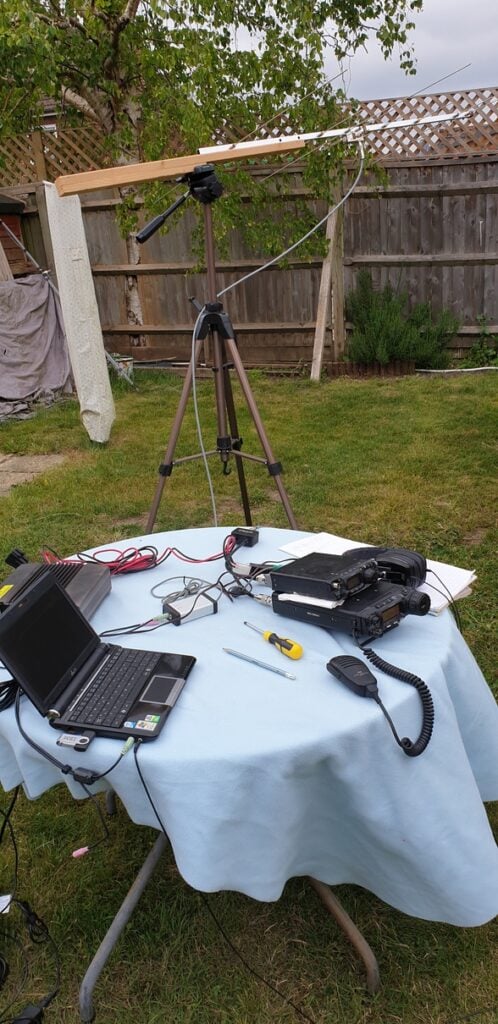
MØNKC’s portable setup (Photo: Kris Conkas)
Kristijan Conkas, MØNKC, Earns AMSAT Rover Award #94
The AMSAT Rover Award program is on a roll. Just one week after award #93 went to Brazil, Bruce Paige, KK5DO, AMSAT Director of Contests and Awards, has announced that AMSAT Rover Award #94 has been earned by Kristijan Conkas, MØNKC, of the United Kingdom – back-to-back awards spanning two continents, and a reminder that roving is a worldwide pursuit.
A satellite enthusiast, Linux user, and self-described occasional maker, Kristijan is also known to many in the hobby as the author of NKCCluster, a mobile DX cluster client for operators on the go – so it is fitting that his award celebrates operating on the go, too.
The Rover Award recognizes operators who take their satellite stations on the road, and is granted upon accumulating 25 points from grid squares activated outside the rover’s home grid: one point per grid via a single-channel FM transponder, two points via a linear SSB/CW transponder, and three points via a digital transponder, with a bonus point for each grid activated in a state, province, or DX entity other than the rover’s own. Five-point bonuses reward publicizing an activation at least 24 hours in advance – by tagging @amsat or #amsat on social media, or via the AMSAT-BB – and posting photos of the operation afterward, while activating a grid while maritime mobile is worth ten points and a /MM endorsement on the certificate. For European rovers, national borders come thick and fast, and every outing hands fresh grids to chasers across the continent and, on the right pass, well beyond.
In announcing the award, Paige offered his congratulations along with his customary encouragement to rovers everywhere to keep on rovin’.
Complete rules and application details for the AMSAT Rover Award are available at https://www.amsat.org/amsat-
Congratulations, Kristijan!
[ANS thanks Bruce Paige, KK5DO, AMSAT Director of Contests and Awards, for the above information]
LIMITED TIME OFFER!!!
AMSAT is offering a limited-time promotion for new and renewing members
that includes a free digital copy of Getting Started with Amateur Satellites.
The promotion is being offered as AMSAT begins the 2026 membership year.
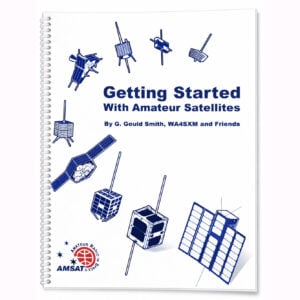
Anyone who joins or renews their AMSAT membership during the promotional period
will receive a download link for the latest edition of
Getting Started with Amateur Satellites in their membership confirmation email.
JOIN TODAY at https://launch.amsat.org/ (Remember! Students join for FREE!)
ARISS Receives Challenger-7 Recognition
ARISS (Amateur Radio on the International Space Station) is honored to receive the prestigious Challenger-7 Recognition, a national honor celebrating organizations whose work reflects the spirit, vision, and values of the Challenger 51-L crew.

“This recognition is a tribute, not a competition,” says the Challenger Center. “It honors those who embody the Challenger crew’s values of exploration, learning, and inspiration, while also celebrating trailblazing organizations and programs that will carry this mission forward into the future.”
Nominations from nonprofit national STEM programs that have a national-level impact on STEM learning and other STEM advocates were submitted by members of the broader Challenger Center community, with honorees selected by an appointed committee. The recognitions are part of the Challenger Center’s 40th Anniversary celebrations.
“The ARISS team is humbled to receive the Challenger-7 recognition,” said ARISS-USA Executive Director and ARISS International Chair, Frank Bauer, KA3HDO. “We thank the Challenger Center community for this honor as well as treasure our long-standing partnership with them. The outcomes of our ARISS on-board astronaut experiences emulate the exploration and education spirit of the Challenger crew—to engage and educate our next generation of explorers in STEM while giving them the tools and inspiration to prepare them for future STEM careers.”
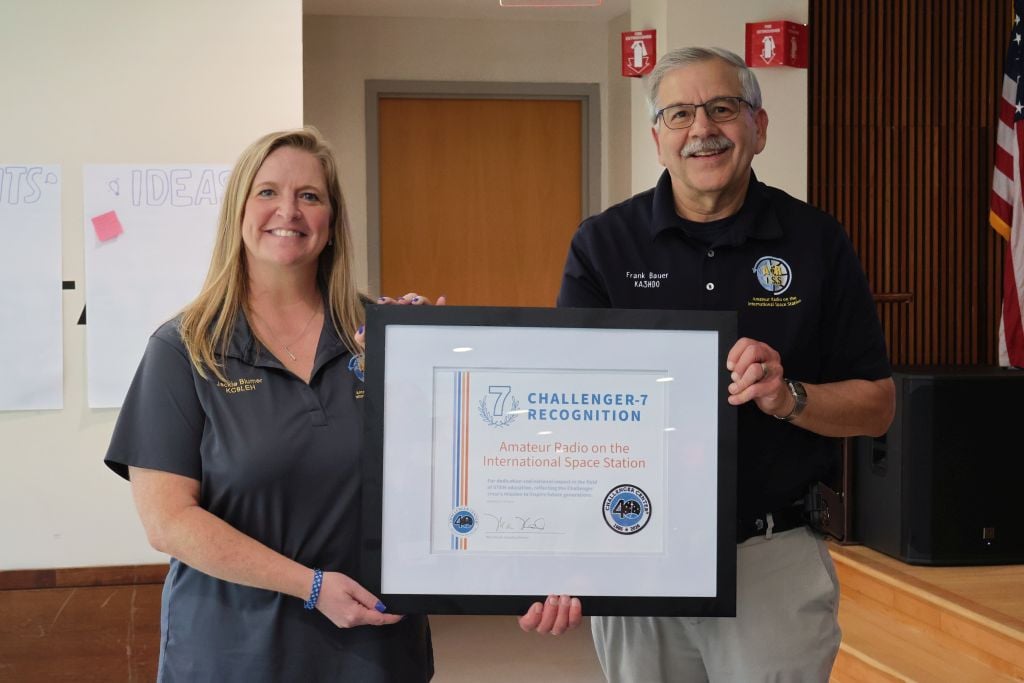
Jackie Blumer, KC9LEH, ARISS-USA Associate Director, and Frank Bauer, KA3HDO, ARISS-USA Executive Director and ARISS International Chair,
hold the Challenger-7 Recognition certificate. (Credit, ARISS)
Other awardees this year include AIAA, American Rocketry Challenge, and Janet’s Planet.
Amateur Radio on the International Space Station (ARISS) is a cooperative venture of international amateur radio societies and the space agencies that support the ISS. In the United States, sponsors are the American Radio Relay League (ARRL), Amateur Radio Digital Communications (ARDC), Radio Amateur Satellite Corporation (AMSAT), NASA’s Space Communications and Navigation program (SCaN) and the ISS National Lab—Space Station Explorers. The primary goal of ARISS is to promote exploration of science, technology, engineering, the arts, and mathematics topics. ARISS does this by organizing scheduled contacts via amateur radio between crew members aboard the ISS and students. Before and during these radio contacts, students, educators, parents, and communities take part in hands-on learning activities tied to space, space technologies, and amateur radio. For more information, see http://www.ariss.org.
[ANS thanks Dave Jordan, AA4KN, ARISS PR Team, for the above information.]
AMSAT Remove Before Flight Key Tags Now Available
Yes, These are the Real Thing!
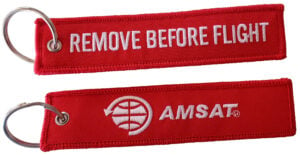
Your $20 Donation Goes to Help Fly a FoxPlus Satellite
Includes First Class Postage (Sorry – U.S. Addresses Only)
Order Today at https://www.amsat.org/product/amsat-remove-before-flight-keychain
Norwegian Amateurs Experiment with Satellite Voice Control
Amateur radio operators from the Oslo Group of the Norwegian Radio Relay League (NRRL), using an experimental satellite and homebrew ham equipment, successfully reprogrammed the satellite to respond to voice control.
On July 27, 2026, a verbal command, sent via a 23-centimeter signal from the roof of the Oslo Group’s club station, was received, transcribed, and executed on board the OPS-SAT PRETTY satellite. The satellite then activated the game DOOM in response, and downloaded images of the game as confirmation. Voice control of a satellite was a reality, performed by radio amateurs in the Oslo Group!
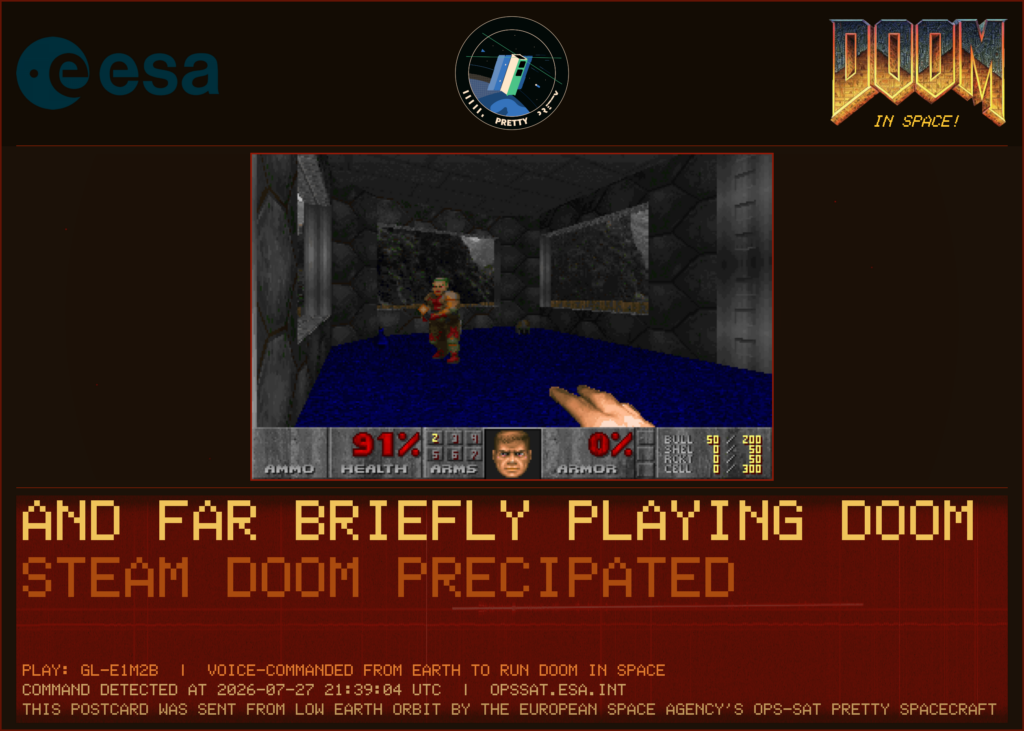
The satellite composed this postcard on board and downlinked it to the ground after launching DOOM on the evening pass, the one commanded by a live human voice. An operator spoke into the microphone: “LIMA ALFA FOUR OSCAR, PRETTY PLAY DOOM DOOM DOOM, PRETTY PLAY DOOM DOOM DOOM.” That is the club call sign for legal identification, then the command twice, with DOOM repeated each time. Printed across the postcard is what the onboard speech-to-text made of it. The model is small enough to fit the satellite’s limited computer, so the transcription is rough, but the repeated DOOM trigger word still got through. (Image credit: tanagraspace.com)
The spacecraft is operated by Graz University of Technology in Austria and the experimentation is coordinated by the European Space Agency’s European Space Operations Centre (ESOC) in Darmstadt, Germany.
The OPS-SAT PRETTY is a 3U CubeSat (10 x 10 x 34 cm) with a reconfigurable processing platform that allows a wide range of custom software and firmware experiments, and is tightly connected to an onboard software defined receiver (SDR).
Everyone involved in the experiment agreed that amateur radio infrastructure can support technically meaningful spacecraft experiments when RF design, signal processing, craft software, and disciplined operations are treated as one system.
“For this satellite, the Satellite Experimental Processing Platform (SEPP) where the experiments run, is connected to an SDR, receive only,” said team member Eskil Hadland, LB6AJ. “As far as I know, the TMTC (Telemetry and Telecommand) is outside of the SEPP. So I do not believe this satellite will be able to talk back to us. Unlike other satellite operations for amateurs, where you can listen when you are aiming directly, we have been shouting towards the stars, and gotten data back hours later.”
The Project Page at partner Tanagra Space tells the whole story from end to end, with the postcard the satellite composed on board and the gameplay sequence it captured as it flew: https://tanagraspace.com/opssat-pretty-doomed/.
Thanks to the Oslo Group of the Norwegian Radio Relay League for taking time to talk with the ARRL Letter about their accomplishments.
[ANS thanks the ARRL Letter for the above information.]
Voting Still in Progress for Board of Directors
AMSAT members are reminded that voting remains open in the 2026 AMSAT Board of Directors election. Three seats on the Board are being filled this year. The three candidates receiving the highest number of votes will be elected to the Board, while the candidates receiving the next highest vote totals will be named First Alternate and Second Alternate, respectively.
Voting opened on July 15, 2026, and will conclude on September 15, 2026. Election results will be announced no later than September 30, 2026.
Current AMSAT members may review the official candidate statements and cast their ballots on the AMSAT 2026 Board of Directors Election website at https://launch.amsat.org/2026-BoD-Election
Members are encouraged to take a few minutes to review the candidates’ statements and cast their ballots. Your participation helps shape the future of AMSAT and its mission to Keep Amateur Radio in Space.
[ANS thanks Douglas Tabor, N6UA, AMSAT Secretary, for the above information]
Satellite DXpedition To The Bahamas This Week
Philippe, EA4NF, will be active on FM LEO satellites from the BAHAMAS (Providence Island & Discovery Island) under the callsign C6AUB from August 19 to 23, 2026.
(DXCC : C6 BAHAMAS / GRID : FL15 / IOTA : NA-001)
He will be operating in full-duplex mode using a portable transceiver equipped with his standard Arrow antenna and his whip antenna.
 August 19-23, 2026
FM LEO SATELLITES
QSL via LoTW as C6AUB
Keep an eye on Philippe’s Twitter feed for further updates : @EA4NF_SAT
[ANS thanks Philippe Chateau, EA4NF, for the above information.]
Changes to AMSAT TLE Distribution for August 14, 2026
Two Line Elements or TLEs, often referred to as Keplerian elements or keps in the amateur community, are the inputs to the SGP4 standard mathematical model of spacecraft orbits used by most amateur tracking programs. Weekly updates are completely adequate for most amateur satellites. TLE bulletin files are updated daily in the first hour of the UTC day. New bulletin files will be posted immediately after reliable elements become available for new amateur satellites. More information may be found at https://www.amsat.org/keplerian-elements-resources/.
The following satellites have been added to this week’s AMSAT TLE distribution:
CO-128 (MARMOTSat) NORAD Cat ID 69872
General Perturbations Data Support
AMSAT is pleased to announce that modern forms of what are called General Perturbations data are being disseminated via modern formats including JSON, XML and KVN at https://newark192.amsat.org/gpdata/current/. The reason this change is being made is that we are running out of 5-digit catalog numbers and the TLE format is not viable for satellites launched after July of this year. See https://celestrak.org/NORAD/documentation/gp-data-formats.php for details.
These data are presently considered in beta test for the next two months while hosted on the test server newark192.amsat.org, and we are very open to community feedback at webmaster at amsat.org. Testers may experience outages and errors while we make improvements. We intend to put this into production on our main web server in July as we expect that satellites launched after this summer will require one of the new formats to accommodate longer object numbers. AMSAT will continue to publish TLE bulletins for satellites launched before July 2026 indefinitely.
[ANS thanks Joe Fitzgerald, KM1P, AMSAT Orbital Elements Manager, for the above information.]
Buying from DX Engineering?
Add AMSAT’s Getting Started With Amateur Satellites to your order.
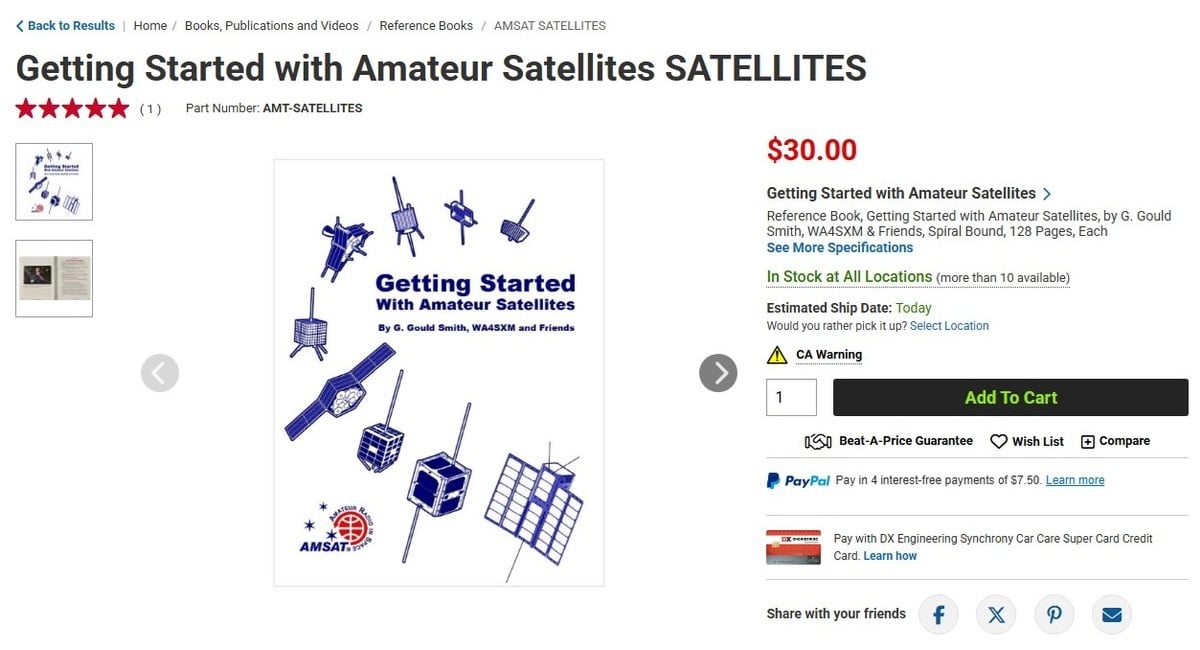 Available for $30 from DX Engineering (free shipping on most orders over $99)
https://www.dxengineering.com/parts/amt-satellites
ARISS News
Amateurs and others around the world may listen in on contacts between amateurs operating in schools and allowing students to interact with astronauts and cosmonauts aboard the International Space Station. The downlink frequency on which to listen is 145.800 MHz worldwide.
Recently Completed
Challenger Learning Center National Conference, Framingham, MA, telebridge via VK4ISS
The ISS callsign was scheduled to be NA1SS
The scheduled crewmember was Sophie Adenot KJ5LTN
The ARISS mentor was KA3HDO
Contact was successful: Wed 2026-08-12 16:31:39 UTC 58 degrees max. elevation
Congratulations to the Challenger Learning Center National Conference students, Sophie, mentor KA3HDO, and telebridge VK4ISS!
Australian Air League (AAL), Adelaide, South Australia, Australia, telebridge via IK1SLD
The ISS callsign was scheduled to be OR4ISS
The scheduled crewmember was Jack Hathaway KJ5NIV
The ARISS mentor was VK4ISS
Contact was successful: Fri 2026-08-14 10:56:13 UTC 76 degrees max. elevation
Live Stream was at http://www.ariotti.com/ starting about 10-15 min before AOS
Congratulations to the Australian Air League, Jack, mentor VK4ISS, and telebridge IK1SLD!
Many times, a school makes a last-minute decision to do a Livestream or runs into a last-minute glitch requiring a change of the URL, but we at ARISS may not get the URL in time for publication. You can always check https://live.ariss.org/ to see if a school is Livestreaming.
As always, if there is an EVA, a docking, or an undocking; the ARISS radios are turned off as part of the safety protocol:
Mon 2026-08-17 19:05 UTC radio power down
Tue 2026-08-18 U.S. Orbital Segment (USOS) EVA (spacewalk by flight engineers Anil Menon and Sophie Adenot, KJ5LTN)
Wed 2026-08-19 10:45 UTC radio power up
The crossband repeater remains configured in the Columbus Module (145.990 MHz up {PL 67} & 437.800 MHz down). If a crewmember decides to pick up the microphone and turn up the volume, you may hear them on the air—so keep listening, as you never know when activity might occur.
Kenwood D710GA in the Zvezda Service Module – Call sign RSØISS. Please note we’re still in the process of troubleshooting and testing this radio. APRS is currently active on 437.825 MHz. Feel free to check out status reports at https://ariss-usa.org/ARISS_APRS/.
Ham TV is currently transmitting a test signal at 2395.00 MHz.
Note, all times are approximate. It is recommended that you do your own orbital prediction or start listening about 10 minutes before the listed time.
The latest information on the operation mode can be found at https://www.ariss.org/current-status-of-iss-stations.html
The latest list of frequencies in use can be found at https://www.ariss.org/contact-the-iss.html
[ANS thanks Charlie Sufana, AJ9N, one of the ARISS operation team mentors for the above information]
Want to fly the colors on your own grid expedition? Get an AMSAT car flag and other neat stuff from our Zazzle store!
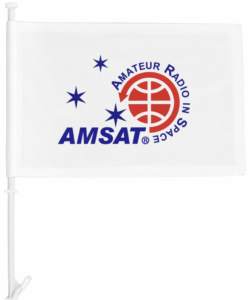
25% of the purchase price of each product goes towards Keeping Amateur Radio in Space
AMSAT Ambassador Activities
AMSAT Ambassadors provide presentations, demonstrate communicating through amateur satellites, and host information tables at club meetings, hamfests, conventions, maker faires, and other events.
August 28-30, 2026
Wyoming HamCon, ARRL Rocky Mountain Division Convention
Best Western (Downtown)
123 W. E St.
Casper, WY 82601
http://wyohamcon.org/
K0NMR
October 8-11, 2026
44th AMSAT Space Symposium and Annual Membership Meeting
Wyndham Jacksonville Hotel & Conference Center
14670 Duval Road
Jacksonville, FL 32218
https://www.amsat.org/2026-amsat-symposium/
Registration is Now Open!
Interested in becoming an AMSAT Ambassador? AMSAT Ambassadors provide presentations, demonstrate communicating through amateur satellites, and host information tables at club meetings, hamfests, conventions, maker faires, and other events. For more information go to: https://www.amsat.org/ambassador/
[ANS thanks Bo Lowrey, W4FCL, Director – AMSAT Ambassador Program, for the above information]
Satellite Shorts from All Over
+ As many may have noticed, UNNE-1B (HADES-E2) was not included in the TR-17 mission. It is now expected to fly on the SpaceX Transporter-18 mission in October. UNNE-1B is a 1.5P PocketQube that uses the same satellite hardware and software as the original UNNE-1 but will be launched on a SpaceX mission instead of the originally planned RFA launch due to delays to the latter. Like UNNE-1, the satellite will provide licensed radio amateurs worldwide with an FM voice transponder and support for FSK-based digital modes. It will also transmit telemetry reporting the satellite’s status, a CW beacon, and a prerecorded CODEC2 digital voice message. All these functions are implemented using an SDR-based FM/FSK repeater. The FM/FSK repeater will be continuously available and activated by carrier squelch, with no access tone required. As an educational payload, students from Universidad Nebrija (Spain) are developing a small “guessing game.” The satellite will transmit one clue per week as part of its telemetry, and radio amateurs will have to collect all the clues to solve the mystery. Details of the game will be published on the AMSAT-EA and Universidad Nebrija websites, and all transmitted data will be publicly available. (ANS thanks Félix Páez, EA4GQS, president of AMSAT EA, for the information.)
+ HamClock version 4.28 adds direct integration with Hams.at to provide satellite operators with personalized information about upcoming satellite activations. By configuring a Hams.at API key in HamClock, users can receive upcoming pass alerts and additional details tailored to their station and location. The integration includes satellite co-visibility calculations, allowing an operator to determine when both their station and a rover or other station will have the same satellite in view. HamClock can also display probability or match information from Hams.at when evaluating opportunities to contact a rover activating a particular grid square. Other satellite features in HamClock include Doppler tracking, satellite group scheduling for planning passes, and a Sky View mode that displays satellites relative to the stars. Additional information about HamClock, including the Open HamClock Backend project, is available at https://ohb.works/. (ANS thanks Brian Wilkins, KO4AQF, for the above information.)
+ While expanding InstantTrack to support the modern GP formats would require the source code, AMSAT Executive VP Paul Stoetzer, N8HM, asked ChatGPT to develop a patch that allows InstantTrack 1.55 to use Alpha5 TLEs. Running the patch utilities requires a DOS install with debug.exe. The patch is available at https://github.com/prstoetzer/InstantTrack-Alpha5-Patch. InstantTrack can be downloaded at https://www.mustbeart.com/software/it/getit.html. (ANS thanks Paul Stoetzer, N8HM, AMSAT Executive VP, for the above information.)
+ The Federal Communications Commission voted on August 6 to advance a proposal to enable satellites to beam data to consumer and IoT devices already equipped with Wi-Fi and Bluetooth chips. This includes harnessing the 2.4 GHz and 5 GHz bands commonly used by Wi-Fi routers. The Association for Broadband Without Boundaries, which represents wireless internet service providers, has been urging the FCC to revise the proposal, which tentatively concludes that opening up the spectrum “will not present an increased harmful interference risk to authorized services.” ARRL, the National Association for Amateur Radio, is also raising concerns, telling the FCC, “Amateur radio terrestrial operations would be uniquely impacted by any interference resulting from adoption of the proposals.” In addition, Intel and Cisco chimed in, urging the FCC to only seek proposals that won’t disrupt access to existing consumer devices and equipment. Nevertheless, the Commission voted unanimously to continue exploring the issue. (ANS thanks PC Magazine and fcc.gov for the above information. Read the full article at https://www.pcmag.com/news/fcc-plan-to-share-wi-fi-bands-with-satellites-raises-interference-alarms.)
+ The Department of Transportation is proposing to exempt commercial space launch licensing from many environmental regulations, a move praised by industry but criticized by environmental groups. The department announced July 28 its intent to file a proposed rule for public comment that would exempt Federal Aviation Administration licenses for commercial launches and reentries, as well as launch sites, from 13 federal laws and associated regulations. Environmental groups, though, strongly oppose the proposal, noting it would waive the National Environmental Policy Act, the Endangered Species Act, Clean Water Act and Clean Air Act. (ANS thanks SpaceNews for the above information. Read the full article at https://spacenews.com/proposed-rule-would-exempt-commercial-launch-licensing-from-environmental-regulations/?utm_source=ActiveCampaign&utm_medium=email&utm_content=Top%20Stories%3A%20Transportation%20Department%20proposes%20waiving%20environmental%20regulations%20for%20launches&utm_campaign=SNTW%20-%202026-07-31.)
Join AMSAT today at https://launch.amsat.org/
In addition to regular membership, AMSAT offers membership to:
- Societies (recognized groups, clubs or organization).
- Students are eligible for FREE membership up to age 25.
- Memberships are available for annual and lifetime terms.
Contact info [at] amsat.org for additional membership information.
73 and remember to help Keep Amateur Radio in Space!
This week’s ANS Editor,
Mark Johns, KØJM
mjohns [at] amsat.org
ANS is a service of AMSAT, the Radio Amateur Satellite Corporation, 712 H Street NE, Suite 1653, Washington, DC 20002. AMSAT is a registered trademark of the Radio Amateur Satellite Corporation.



![[Valid RSS]](https://www.iz4wnp.it/wp-content/uploads/2026/04/valid-rss-rogers.png "Validate my RSS feed")