
August 30,2026
In this edition:
- ARISS Proposal Window Open Now through September 30, 2026
- AMSAT Board of Directors Voting Ends Soon
- European Astro Pi Challenge 2026/27 Registration Opens September 14, 2026
- Call for Presentations: 44th AMSAT Space Symposium
- How Cell-Phone Technology Revolutionized Amateur Satellites
- Changes to AMSAT TLE Distribution for August 28, 2026
- SpaceX Plans Massive New Launch Facility in Louisiana
- Ambassador Events
- ARISS News
- Satellite Shorts from All Over
The AMSAT(R) News Service bulletins are a free, weekly news and information service of AMSAT, the Radio Amateur Satellite Corporation. ANS publishes news related to Amateur Radio in Space including reports on the activities of a worldwide group of Amateur Radio operators who share an active interest in designing, building, launching and communicating through analog and digital Amateur Radio satellites.
The news feed on http://www.amsat.org publishes news of Amateur Radio in Space as soon as our volunteers can post it.
Please send any amateur satellite news or reports to: ans-editor [at] amsat [dot] org .
Sign up for free e-mail delivery of the AMSAT News Service Bulletins via the ANS List. Join this list at: https://mailman.amsat.org/postorius/lists/ans.amsat.org/
ARISS Proposal Window Open Now through September 30, 2026
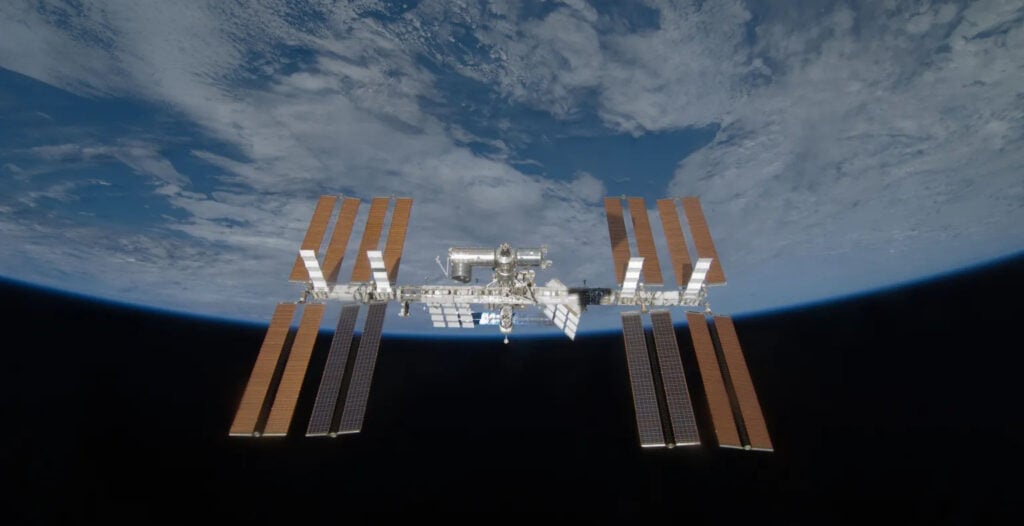
The Amateur Radio on the International Space Station (ARISS) Program is seeking formal and informal education institutions and organizations, individually or working together, to host an Amateur Radio contact with a crew member on board the ISS. ARISS anticipates that the contact would be held between January 1, 2027 – June 30, 2027. To maximize these radio contact opportunities, ARISS is looking for organizations that will draw large numbers of participants and integrate the contact into a well-developed education plan.
The Opportunity
Crew members aboard the International Space Station will participate in scheduled Amateur Radio contacts. These radio contacts are approximately 10 minutes in length and allow students to interact with the astronauts through a question-and-answer session.
An ARISS contact is a voice-only communication opportunity via Amateur Radio between astronauts and cosmonauts aboard the space station and classrooms and communities. ARISS contacts afford education audiences the opportunity to learn firsthand from astronauts what it is like to live and work in space and to learn about space research conducted on the ISS.
Students also will have an opportunity to learn about satellite communication, wireless technology, and radio science. Because of the nature of human spaceflight and the complexity of scheduling activities aboard the ISS, organizations must demonstrate flexibility to accommodate changes in dates and times of the radio contact.
Proposals are due to ARISS by September 30, 2026, at 11:59 PM Pacific Time. To help you get started, an informative video is available at youtube.com/arisslive. Detailed guidelines and expectations can be found at ariss.org, and the proposal form is available via the online ARISS Contact Application.
[ANS thanks Dave Jordan, AA4KN, ARISS PR for the above information.]
The 2026 President’s Club Coin is Now Here!
Help Support GOLF and FoxPlus.
Annual memberships start at only $120
Join the AMSAT President’s Club today and help
Keep Amateur Radio in Space!
https://www.amsat.org/join-the-amsat-presidents-club/
AMSAT Board of Directors Voting Ends Soon
AMSAT members who have not yet voted for the 2026 AMSAT Board of Directors election should note that voting ends on September 15, 2026.. Three seats on the Board are being filled this year. The three candidates receiving the highest number of votes will be elected to the Board, while the candidates receiving the next highest vote totals will be named First Alternate and Second Alternate, respectively.
Current AMSAT members may review the official candidate statements and cast their ballots on the AMSAT 2026 Board of Directors Election website at https://launch.amsat.org/2026-BoD-Election .
Members are encouraged to take a few minutes to review the candidates’ statements and cast their ballots. Your participation helps shape the future of AMSAT and its mission to Keep Amateur Radio in Space.
Election results will be announced no later than September 30, 2026.
Current AMSAT members may review the official candidate statements and cast their ballots on the AMSAT 2026 Board of Directors Election website at https://launch.amsat.org/2026-BoD-Election
Members are encouraged to take a few minutes to review the candidates’ statements and cast their ballots. Your participation helps shape the future of AMSAT and its mission to Keep Amateur Radio in Space.
[ANS thanks Douglas Tabor, N6UA, AMSAT Secretary, for the above information]
European Astro Pi Challenge 2026/27 Registration Opens September 14, 2026
Mission Space Lab invites young people to run their own code on the International Space Station (ISS), giving them an opportunity to conduct science in space. Teams write a Python program that captures sensor data from Raspberry Pi computers on board the ISS to use in space science projects.
What is Mission Space Lab?
Working in teams, young people will write a program to collect data from the Astro Pi computer’s sensors or camera, logging the results to a file. By analyzing atmospheric readings or capturing images of Earth from 400km above, they can investigate everything from life on our planet to the mechanics of orbital space flight.
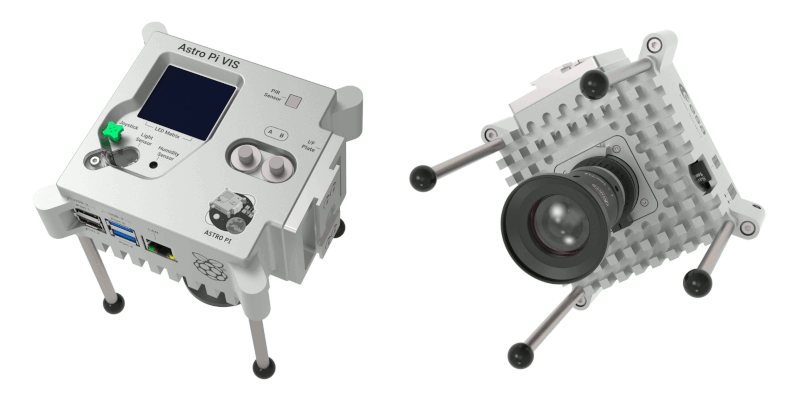
What can a team investigate? Teams can design an entirely original space science project or follow one of our ready-made project guides to get started.
Every eligible program is given a 10-minute slot on the ISS. Once the mission is complete, successful teams will receive official certificates showing the exact time and geo-coordinates when their code ran. They’ll also receive their own data and image sets to download, keep, and analyze!
Who Can Take Part?
Mission Space Lab is designed for young people who have some basic coding experience. We recommend this mission for young people aged between 12 and 19. They will use their knowledge to investigate real space science using a program they write themselves. Project guides are available to support teams in creating their program.
Why take part?
Participating in Astro Pi Mission Space Lab empowers young people to learn about life on the ISS, discover how to gather and utilize data in space, and master the art of creating and troubleshooting a computer program. Best of all, teams have the opportunity to capture unique Earth observation images and space data to keep forever!
Registration is open from Monday 14 September 2026 to Monday 22 February 2027, 12:00 CET.
Astro Pi is an ESA Education project run in collaboration with the Raspberry Pi Foundation.
Read the full article at https://astro-pi.org/mission-space-lab .
[ANS thanks raspberrypi.org for the above information.]
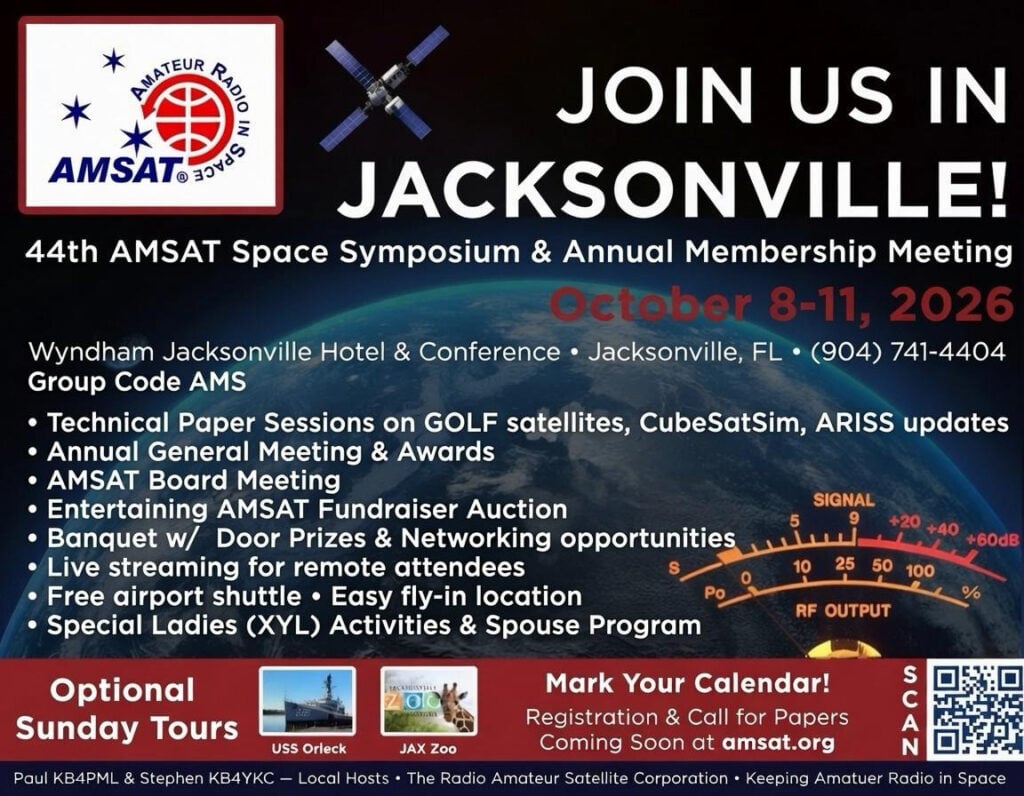
Call for Presentations: 44th AMSAT Space Symposium
Do you have a story to tell the amateur satellite community? AMSAT invites proposals for presentations at the 44th AMSAT Space Symposium and Annual General Meeting, to be held October 8-11, 2026, at the Wyndham Jacksonville Hotel & Conference Center in Jacksonville, Florida.
Presentations are welcome on any topic of interest to the amateur satellite community. Suggested subjects include current and future satellite projects such as the GOLF program and the CubeSatSim; ARISS and human spaceflight activities; ground station, antenna, and portable station design; software-defined radio; telemetry collection and analysis; satellite operating techniques and achievements; educational programs and youth outreach; and reports from DXpeditions and roving operations. Whether you have built it, flown it, coded it, taught it, or worked it through a satellite, your fellow attendees want to hear about it.
Prospective presenters should email a tentative presentation title and a brief abstract to symposium [at] amsat.org as soon as possible. Presentation time slots are limited, so early submissions are encouraged, and information on submitting final papers and presentation materials for inclusion in the Symposium Proceedings will be provided to presenters. A digital copy of the Proceedings is included with every Symposium registration.
Symposium presentations begin Friday afternoon, October 9, and continue through Saturday, October 10, leading into the Annual General Meeting. Live streaming will bring the sessions to members unable to attend in person – all the more reason to make sure your work is on the program.
Registration for the Symposium is now open at https://launch.amsat.org/event-6789663, with early bird pricing available through September 8. Hotel reservations at the Wyndham Jacksonville – the property formerly known as the Crowne Plaza Jacksonville Airport/I-95 – may be made through the booking link at https://www.amsat.org/2026-amsat-symposium/ or by phone at 1-800-227-6963 using group code AMS.
[ANS thanks the AMSAT Symposium Team for the above information.]
Need new satellite antennas? Purchase M2 LEO-Packs from the AMSAT Store.
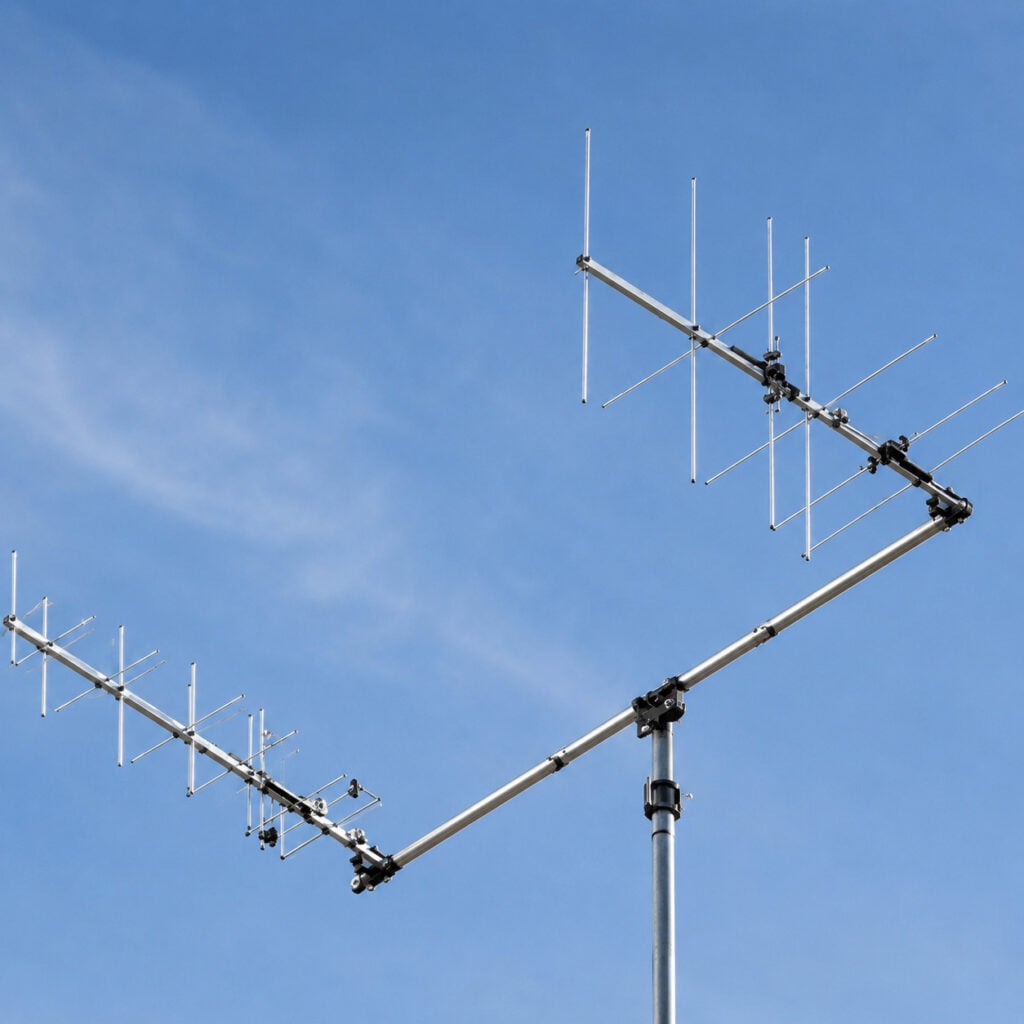
When you purchase through AMSAT, a portion of the proceeds goes towards Keeping Amateur Radio in Space.
https://amsat.org/product-category/hardware/
How Cell-Phone Technology Revolutionized Amateur Satellites
Cell-phone technology has played a major role in the development of today’s small satellites and CubeSats. Smartphones require components that are small, lightweight, inexpensive and power-efficient—the same qualities satellite designers need.
Because billions of phones and other portable devices are manufactured, sophisticated electronic components that once were extremely expensive are now available as commercial off-the-shelf (COTS) products.
Smartphone-class processors give small satellites substantial computing power for controlling experiments, processing images and compressing data. Miniature CMOS cameras can provide Earth imagery, while MEMS accelerometers and gyroscopes help determine a spacecraft’s movement and orientation. Compact GPS receivers provide position and timing information, and inexpensive flash memory can store large quantities of images and scientific data for later transmission.
Advances in compact radio-frequency electronics and digital signal processing have also allowed sophisticated communications systems to fit inside CubeSats. Meanwhile, improvements in lithium-ion batteries provide lightweight rechargeable energy storage.
Traditional spacecraft often use expensive radiation-hardened electronics designed specifically for space. CubeSat builders can sometimes substitute commercial components, reducing costs dramatically while using shielding, redundancy and software to compensate for increased risk.
NASA demonstrated the potential of consumer electronics with its PhoneSat program. Beginning in 2013, PhoneSat spacecraft used Android smartphones as important parts of their onboard systems, taking advantage of their processors, cameras and sensors.
The greatest contribution of the smartphone industry may therefore be the philosophy of packing tremendous capability into very little space while consuming minimal power.
For amateur-radio and university satellite builders, this has been especially important. A modern CubeSat can combine a computer, radio, GPS receiver, cameras, sensors and telemetry system in a spacecraft small enough to hold in your hands.
[This article was compiled from ChatGPT.]
Changes to AMSAT TLE Distribution for August 28, 2026
Two Line Elements or TLEs, often referred to as Keplerian elements or keps in the amateur community, are the inputs to the SGP4 standard mathematical model of spacecraft orbits used by most amateur tracking programs. Weekly updates are completely adequate for most amateur satellites. TLE bulletin files are updated daily in the first hour of the UTC day. New bulletin files will be posted immediately after reliable elements become available for new amateur satellites. More information may be found at https://www.amsat.org/keplerian-elements-resources/.
This week there are no additions or deletions to the AMSAT TLE distribution.
[ANS thanks Joe Fitzgerald, KM1P, AMSAT Orbital Elements Manager for the above information.]
SpaceX Plans Massive New Launch Facility in Louisiana
SpaceX has announced plans to build what could become the world’s largest commercial space launch facility along the Louisiana Gulf Coast. The proposed $100 billion development, known as Starbase Louisiana, would be located on approximately 125,000 acres near Pecan Island in Vermilion Parish.
The new spaceport would become SpaceX’s fourth and largest U.S. launch site and would primarily support the company’s enormous Starship rocket. At full development, plans call for five launch complexes, each containing two launch pads and associated propellant facilities. The site would also include rocket processing facilities, power generation, methane propellant production, employee housing and deep-water shipping capabilities.

SpaceX ultimately envisions launching Starships from Louisiana thousands of times each year. Starship is being developed as a fully reusable transportation system capable of carrying satellites, cargo and people into Earth orbit and eventually to the Moon and Mars. The Louisiana location provides several advantages, including extensive undeveloped land, access to Gulf shipping routes and abundant natural gas resources that could support power generation and methane production.
Louisiana officials estimate that the project will create about 3,000 direct jobs during its first decade, with an average annual salary of approximately $92,600. Another 8,100 indirect jobs could be generated throughout the Acadiana region. Construction is expected to begin in 2027, with the first launch possible as early as 2029.
The ambitious project will also face environmental scrutiny. The proposed site contains sensitive coastal wetlands and important migratory-bird habitat. Environmental organizations have called for careful permitting and public review. SpaceX says much of the property will remain undeveloped and that it intends to work with government agencies on marsh restoration, shoreline protection and wildlife conservation.
If completed as planned, Starbase Louisiana could transform the state into one of the most important centers of commercial spaceflight in the world.
[This article was compiled from ChatGPT.]
ARISS NEWS
Amateurs and others around the world may listen in on contacts between amateurs operating in schools and allowing students to interact with astronauts and cosmonauts aboard the International Space Station. The downlink frequency on which to listen is 145.800 MHz worldwide.

- Contacts
No contacts scheduled at this time. - Radio Power Ups and Downs
COL=Columbus module
SM=Service Module
Monday, August 31, 2026 09:25 UTC – COL radio power down
Monday, August 31, 2026 19:30 UTC – SM radio power down
Tuesday, September 1, 2026 – USOS EVA
- Egress: 12:35-13:05 UTC
- Ingress 18:35-19:05 UTC
Wednesday, September 2,2026 11:55 UTC – COL radio power up
Wednesday, September 2, 2026 12:00 UTC – SM radio power up
The crossband repeater continues to be active (145.990 MHz up {PL 67} & 437.800 MHz down). If any crewmember is so inclined, all they have to do is pick up the microphone, raise the volume up, and talk on the crossband repeater. So give a listen, you just never know.
As always, if there is an EVA, a docking, or an undocking; the ARISS radios are turned off as part of the safety protocol.
Note, all times are approximate. It is recommended that you do your own orbital prediction or start listening about 10 minutes before the listed time.
The latest information on the operation mode can be found at https://www.ariss.org/current-status-of-iss-stations.html
The latest list of frequencies in use can be found at https://www.ariss.org/contact-the-iss.html
[ANS thanks Charlie Sufana, AJ9N, one of the ARISS operation team mentors for the above information.]
LIMITED TIME OFFER!
AMSAT is offering a limited-time promotion for new and renewing members that includes a free digital copy of Getting Started with Amateur Satellites. The promotion is being offered as AMSAT begins the 2026 membership year.
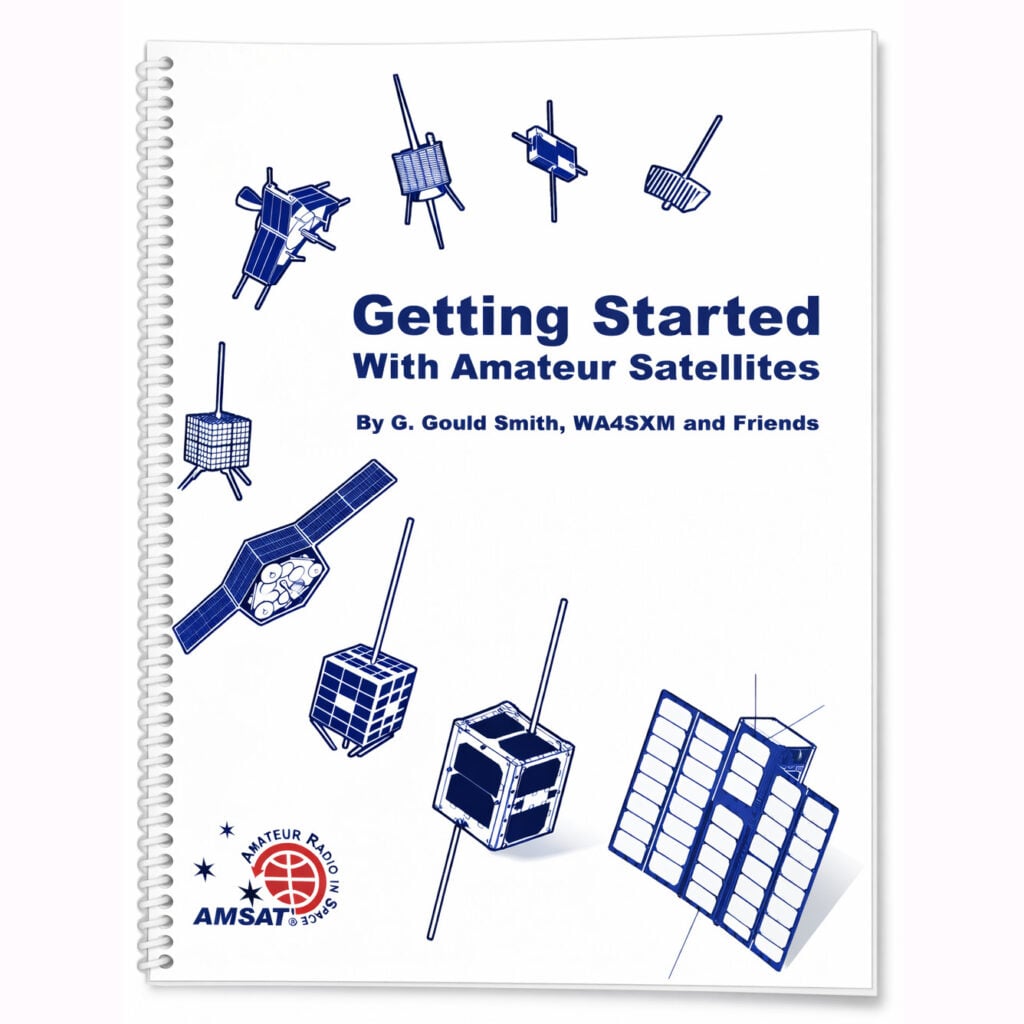
Anyone who joins or renews their AMSAT membership during the promotional period will receive a download link for the latest edition of Getting Started with Amateur Satellites in their membership confirmation email.
JOIN TODAY at https://launch.amsat.org/
(Remember! Students join for FREE!)
AMSAT Ambassador Activities
AMSAT Ambassadors provide presentations, demonstrate communicating through amateur satellites, and host information tables at club meetings, hamfests, conventions, maker faires, and other events.
September 12, 2026
Greater Louisville Hamfest
Paroquet Springs Conference Centre
395 Paroquet Springs Drive
Shepherdsville, KY 40165-6007
https://louisvillehamfest.wixsite.com/louisvillehamfest
W4FCL
October 3, 2026
Bored Net µExpo and ARRL Santa Barbara Section Convention
Cal State University Channel Islands
1 University Drive
Camarillo, CA 93010
https://www.theborednet.net/index.php/2026/06/22/2026-microexpo-is-on/
K6KH
October 3, 2026
Tucson Area Autumn Hamfest
Radio Society of Tucson
Immanuel Presbyterian Church
9252 E. 22nd St.
Tucson, AZ
https://k7rst.club
N1UW
October 8-11, 2026
44th AMSAT Space Symposium and Annual Membership Meeting
Wyndham Jacksonville Hotel and Conference Center
14670 Duval Road
Jacksonville, FL 32218
https://www.amsat.org/2026-amsat-symposium/
November 14, 2026
Southern Arizona Fall Hamfest
Oro Valley Amateur Radio Club
Marana Middle School
11285 W. Grier Rd.
Marana AZ
www.tucsonhamradio.org/hamfest
N1UW
[ANS thanks Bo Lowrey, W4FCL, Director – AMSAT Ambassador Program, for the above information.]
Satellite Shorts From All Over
- VibeSDR Jr is a standalone Apple Watch software-defined radio client. It runs directly on the watch and does not require an iPhone. It can connect to VibeServer and many compatible remote SDR servers. Its developer, Stuart, has launched a live demonstration at demo.vibesdr.net featuring RTL-SDR V4C, SDRplay RSP1B, and AirSpy HF receivers connected to an AirSpy YouLoop and LNA setup. Users can test VibeSDR’s DSP functions, built-in decoders, and advanced RDS tools on the site. VibeSDR Jr is available for download at the Apple App store. An Android version is also awaiting approval on the Google Play Store. [ANS thanks rtl-sdr.com for the above information.]
- NASA launched its Aerospace Skilled Technical Workforce Hubs initiative to create pathways into aerospace careers that do not necessarily require a four-year engineering degree. NASA awarded about $10.5 million to seven institutions in California, Colorado, Florida, Georgia, Minnesota, Texas and Utah. The hubs connect high schools, community colleges, employers, apprenticeships and workforce-development organizations. The program focuses on occupations such as machinists, electricians, welders and other highly skilled aerospace technicians. That represents an important expansion of NASA education beyond its traditional emphasis on scientists and engineers. [ANS thanks NASA for the above information.]
Join AMSAT today at https://launch.amsat.org/
In addition to regular membership, AMSAT offers membership to:
Societies (a recognized group, clubs or organization).
Students are eligible for FREE membership up to age 25.
Memberships are available for annual and lifetime terms.
Contact info [at] amsat.org for additional membership information.
73 and remember to help Keep Amateur Radio in Space!
This week’s ANS Editor, Frank Karnauskas, N1UW.
f.karnauskas [at] amsat [dot] org
ANS is a service of AMSAT, the Radio Amateur Satellite Corporation, 712 H Street NE, Suite 1653, Washington, DC 20002.
AMSAT is a registered trademark of the Radio Amateur Satellite Corporation.





![[Valid RSS]](https://www.iz4wnp.it/wp-content/uploads/2026/04/valid-rss-rogers.png "Validate my RSS feed")