
AMSAT News Service
ANS-263
September 20, 2026
In this edition:
* AMSAT Board of Directors Election Results
* Call for Presentations: 44th AMSAT Space Symposium
* AO-7 Again Captures Attention
* Binar-567 CubeSat Trio Prepared for Launch
* LEO.space Free Platform for Tracking Satellites
* NASA’s Moon Orbiter Spots ‘Once-in-Century’ Crater
* Changes to AMSAT TLE Distribution for Sept. 18, 2026
* Three U.S. Schools Moved Forward in ARISS Selection Process
* ARISS News
* AMSAT Ambassador Activities
* Satellite Shorts from All Over
The AMSAT® News Service bulletins are a free, weekly news and information service of AMSAT, The Radio Amateur Satellite Corporation.
ANS publishes news related to Amateur Radio in Space including reports on the activities of a worldwide group of Amateur Radio operators who share an active interest in designing, building, launching and communicating through analog and digital Amateur Radio satellites.
The news feed on https://www.amsat.org publishes news of Amateur Radio in Space as soon as our volunteers can post it.
Please send any amateur satellite news or reports to: ans-editor [at] amsat.org
You can sign up for free e-mail delivery of the AMSAT News Service Bulletins via the ANS List; to join this list see: https://mailman.amsat.org/postorius/lists/ans.amsat.org/
AMSAT Board of Directors Election Results
The following were elected to the three expiring seats of the Board of Directors:
- Paul Stoetzer
- Rich Gopstein
- Mark Hammond
The following were elected as noted:
- Douglas Tabor, First Alternate
- Bruce Paige, Second Alternate
On September 16, 2026, Barry Baines formally tendered his resignation from the Board for personal reasons.
The Board officially consists of the following 7 members:
- Jerry Buxton
- Drew Glasbrenner
- Rich Gopstein
- Mark Hammond
- Frank Karnauskas
- Paul Stoetzer
- Douglas Tabor
By my hand on September 19, 2026,
Douglas Tabor
AMSAT Secretary
Call for Presentations: 44th AMSAT Space Symposium
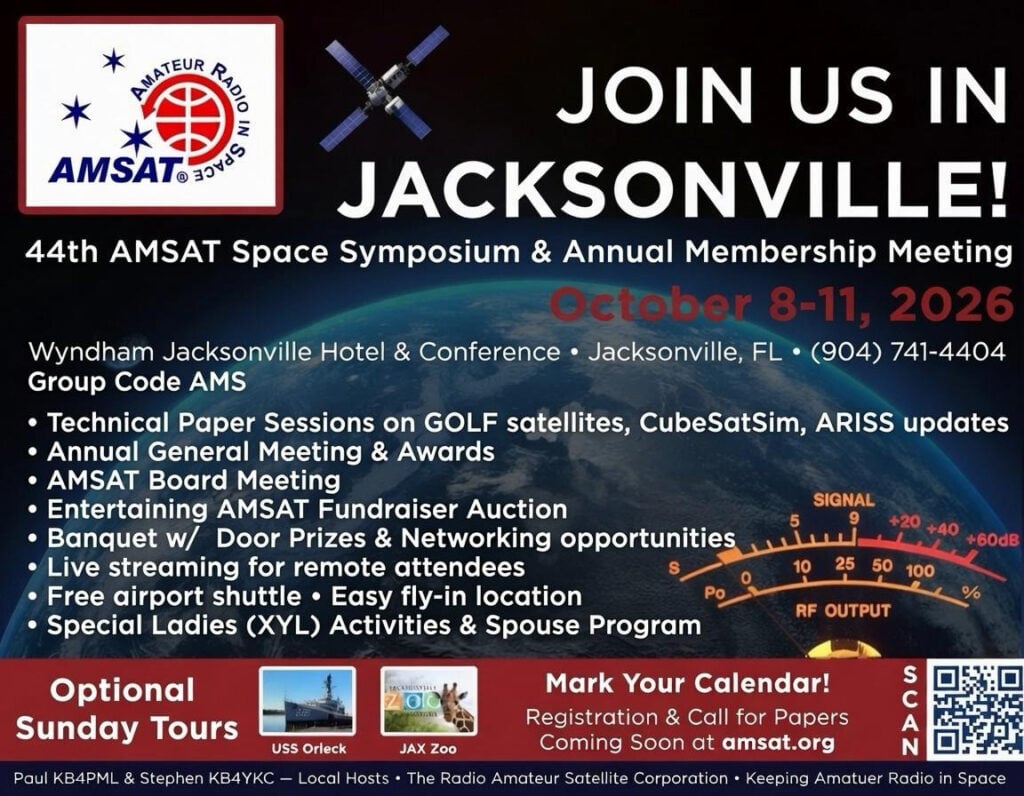
Do you have a story to tell the amateur satellite community? AMSAT invites proposals for presentations at the 44th AMSAT Space Symposium and Annual General Meeting, to be held October 8-11, 2026, at the Wyndham Jacksonville Hotel & Conference Center in Jacksonville, Florida.
Presentations are welcome on any topic of interest to the amateur satellite community. Suggested subjects include current and future satellite projects such as the GOLF program and the CubeSatSim; ARISS and human spaceflight activities; ground station, antenna, and portable station design; software-defined radio; telemetry collection and analysis; satellite operating techniques and achievements; educational programs and youth outreach; and reports from DXpeditions and roving operations. Whether you have built it, flown it, coded it, taught it, or worked it through a satellite, your fellow attendees want to hear about it.
Prospective presenters should email a tentative presentation title and a brief abstract to symposium [at] amsat.org as soon as possible. Presentation time slots are limited, so early submissions are encouraged, and information on submitting final papers and presentation materials for inclusion in the Symposium Proceedings will be provided to presenters. A digital copy of the Proceedings is included with every Symposium registration.
Symposium presentations begin Friday afternoon, October 9, and continue through Saturday, October 10, leading into the Annual General Meeting. Live streaming will bring the sessions to members unable to attend in person – all the more reason to make sure your work is on the program.
Registration for the Symposium is now open at https://launch.amsat.org/event-6789663, with early bird pricing available through September 8. Hotel reservations at the Wyndham Jacksonville – the property formerly known as the Crowne Plaza Jacksonville Airport/I-95 – may be made through the booking link at https://www.amsat.org/2026-amsat-symposium/ or by phone at 1-800-227-6963 using group code AMS.
[ANS thanks the AMSAT Symposium Team for the above information.]
Registration is Now Open!
AO-7 Again Captures Attention
AMSAT OSCAR 7, the amateur satellite launched in 1974 but operational yet today, has once again gained the attention of the media. Historians and fans of space lore have often focused on the story of AO-7, one of the oldest — if not the oldest — satellite of any type to remain in operation a half century after its commissioning. Yet another space journalist has discovered the story and published an article about our venerable repeater in the sky.
Lachlan Brown, Editor-in-Chief and a Co-Publisher of Space Daily, an online technical news outlet that has published continuously since 1995, posted a new article on September 17 that recounts the history of the satellite. The full article is available at https://spacedaily.com/t-ao-7-amateur-radio-satellite-returned-after-21-years/.
As Brown notes, “AO-7 worked for more than six years, well beyond the two-year design life commonly given for the mission. Then it went silent in mid-1981.” As was typical of satellites designed and built in that era, the bird had succumbed to a shorted battery pack.
Radio amateur Pat Gowen, G3IOR, happened to hear a CW transmission in June of 2002 that was later confirmed to be the telemetry beacon of OSCAR 7. Apparently the repeated cycles of heating and cooling satellites experience when moving between sunlight and eclipse had cause the shorted batteries to become an open circuit. This allowed the solar panels to supply current to the satellite’s electronics directly. Experiments proved that not only the beacon, but also the transponders, could be operational.
AO-7 continues to be “semi-operational.” That is, when it is in sunlight one or the other of its transponders becomes active. Control of the satellite is limited, and overly strong signals on the uplink can create power drains that cause the satellite to change modes, and could potentially do more permanent damage.
An article in the recent, July/August 2026 issue of The AMSAT Journal, written by Paul Stoetzer, N8HM, AMSAT Executive Vice President, documents that mode timers and other basic functions of AO-7 continue to operate as designed. It is only abuse by careless operators transmitting excessively strong signals to the satellite that cause the mode changes that have been observed. AMSAT members can access the Journal by logging into the Member Portal on the AMSAT website, https://launch.amsat.org/.
The lengthy Space Daily retrospective is only one of a number of articles celebrating AMSAT OSCAR 7 in recent years, particularly since the 50th anniversary of its launch in 2024. The old bird continues to inspire the awe of space fans, the interest of journalists, and the attention of radio amateurs. With care and responsible operating, amateur will hopefully be able to continue to enjoy the use of AO-7 for many years.
[ANS thanks Space Daily and The AMSAT Journal for the above information.]
Help Support GOLF and FoxPlus.
Annual memberships start at only $120
Join the AMSAT President’s Club today and help
Keep Amateur Radio in Space!
https://www.amsat.org/join-the-amsat-presidents-club/
Binar-567 CubeSat Trio Prepared for Launch
Binar-567, a group of three 1U satellites known as Binar-5, Binar-6 and Binar-7, is scheduled to launch no earlier than Q4 2026. The satellites are intended to support research, technology development and STEM engagement in low-Earth orbit.
Operation of student payloads will take place from high schools with ground stations built by students. Schools will be encouraged to constantly operate a downlink only station and (with support from a licensed amateur) uplink from their station or from the university ground station. The Binar team will support students who pursue an amateur license and start clubs at their schools.
The satellites also carry packet store and forward capability for general amateur engagement. UHF downlinks for Beacon and Telemetry will be OQPSK for 100 and 38.4kbps GFSK for 19.2, 9.6 and 1.2 kbps, and intermittent CW.
Binar-5 will carry student-designed payloads developed through the BinarX Student Payload Development Program, aimed at giving Western Australian high school students the chance to run experiments in space as part of a satellite mission. A downlink frequency of 437.750 MHz has been coordinated for Binar-5.
Binar-6 is intended to test technologies for future spacecraft developed under the Binar Space Program. The global amateur radio community is invited to transmit a command to Binar-6 on the UHF band, with the frequency yet to be announced, to attempt to activate an LED payload that would flash the mission call sign in Morse code. A downlink frequency of 437.850 MHz has been coordinated for Binar-6.
Binar-7 will carry an Earth imaging payload intended to capture data and imagery for environmental monitoring, including potential applications such as bushfire awareness, as well as outreach and public engagement. A downlink frequency of 437.725 MHz has been coordinated for Binar-7.
The mission builds on previous Binar efforts and is positioned as supporting Western Australia’s space sector through research, education and industry collaboration.
According to a recent update, on August 25, 2026 the team took the satellites to JAXA’s Tsukuba Space Center in Japan, with launch services support from Space BD Inc. The following day, the satellites were integrated with JAXA’s J-SSOD deployment system.
From Tsukuba, the satellites are expected to be transported to the United States for launch on a SpaceX Falcon 9 (NG-25) cargo mission to the International Space Station. Once aboard the ISS, the J-SSOD deployment hardware is expected to be prepared in the Japanese Experiment Module before the satellites are released into low-Earth orbit at about 400km altitude.
[ANS thanks Space & Defense magazine for the above information. Read the full article at https://spaceanddefense.io/binar-567-cubesat-trio-set-for-launch-in-q4-2026/.]
LIMITED TIME OFFER!!!
AMSAT is offering a limited-time promotion for new and renewing members
that includes a free digital copy of Getting Started with Amateur Satellites.
The promotion is being offered as AMSAT begins the 2026 membership year.
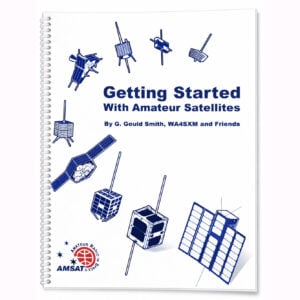
Anyone who joins or renews their AMSAT membership during the promotional period
will receive a download link for the latest edition of
Getting Started with Amateur Satellites in their membership confirmation email.
JOIN TODAY at https://launch.amsat.org/ (Remember! Students join for FREE!)
LEO.space Free Platform for Tracking Satellites
Thousands of satellites are orbiting overhead, but discovering what they are, where they are going and what they are doing often requires navigating specialized databases and technical websites.
LEO.space is changing that.

LEO.space logo (Image credit: LEO.space)
The newly launched free online platform brings together satellite information, orbital data, amateur radio resources, space weather, news and interactive tools designed to make low Earth orbit easier for anyone to explore.
Available free at LEO.space, the platform is built for satellite enthusiasts, amateur radio operators, students, educators and anyone who has looked into the night sky and wondered what is passing overhead.
Explore What Is Orbiting Earth
Low Earth Orbit (LEO) has become one of the most active areas of modern technology. Thousands of satellites support communications, Earth observation, scientific research, navigation and rapidly expanding satellite internet networks.
LEO.space provides a starting point for exploring this increasingly busy environment.
Visitors can discover satellites and learn about their missions, orbital characteristics and the larger constellations and systems operating around Earth. Interactive tools and visualizations are designed to make orbital information understandable while preserving the technical detail useful to more experienced users.
The objective is simple: turn complex space data into something people can explore.
Discover Amateur Radio Satellites
LEO.space also focuses on one of the most accessible ways individuals can directly interact with spacecraft: amateur radio.
Amateur radio satellites carry beacons, telemetry systems, repeaters and transponders that allow people on Earth to receive signals from space and, with an amateur radio license and appropriate equipment, communicate through satellites.
LEO.space helps licensed HAM radio operators discover amateur radio satellites and explore information about passes, frequencies and operating capabilities.
For someone interested in satellite radio but unsure where to begin, the platform provides a path from discovering a spacecraft to understanding how it can be heard or used.
Understand Space Weather and Propagation
Satellites operate within a dynamic environment influenced by the Sun and Earth’s atmosphere.
Solar activity can affect radio propagation, satellite communications and spacecraft operations. Conditions in Earth’s upper atmosphere can also influence spacecraft traveling through Low Earth Orbit.
LEO.space brings space weather and propagation information alongside satellite resources, helping users understand how conditions around Earth affect both spacecraft and radio communications.
This combination is particularly useful for amateur radio operators while providing students and space enthusiasts with a practical way to explore the relationship between the Sun, Earth and satellites.
Space Exploration From a Web Browser
LEO.space is designed around the idea that exploring space should not require specialized software or an aerospace background.
A visitor might arrive wanting to identify a satellite and leave having explored orbital mechanics, radio communications, space weather, satellite constellations or the technology behind modern spacecraft.
The platform will continue expanding with new interactive tools, satellite data, visualizations and educational resources.
As the number of spacecraft surrounding Earth continues to grow, LEO.space aims to provide an accessible place for people to understand and participate in the rapidly changing world of Low Earth Orbit.
Explore what is happening above Earth at LEO.space.
About LEO.space
LEO.space is a free, independent online platform dedicated to Low Earth Orbit. It brings together satellite information, interactive tools, amateur radio resources, space weather, news and educational content to make satellites and the environment surrounding Earth easier to discover and understand.
Visit https://LEO.space to start exploring.
[ANS thanks EIN Presswire for the above information.]
AMSAT Remove Before Flight Key Tags Now Available
Yes, These are the Real Thing!
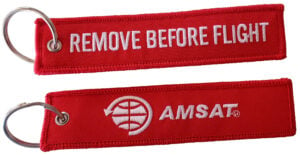
Your $20 Donation Goes to Help Fly a FoxPlus Satellite
Includes First Class Postage (Sorry – U.S. Addresses Only)
Order Today at https://www.amsat.org/product/amsat-remove-before-flight-keychain
NASA’s Moon Orbiter Spots ‘Once-in-Century’ Crater
It started as a routine data-quality check. But as Robert Wagner, a scientist with NASA’s Lunar Reconnaissance Orbiter (LRO), scanned a giant Moon map on his computer screen, an unusually large bright spot circled by a dark halo caught his eye, as it implied that surface material in that area had been shaken up.
“I just stopped, dropped everything, and started looking into what that spot was,” said Wagner, an image-processing specialist from Intuitive Machines who works with data from the Lunar Reconnaissance Orbiter Camera (LROC) system.

Side view (55 degrees away from straight down) of McGetchin – Image: NASA
By comparing before and after images of the Moon, Wagner realized he had discovered the largest, newly formed crater ever found in the solar system, as scientists reported Wednesday in Science Advances. This discovery highlights the value of NASA’s Moon orbiter data in studying a dynamic landscape as the agency advances a sustained human presence and expanded scientific and commercial activity on the Moon.
Officially named McGetchin after pioneering lunar scientist Tom McGetchin, the crater formed on the Moon’s eastern edge sometime between April 11 and May 22, 2024, after a comet or asteroid the size of a three- to six-story building hit the surface.
The crash left a crater, 728 feet wide, that spans the length of two football fields. And at 141 feet deep, the crater could fit three vertically stacked yellow school buses.
Scientists estimate that an impact of this magnitude happens on the Moon about once in a century or even longer.
The LROC system collects images from about 60 miles above the Moon as LRO loops from pole to pole. The system includes two cameras that capture high‑resolution black‑and‑white images and one camera for moderate‑resolution multispectral images. Over the years and thousands of passes, scientists have built maps detailed enough to spot not only new craters, but also landslides, landers, seismic faults, and even hints of lava tubes.
LROC scientists regularly analyze close-up images of small portions of the Moon’s surface taken by the Narrow-Angle Camera. Using these images, they look for changes that are typically less than 30 feet across. But every few years the team searches for large (wider than 150 feet) features by creating global Moon maps and comparing them to older versions.
[ANS thanks NASA for the above information. Read the full story at https://science.nasa.gov/solar-system/moon/nasas-moon-orbiter-spots-new-once-in-century-moon-crater/.]

Changes to AMSAT TLE Distribution for Sept. 18, 2026
Two Line Elements or TLEs, often referred to as Keplerian elements or keps in the amateur community, are the inputs to the SGP4 standard mathematical model of spacecraft orbits used by most amateur tracking programs. Weekly updates are completely adequate for most amateur satellites. TLE bulletin files are updated daily in the first hour of the UTC day. New bulletin files will be posted immediately after reliable elements become available for new amateur satellites. More information may be found at https://www.amsat.org/keplerian-elements-resources/.
This week there are no additions or deletions to the AMSAT TLE distribution.
General Perturbations Data Support
AMSAT is pleased to announce that modern forms of what are called General Perturbations data are being disseminated via modern formats including JSON, XML and KVN at https://newark192.amsat.org/gpdata/current/. The reason this change is being made is that we are running out of 5-digit catalog numbers and the TLE format is not viable for satellites launched after July of this year. See https://celestrak.org/NORAD/documentation/gp-data-formats.php for details.
These data are presently considered in beta test for the next two months while hosted on the test server newark192.amsat.org, and we are very open to community feedback at webmaster at amsat.org. Testers may experience outages and errors while we make improvements. We intend to put this into production on our main web server in July as we expect that satellites launched after this summer will require one of the new formats to accommodate longer object numbers. AMSAT will continue to publish TLE bulletins for satellites launched before July 2026 indefinitely.
[ANS thanks Joe Fitzgerald, KM1P, AMSAT Orbital Elements Manager, for the above information.]
Three U.S. Schools Moved Forward in ARISS Selection Process
Amateur Radio on the International Space Station (ARISS) is pleased to announce that 3 additional US schools have been selected for ARISS contacts in 2026 and 2027. These schools submitted proposals during the recent proposal window and have been accepted to move forward in the processes of planning to host a scheduled amateur radio contact with crew on the ISS. The primary goal of the ARISS program is to engage young people in Science, Technology, Engineering, Arts and Math (STEAM) activities and raise their awareness of space communications, radio communications, space exploration, and related areas of study and career possibilities.
ARISS USA is announcing selections for ham radio contacts with the ISS crew during the Fall 2026 through June, 2027. They are now at work starting to implement their 4–6-month education plan which was outlined in their proposal. These STEAM based educational activities help prepare students for their contact as well as create an on-going exploration and interest in aerospace and amateur radio topics. They are also completing an acceptable equipment plan that demonstrates their ability to execute the ham radio contact. Once their equipment plan is approved by ARISS, the final selected schools will be scheduled as their availability and flexibility match up with the scheduling opportunities offered by NASA.

The schools are:
- The Archdiocese of Atlanta Catholic Schools
- Dresden Elementary in Dresden, Ohio
- The University of Texas at Austin’s Women in STEM – STEM Girls Day event
Amateur Radio on the International Space Station (ARISS) is a cooperative venture of international amateur radio societies and the space agencies that support the ISS. In the United States, sponsors are the American Radio Relay League (ARRL), Amateur Radio Digital Communications (ARDC), Radio Amateur Satellite Corporation (AMSAT), NASA’s Space Communications and Navigation program (SCaN) and the ISS National Lab—Space Station Explorers. The primary goal of ARISS is to promote exploration of science, technology, engineering, the arts, and mathematics topics. ARISS does this by organizing scheduled contacts via amateur radio between crew members aboard the ISS and students. Before and during these radio contacts, students, educators, parents, and communities take part in hands-on learning activities tied to space, space technologies, and amateur radio. For more information, see http://www.ariss.org.
[ANS thanks the Dave Jordan, AA4KN, of the ARISS PR Team for the above information.]
Buying from DX Engineering?
Add AMSAT’s Getting Started With Amateur Satellites to your order.
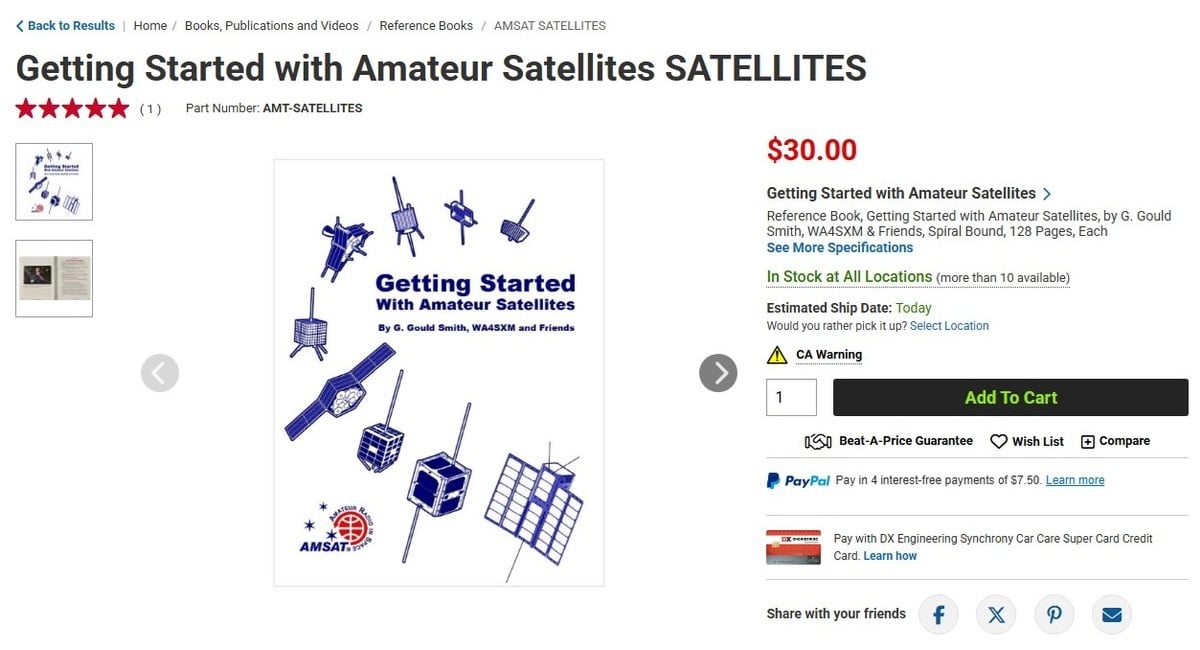 Available for $30 from DX Engineering (free shipping on most orders over $99)
https://www.dxengineering.com/parts/amt-satellites
ARISS News
Amateurs and others around the world may listen in on contacts between amateurs operating in schools and allowing students to interact with astronauts and cosmonauts aboard the International Space Station. The downlink frequency on which to listen is 145.800 MHz worldwide.
Upcoming Contacts
MAOU “School No. 200, Belogorsk, Russia, direct via TBD
The ISS callsign is presently scheduled to be RSØISS
The scheduled crewmember is Anna Kikina and Andrey Fedyaev
The ARISS mentor is RV3DR
Contact is go for Tue 2026-09-22 08:15 UTC
Atrium Health Levine Children’s Hospital, Charlotte, NC, telebridge via ON4ISS
The ISS callsign is presently scheduled to be OR4ISS
The scheduled crewmember is Jack Hathaway KJ5NIV
The ARISS mentor is K4RGK
Contact is go for: Wed 2026-09-23 16:51:34 UTC 80 degrees maximum elevation
Collège Roger Martin du Gard, Belleme, France, direct via F6KCO
The ISS callsign is presently scheduled to be OR4ISS
The scheduled crewmember is Sophie Adenot KJ5LTN
The ARISS mentor is F6ICS
Contact is go for: Fri 2026-09-25 13:38:43 UTC 38 degrees maximum elevation
Many times, a school makes a last-minute decision to do a Livestream or runs into a last-minute glitch requiring a change of the URL, but we at ARISS may not get the URL in time for publication. You can always check https://live.ariss.org/ to see if a school is Livestreaming.
As always, if there is an EVA, a docking, or an undocking; the ARISS radios are turned off as part of the safety protocol.
The crossband repeater remains configured in the Columbus Module (145.990 MHz up {PL 67} & 437.800 MHz down). If a crewmember decides to pick up the microphone and turn up the volume, you may hear them on the air—so keep listening, as you never know when activity might occur.
Kenwood D710GA in the Zvezda Service Module – Call sign RSØISS. Please note we’re still in the process of troubleshooting and testing this radio. APRS is currently active on 437.825 MHz. Feel free to check out status reports at https://ariss-usa.org/ARISS_APRS/.
Ham TV is currently scheduled to power up Wed 2026-09-23 17:10 UTC at 2395.00 MHz.
Note, all times are approximate. It is recommended that you do your own orbital prediction or start listening about 10 minutes before the listed time.
The latest information on the operation mode can be found at https://www.ariss.org/current-status-of-iss-stations.html
The latest list of frequencies in use can be found at https://www.ariss.org/contact-the-iss.html
[ANS thanks Charlie Sufana, AJ9N, one of the ARISS operation team mentors for the above information]
Give Your Next Rove a Payload — Put Your Lunch into Orbit!
Pack the rover dogs and hit the grid line with an all-new
AMSAT Round Logo Metal Lunchbox.
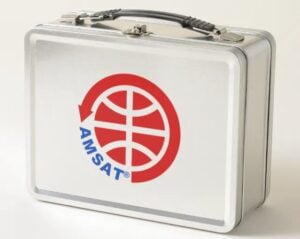
Keep Amateur Radio in Space — and your lunch in the box!
https://www.zazzle.com/amsat_round_logo_metal_lunchbox-256761530568368967
AMSAT Ambassador Activities
AMSAT Ambassadors provide presentations, demonstrate communicating through amateur satellites, and host information tables at club meetings, hamfests, conventions, maker faires, and other events.
October 3, 2026
Bored Net μExpo and ARRL Santa Barbara Section Convention
Cal State University Channel Islands
1 University Drive
Camarillo, CA 93010
https://www.theborednet.net/index.php/2026/06/22/2026-microexpo-is-on/
K6KH
October 3, 2026
Tucson Area Autumn Hamfest
Radio Society of Tucson
Immanuel Presbyterian Church
9252 E. 22nd St.
Tucson, AZ
https://k7rst.club
N1UW
October 8-11, 2026
44th AMSAT Space Symposium and Annual Membership Meeting
Wyndham Jacksonville Hotel and Conference Center
14670 Duval Road
Jacksonville, FL 32218
https://www.amsat.org/2026-amsat-symposium/
November 14, 2026
Southern Arizona Fall Hamfest
Oro Valley Amateur Radio Club
Marana Middle School
11285 W. Grier Rd.
Marana AZ
https://www.tucsonhamradio.org/hamfest
N1UW
Interested in becoming an AMSAT Ambassador? AMSAT Ambassadors provide presentations, demonstrate communicating through amateur satellites, and host information tables at club meetings, hamfests, conventions, maker faires, and other events. For more information go to: https://www.amsat.org/ambassador/
[ANS thanks Bo Lowrey, W4FCL, Director – AMSAT Ambassador Program, for the above information]
Satellite Shorts from All Over
+ A50QO was actived in Bhutan on GEO and LEO last month, and the website with the operation report will be online soon on QSL dot net page. Feng, BA7LVG, and Taka, JK2XXK, operated as A50QO from NL47VL Thimphu, Bhutan, from August 15-20, 2026, on QO-100 and LEO satellites. Total 1564 QSOs with 841 stations in 306 grids, including 1057 on QO-100 and 507 on LEO satellites. Paper QSL direct or via OQRS. LoTW confirmation is free. (ANS thanks Ma Zhiwei, BG7ZDQ, for the above information.)
+ Russia launched a cargo mission toward the International Space Station (ISS) on September 16, delivering about three tons of food, propellant and other supplies for the astronauts aboard. The robotic Progress 96 spacecraft lifted off atop a Soyuz rocket from the Russian-run Baikonur Cosmodrome in Kazakhstan at 1333 UTC. The freighter docked with the station on Saturday, September 19 and will remain docked to the orbiting lab for about five months. As is the usual protocol, amateur radio activity aboard the ISS was suspended during the docking, but should be restored later Saturday. (ANS thanks Space.com for the above information. See the full story at https://www.space.com/space-exploration/international-space-station/russia-progress-96-cargo-launch-international-space-station.)
+ Russia’s planned alternative to Starlink is encountering severe operational setbacks, with satellites deployed in orbit losing altitude while newly launched units fail to reach their designated positions. Commercial operations were set to launch in 2027, with plans to expand the constellation from 250 to 900 satellites in orbit by 2035. Deploying the intended satellite group requires at least 18 Soyuz-2.1b rocket launches. However, Russia conducts only six to eight such launches per year. On the night of August 15, the Ukrainian Defense Forces struck the Progress Space Center in Samara—the sole facility manufacturing the Soyuz-2.1b rockets. According to orbital tracking data, the first spacecraft are already beginning to lose altitude earlier than anticipated, while several others were unable to enter their assigned orbits. (ANS thanks United24 Media for the above information. See the full article at https://united24media.com/world/russia-wanted-its-own-starlink-now-its-satellites-are-falling-before-the-network-even-takes-off-22100.)
+ Yaogan 50-02 — a Chinese reconnaissance satellite that had been flying in an unusual retrograde orbit about 590 miles above Earth — has broken up. Experts speculate that the failure was due to a battery explosion or an impact by space debris. The U.S. Space Force is tracking 43 fragments from the breakup in orbits ranging from 372 to 683 miles. Fragments at those heights can stay in orbit for extraordinarily long periods, so a single satellite failure can create a pollution problem that endures for generations. (ANS thanks Yahoo News for the above information. See the full story at https://www.yahoo.com/news/science/articles/china-satellite-breaks-unusual-orbit-132200637.html.)
Join AMSAT today at https://launch.amsat.org/
In addition to regular membership, AMSAT offers membership to:
- Societies (recognized groups, clubs or organization).
- Students are eligible for FREE membership up to age 25.
- Memberships are available for annual and lifetime terms.
Contact info [at] amsat.org for additional membership information.
73 and remember to help Keep Amateur Radio in Space!
This week’s ANS Editor,
Mark Johns, KØJM
mjohns [at] amsat.org
ANS is a service of AMSAT, the Radio Amateur Satellite Corporation, 712 H Street NE, Suite 1653, Washington, DC 20002. AMSAT is a registered trademark of the Radio Amateur Satellite Corporation.





![[Valid RSS]](https://www.iz4wnp.it/wp-content/uploads/2026/04/valid-rss-rogers.png "Validate my RSS feed")