
AMSAT News Service
ANS-291
October 18, 2026
In this edition:
* AMSAT 44th Annual Symposium Highlights
* AMSAT-UK International Space Colloquium 2026 Highlights
* 65 Years of Amateur Radio Satellites
* Student-Built CubeSats Launch to Test Open-Source Radio and Intersatellite Communications
* AMSAT Director Appoints Three New Ambassadors to Volunteer Network
* Meteor Scatter Communications on 6 Meters Using MSK144
* AMSAT CubeSatSim Introduces Exciting New Features for 2026
* Changes to AMSAT TLE Distribution for October 16, 2026
* ARISS News
* AMSAT Ambassador Activities
* Satellite Shorts from All Over
The AMSAT® News Service bulletins are a free, weekly news and information service of AMSAT, The Radio Amateur Satellite Corporation. ANS publishes news related to Amateur Radio in Space including reports on the activities of a worldwide group of Amateur Radio operators who share an active interest in designing, building, launching and communicating through analog and digital Amateur Radio satellites.
The news feed on https://www.amsat.org publishes news of Amateur Radio in Space as soon as our volunteers can post it.
Please send any amateur satellite news or reports to: ans-editor [at] amsat.org
You can sign up for free e-mail delivery of the AMSAT News Service Bulletins via the ANS List; to join this list see: https://mailman.amsat.org/postorius/lists/ans.amsat.org/
AMSAT 44th Annual Symposium Highlights
 AMSAT 44th Annual Symposium [Credit: AMSAT]
General Overview:
AMSAT held its 44th Annual Space Symposium in Jacksonville, Florida. Presentations covered satellite operations, engineering, education, and future missions. Friday featured an education-focused session. Saturday included technical presentations and AMSAT’s Annual General Meeting. Speakers shared progress on current programs and also outlined ways to expand amateur radio in space.
AMSAT President Drew Glasbrenner, KO4MA, spoke at the Annual General Meeting. He discussed plans for satellite missions beyond low Earth orbit. AMSAT is forming a High Orbit Committee to create mission concepts and hardware proposals. They will build a portfolio of future mission ideas. These will be ready for rideshare or hosted-payload opportunities. Glasbrenner highlighted the need for partnerships between industry and academia.
The event focused on bringing in students and new volunteers. AMSAT wants students to present their satellite work at future symposiums. They also noted that membership is free for students under 25.
CubeSat Simulator, GOLF, Fox-Plus Program Updates:
AMSAT’s CubeSat Simulator program was a key educational highlight during Friday’s sessions. This simulator lets students and amateur operators practice satellite communications using affordable, accessible hardware. AMSAT also partnered with the ARRL Teachers Institute to provide over 30 simulator kits across three summer classes.
Saturday’s engineering sessions focused on updates for the GOLF and Fox-Plus satellite programs. Jerry Buxton, N0JY, reviewed ongoing development for GOLF-T, while the Fox-Plus program moves closer to flight readiness. AMSAT officials are evaluating both government and commercial launch options to secure future flights. These satellite projects aim to advance space technology while expanding communication options for radio amateurs.
Linear Transponder Module Updates:
AMSAT also highlighted its Linear Transponder Module (LTM) program, which provides communications payloads to university satellite teams. The hardware features a 30 kHz linear transponder with a 2-meter uplink, a 70-centimeter downlink, and 1200-baud BPSK telemetry. Participating universities receive the radio package from AMSAT in exchange for hosting and operating the amateur transponder on their satellites. AMSAT plans to expand production of these modules to increase the total number of operational transponders in orbit.
Recordings of the Friday education session and Saturday technical sessions, including the Annual General Meeting, are available through the AMSAT-NA YouTube channel for those unable to attend:
Friday Session: https://www.youtube.com/watch?v=gaTIb-RBVYU
Saturday Session: https://www.youtube.com/watch?v=QW49Dt9hRZE
While AMSAT is still collecting papers an working to edit day-long videos, persons wanting to see presentation materials as they become available can find them at: https://www.amsat.org/2026-amsat-symposium-papers-and-presentations/ .
[ANS thanks AMSAT-NA for the above information.]
2026 AMSAT-UK International Space Colloquium Highlights
The 2026 AMSAT-UK International Space Colloquium, held on October 10–11, 2026, at Kents Hill Park in Milton Keynes, focused on transitioning amateur radio into modern digital architectures and testing next-generation satellite payloads.
The major presentation and event highlights included:
-
Andre, M6GND, gave a technical presentation on implementing CCSDS 235.1 session control standards for amateur satellite communications. This highlights a community effort to normalize robust, commercial-grade open-source digital radio designs in amateur space telemetry.
-
Peter Gülzow, DB2OS (President of AMSAT-DL), presented a comprehensive update on active operations, ongoing optimizations for the geostationary QO-100 payload, and upcoming collaborative deep-space or high-orbit projects.
-
The weekend featured technical deep dives into the RADIANT platform’s progress and operational status.
-
Mirroring global initiatives like the AMSAT North America Symposium, the event highlighted advancements in the CubeSat Simulator project. Key focuses included using pre-configured Raspberry Pi ground station images (such as Fox-in-a-Box) to capture live telemetry in classrooms at low cost.
-
The formal Annual General Meeting took place over the weekend, detailing financial health and strategic planning for the next generation of UK payloads.
-
Attendees gathered at the nearby Woughton House Hotel for the traditional Saturday evening Gala Dinner, serving as the main networking event for international space operators.
Recordings of the Saturday and Sunday sessions, including the Annual General Meeting, are available through the AMSAT-UK YouTube channel for those unable to attend:
[ANS thanks AMSAT-UK and AMSAT-SM for the above information.]
65 Years of Amateur Radio Satellites: From OSCAR I to Canada-OSCAR 128
The history of amateur radio satellite tracking spans over six decades, marked by key technical milestones from early spaceflight to modern portable operations. Two distinct satellite receptions illustrate the profound changes in equipment and techniques available to operators.
The Launch of OSCAR I (December 1961)
 OSCAR 1 Communications Satellite [Credit: National Air and Space Museum]
In December 1961, a group of student amateur radio operators at Case Western Reserve University combined their efforts to listen to OSCAR 1 (Orbiting Satellites Carrying Amateur Radio), the first amateur radio satellite.
Station operations were divided among team members to handle the manual demands of early satellite tracking:
-
One student managed orbital calculations.
-
One student controlled azimuth positioning.
-
One student controlled elevation tracking.
-
One student managed frequency control.
The team successfully heard the distinctive “HI HI” Morse code identifier broadcast from American OSCAR I.
Modern Portable Tracking of CO-128 (August 2026)
 Antenna Setup to Monitor Canada-OSCAR 128 [Credit: AMSAT-Canada]
In August 2026, a portable setup on Prince Edward Island monitored Canada-OSCAR 128 (CO-128 / MARMOTSat) transmitting on 145.875 MHz.
The portable field station utilized:
-
Tracking: A cell phone to track azimuth and elevation.
-
Receiver: A Yaesu VX-8GR portable radio set to receive amplitude modulation.
-
Antenna: An Arrow II 146/440-14 antenna with a 4-element VHF Yagi.
The operator captured the call sign CQ DE VA7UVS in Morse code. The AM output produced more static than a tone during transmission. Nearby power lines initially caused a buzzing sound over the signal, but placing a finger on the antenna’s aluminum main boom eliminated the distortion and made DE VA7UVS easier to hear.
[ANS thanks AMSAT-Canada, John DeDourek, VE9TFB (ex K8TFB), and Brent Petersen, VY2/VE9EX, W1IY, for the above information.]
Student-Built CubeSats Launch to Test Open-Source Radio and Intersatellite Communications

Launch of SpaceX Falcon 9 with Student CubeSat [Credit: NASA]
A SpaceX Falcon 9 launched two student-built CubeSats to the International Space Station on Oct. 13, 2026, as part of NASA’s 35th commercial resupply mission. NASA’s CubeSat Launch Initiative (CSLI) provided the mission, led by Cal Poly Pomona, to demonstrate open-source space technology and support amateur radio operations.
The two CubeSats belong to the open-source Pleiades Five / PROVES project:
-
PROVES-Maia (Texas State University): Assembled and tested by students at NASA’s Johnson Space Center, it will relay digital messages for radio operators over UHF and S-band frequencies and evaluate intersatellite routing.
-
PROVES-Taygeta (Cal Poly Pomona & Mt. San Antonio College): Features an amateur radio payload, a camera that transmits downloadable orbital photos, and a student-monitored radiation sensor that accepts on-demand data requests.
Both student missions test intersatellite data routing via the open-source Dynamic Relay for Intersatellite Fault Tolerance (DRIFT) protocol. This launch builds on three earlier student-built PROVES satellites (Alcyone, Atlas, and Electra) launched in April.
[ANS thanks NASA and CSLI for the above information.]
Give Your Next Rove a Payload — Put Your Lunch into Orbit!
Pack the rover dogs and hit the grid line with an all-new
AMSAT Round Logo Metal Lunchbox.
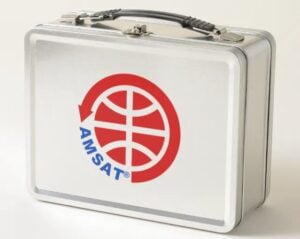
Keep Amateur Radio in Space — and your lunch in the box!
https://www.zazzle.com/amsat_round_logo_metal_lunchbox-256761530568368967
AMSAT Director Appoints Three New Ambassadors to Volunteer Network
Bo Lowry, W4FCL, AMSAT Director of the Ambassador Program, is pleased to announce the addition of three new AMSAT Ambassadors:
-
Sam Albus, KR4EJD – Jacksonville, FL
-
Josh Tate, KF4EAG – Fuquay-Varina, NC
-
Joseph DiVerdi, K0NMR – Fort Collins, CO

Frank Karnauskas, N1UW, AMSAT Ambassador and Vice President – Development.RST HamFest 2024 [Credit: AMSAT]
AMSAT Ambassadors are dedicated volunteers who represent AMSAT at local ham fests, maker fairs, and club meetings. In their roles, Ambassadors agree to attend at least one local event per year and mentor area radio amateurs looking to get started with satellite operations.
To support their outreach efforts, each Ambassador receives:
-
A custom AMSAT Ambassador callsign badge
-
A 3′ x 5′ AMSAT banner flag
-
An “FAQ” presentation binder designed for interactive demonstrations
The presentation binder includes visual aids explaining core concepts such as satellite types, orbital mechanics, tracking software, antenna configurations, Doppler shift compensation, and operating techniques. The binder’s front cover features a QR code that directs interested operators directly to beginner articles and getting-started resources.
The Ambassador Program is open to current AMSAT members residing in the United States. U.S. members interested in joining the program can contact [email protected].
[ANS thanks Bo Lowry, W4FCL, AMSAT Director – Ambassador Program, for the above information.]
Meteor Scatter Communications on 6 Meters Using MSK144
Amateur radio operators looking to expand beyond traditional local or HF modes can use meteor scatter propagation to make contacts over distances from 400 to 2,000 kilometers. As Earth moves through space, millions of meteors enter the upper atmosphere at altitudes of 80 km to 120 km, creating short-lived ionized trails that reflect VHF radio signals. While activity in southern Africa has historically lagged compared to active regions in North America and Europe, techniques using modern digital modes make this propagation path highly accessible.
How Meteor Scatter Works
Because meteor trails persist for only milliseconds to a few seconds, traditional voice communication is generally impractical outside of major annual meteor showers (such as the Perseids or Geminids). Instead, operators use specialized digital protocols:
-
Mode: MSK144 (Minimum Shift Keying at 144 baud), designed specifically for efficient meteor scatter communications within software like WSJT-X.
-
Transmission Cycles: Stations exchange short data bursts using synchronized 15-second transmit/receive intervals.
-
Frequency: The primary calling frequency on the 6-meter band is 50.260 MHz.
-
Interference-Free Operation: Because meteors enter the atmosphere at random angles across a shared sky area, multiple stations can operate on the same frequency simultaneously without interfering with one another.
 Perseids Meteor Shower [Credit: AMSAT-SA]
Recommended Equipment & Station Setup
Setting up a station for MSK144 meteor scatter requires minimal specialized hardware:
-
Transceiver: A 50 MHz (6-meter) radio capable of moderate power (typically 50W to 100W, though higher power increases contact speed).
-
Antenna: A horizontal directional antenna (such as a 5- to 7-element Yagi) is strongly recommended over a vertical antenna to properly spread the signal horizontally across the reflection zone.
-
Software: A computer running WSJT-X connected via a USB interface for CAT control, audio input/output, and PTT timing. Accurate PC clock synchronization (via an internet time server like Dimension 4) is critical to maintain precise 15-second sequencing.
Operating Tips for Success
-
Timing: While meteor scatter occurs 24/7, success rates improve significantly in the early morning when atmospheric meteor activity peaks, or during dedicated annual shower windows.
-
Patience: Pings may be brief, and completing a full QSO can take several minutes or longer depending on trail density and geometry. Operators monitor real-time spotting via platforms like PSK Reporter to coordinate active sessions.
[ANS thanks AMSAT-SA and the Southern Africa VHF group for the above information.]
AMSAT CubeSatSim Introduces Exciting New Features for 2026
Alan Johnston, KU2Y, AMSAT VP – Educational Relations, announced several significant upgrades to the CubeSatSim satellite simulator, expanding its capabilities for amateur radio enthusiasts, educators, and students. The new software releases, versions 2.2 and 2.3, make the low-cost, open-source simulator an even more versatile tool for learning about satellite communications.

CubeSatSim Kit [Credit: AMSAT]
One major addition is PacSat mode, which simulates a packet-radio satellite that can store and forward digital messages and files between ground stations. Users can practice uploading and downloading information, recreating the operations of actual amateur radio satellites.
Another improvement is simulated Doppler shift, which reproduces the changing radio frequency experienced as a satellite passes overhead. During a simulated ten-minute pass, the transmitted frequency changes by approximately 18 kHz, providing realistic training for satellite operators.
A new web-based Dashboard lets users configure and control CubeSatSim from a computer or smartphone. The added Wi-Fi hotspot eliminates the need for an existing wireless network.
Version 2.2 also introduced simulated equipment failures, allowing students to practice identifying satellite problems through telemetry analysis.
Built around a Raspberry Pi Zero 2, CubeSatSim.org provides complete construction plans, software, and documentation.
[ANS thanks Alan Johnston, KU2Y, AMSAT VP – Educational Relations for the above information.]
The 2026 Coins Are Here! Help Support GOLF-TEE and Fox-Plus.
Annual memberships start at only $120.
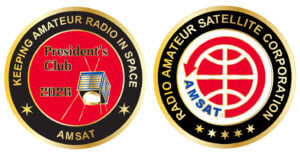
Join the AMSAT President’s Club today and help Keep Amateur Radio in Space!
https://www.amsat.org/join-the-amsat-presidents-club/
Changes to AMSAT TLE Distribution for October 16, 2026
Two Line Elements or TLEs, often referred to as Keplerian elements or keps in the amateur community, are the inputs to the SGP4 standard mathematical model of spacecraft orbits used by most amateur tracking programs. Weekly updates are completely adequate for most amateur satellites. TLE bulletin files are updated daily in the first hour of the UTC day. New bulletin files will be posted immediately after reliable elements become available for new amateur satellites. More information may be found at https://www.amsat.org/keplerian-elements-resources/.
Bulletin format elements for all satellites of interest to radio amateurs. This file is updated at least every 24 hours.
Bare elements are derived from the bulletin, but contain no header or footer. These data are used as input to the AMSAT Pass Predictions page.
This week there are no additions or deletions to the AMSAT TLE distribution.
General Perturbations Data Support
AMSAT is pleased to announce that modern forms of what are called General Perturbations data are being disseminated via modern formats including JSON, XML and KVN at https://newark192.amsat.org/gpdata/current/. The reason this change is being made is that we are running out of 5-digit catalog numbers and the TLE format is not viable for satellites launched after July of this year. See https://celestrak.org/NORAD/documentation/gp-data-formats.php for details.
These data are presently considered in beta test for the next two months while hosted on the test server newark192.amsat.org, and we are very open to community feedback at webmaster [at] amsat.org. Testers may experience outages and errors while we make improvements. We intend to put this into production on our main web server in July as we expect that satellites launched after this summer will require one of the new formats to accommodate longer object numbers. AMSAT will continue to publish TLE bulletins for satellites launched before July 2026 indefinitely.
[ANS thanks Joe Fitzgerald, KM1P, AMSAT Orbital Elements Manager, for the above information.]
ARISS News
Amateurs and others around the world may listen in on contacts between amateur radio operators at schools and astronauts and cosmonauts aboard the International Space Station. The downlink frequency on which to listen is 145.800 MHz worldwide.
Scheduled Contacts
+ Recently Completed
Ecole Internationale PACA de Manosque, Manosque, France — direct via F4KKM
The ISS callsign was NA1SS
The scheduled crewmember was Joshua Kutryk, KJ5BFU
The ARISS mentor is F6ICS
Contact was successful: Fri 2026-10-16 10:03 UTC
Congratulations to the students of international school EIPACA, crew member Joshua Kutryk, KJ5BFU, and mentor F6ICS.
EcoTarium Science Center, Worcester, MA — telebridge via AB1OC
The ISS callsign was NA1SS.
The scheduled crewmember is Luke Delaney, KJ5PPF.
The ARISS mentor was AB1OC
Contact was successful: Thu 2026-10-15 15:28 UTC
Congratulations to the students at EcoTarium Science Center, crew member Luke Delaney, KJ5PPF, and mentor AB1OC.
+ Upcoming Contacts
No Upcoming Contacts.
Many times, a school makes a last-minute decision to do a Livestream or runs into a last-minute glitch requiring a change of the URL, but ARISS may not get the URL in time for publication. You can always check https://live.ariss.org/ to see if a school is Livestreaming.
As always, if there is an EVA, a docking, or an undocking, the ARISS radios are turned off as part of the safety protocol.
+ Upcoming SSTV Events
2026-10-14 Expedition 75 Series 34 “ARISS Hardware”
Begins Thursday, October 22; time TBD
Concludes Sunday, October 25; time TBD
Images will be transmitted at 437.55 MHz (+/- Doppler shift), decode with Robot 36 mode, transmission 36 seconds on, two minutes off.
Submit your images to the SSTV gallery for event certificate.

SSTV Series 34 [Credit: Ariss.org]
The crossband repeater remains configured in the Columbus Module (145.990 MHz up {PL 67} & 437.800 MHz down). If a crewmember decides to pick up the microphone and turn up the volume, you may hear the crew member on the air—so keep listening, as you never know when activity might occur.
Kenwood D710GA in the Zvezda Service Module – Callsign RSØISS. Please note we’re still in the process of troubleshooting and testing this radio. APRS is currently active on 437.825 MHz. Feel free to check out status reports at https://ariss-usa.org/ARISS_APRS/.
HamTV in the Columbus Module (2395.00 MHz) is currently transmitting a test signal. For more information, visit the ARISS Ham TV Live site at https://live.ariss.org/hamtv/.
Note that all times are approximate. It is recommended that you do your own orbital prediction or start listening about 10 minutes before the listed time.
The latest information on the operation mode can be found at https://www.ariss.org/current-status-of-iss-stations.html
The latest list of frequencies in use can be found at https://www.ariss.org/contact-the-iss.html
[ANS thanks Charlie Sufana, AJ9N, one of the ARISS operation team mentors for the above information.]
AMSAT Ambassador Activities
AMSAT Ambassadors provide presentations, demonstrate communicating through amateur satellites, and host information tables at club meetings, hamfests, conventions, maker fairs, and other events.
AMSAT Ambassador Clint Bradford, K6LCS, says,
“Think a 75-minute presentation on ‘working the easy satellites’ would be appropriate for your club or event? Let me know by emailing me at k6lcsclint [at] gmail [dot] com or calling me at 909-999-SATS (7287)!”
Clint has NEVER given the same show twice: EACH of the 150+ presentations so far has been customized to its audiences.
Scheduled Events
November 14, 2026
Southern Arizona Fall Hamfest
Oro Valley Amateur Radio Club
Marana Middle School
11285 W. Grier Rd.
Marana AZ
https://www.tucsonhamradio.org/hamfest
N1UW
For more information go to: https://www.amsat.org/ambassador/
[ANS thanks Bo Lowrey, W4FCL, Director – AMSAT Ambassador Program, for the above information.]
Buying from Ham Radio Outlet?
Add AMSAT’s Getting Started With Amateur Satellites to your order.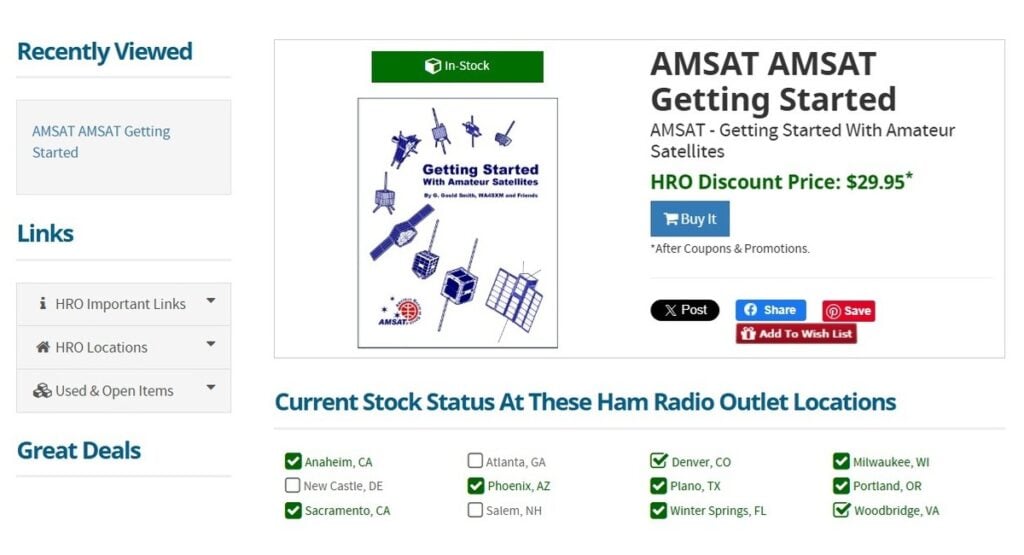
Available for $29.95 from HRO (free shipping on most orders over $100)
https://www.hamradio.com/detail.cfm?pid=H0-019238
Satellite Shorts from All Over
+ Five spacecraft are currently docked at the International Space Station after a SpaceX Dragon cargo capsule arrived on Thursday morning, delivering over 6,300 pounds of scientific experiments, crew supplies, and roll-out solar arrays. Station crew members have begun transferring critical biological research and preparing for upcoming spacewalks on Oct. 29 and Nov. 5 to install the new solar arrays, while Roscosmos cosmonauts completed robotics and spatial orientation studies. [ANS thanks NASA for the above information.]
+ Media representatives are invited to attend the Europa-Park Science Days from October 22–24, 2026, in Rust, Germany, featuring presentations, STEM activities, and media opportunities with ESA experts. Highlights on Thursday, October 22, include a keynote address and interview opportunities with German ESA astronaut Alexander Gerst, alongside talks by ESA directors and interactive exhibits spanning VR experiences, robotics, and planetary science models. [ANS thanks ESA for the above information.]
+ Using NASA’s Chandra X-ray Observatory, eROSITA, and LOFAR, scientists observed a merging galaxy cluster nicknamed the “treble clef” due to its distinct, music-note-shaped radio emission. Researchers report in Astronomy & Astrophysics that it was likely generated and amplified by a violent collision between two galaxy clusters. [ANS thanks Space.com for the above information.]
+ Scientists from the Indian Institute of Astrophysics (IIA) and international collaborators analyzed joint observations of solar coronal mass ejections (CMEs) captured by India’s Aditya-L1 and ESA’s Proba-3 satellites. By combining spectroscopic data from VELC aboard Aditya-L1 with imaging from ASPIICS on Proba-3, the cross-checked observations provided new insights into CME mass, density, thermal energy, and early-stage dynamics in the low solar corona. [ANS thanks The Hindu and ISRO for the above information.]
+ The Australian Space Agency and the Roo-ver Consortium unveiled the latest design model of “Roo-ver,” Australia’s first lunar rover, at the Queensland University of Technology’s Lunar Testbed and Space Lab during World Space Week on October 7, 2026. Scheduled to land at the lunar South Pole in 2030 aboard an Intuitive Machines lander under NASA’s Commercial Lunar Payload Services (CLPS) program, the semi-autonomous rover will collect and analyze regolith to support sustainable human exploration through the Artemis program. Designed to withstand extreme lunar temperature swings from -246°C to 121°C, the vehicle features homegrown Australian technology including specialized treaded wheels, thermal management systems, and tools to mitigate against lunar dust and radiation. [ANS thanks the Australian Space Agency for the above information.]
Join AMSAT today at https://launch.amsat.org/
In addition to regular membership, AMSAT offers membership to:
- Societies (a recognized group, clubs or organization).
- Students enrolled in at least half-time status are eligible for free membership to age 25.
- Memberships are available for annual and lifetime terms.
Contact info [at] amsat.org for additional membership information.
73 and remember to help Keep Amateur Radio in Space!
This week’s ANS Editor,
Vidya Gopalakrishnan, K4VGK
ANS is a service of AMSAT, the Radio Amateur Satellite Corporation, 712 H Street NE, Suite 1653, Washington, DC 20002
AMSAT is a registered trademark of the Radio Amateur Satellite Corporation.




![[Valid RSS]](https://www.iz4wnp.it/wp-content/uploads/2026/04/valid-rss-rogers.png "Validate my RSS feed")