
AMSAT News Service
ANS-214
August 2, 2026
In this edition:
- Expedition 74 Crew Returns to Earth After 241 Days in Space
- Voting Continues in 2026 AMSAT Board of Directors Election
- MARMOTSat Designated Canada-OSCAR 128 (CO-128)
- ARISS Selects 13 U.S. Organizations for Fall 2026–Spring 2027 Contacts
- New Tracking Programs Released
- HamSCI Meteor Scatter QSO Parties Target the Perseids
- IARU Region 1 Conference Papers Address Satellite Spectrum Issues
- Recent IARU Amateur Satellite Frequency Coordination Activity
- New Satellite Distance Records Claimed on AO-7, AO-123, and SO-125
- Zero Retries Digital Conference 2026 Issues Call for Technical Papers
- Changes to AMSAT TLE Distribution for July 31, 2026
- ARISS News
- AMSAT Ambassador Activities
- Satellite Shorts From All Over
The AMSAT® News Service bulletins are a free, weekly news and information service of AMSAT, The Radio Amateur Satellite Corporation.
ANS publishes news related to Amateur Radio in Space including reports on the activities of a worldwide group of Amateur Radio operators who share an active interest in designing, building, launching and communicating through analog and digital Amateur Radio satellites.
The news feed on https://www.amsat.org publishes news of Amateur Radio in Space as soon as our volunteers can post it.
Please send any amateur satellite news or reports to: ans-editor [at] amsat.org
You can sign up for free e-mail delivery of the AMSAT News Service Bulletins via the ANS List; to join this list see: https://mailman.amsat.org/postorius/lists/ans.amsat.org/
Expedition 74 Crew Returns to Earth After 241 Days in Space
NASA astronaut Chris Williams, KJ5GEW, and Roscosmos cosmonauts Sergey Kud-Sverchkov and Sergei Mikaev are safely back on Earth after 241 days in space. The trio landed in their Soyuz MS-28 spacecraft on the Kazakh steppe southeast of Dzhezkazgan, Kazakhstan, on Sunday, July 26, wrapping up their service as members of Expeditions 73 and 74 aboard the International Space Station.
Soyuz MS-28 undocked from the station’s Rassvet module shortly after 0700 UTC and descended under parachute to a touchdown at approximately 1026 UTC, about three and a half hours later. Over the course of the mission, the crew orbited the Earth 3,856 times and traveled more than 102 million miles. The spacecraft launched and docked with the station on November 27, 2025 – Thanksgiving Day in the United States. The flight was the first for Williams and Mikaev and the second for Kud-Sverchkov, who has now logged more than 426 days in space.
Before departure, Kud-Sverchkov handed command of the station to NASA astronaut Jessica Meir in a change-of-command ceremony on Saturday, July 25, marking the transition from Expedition 74 to Expedition 75, which formally began at undocking. Seven crew members remain aboard the station.
Amateur radio was part of Williams’ final week in orbit. On Friday, July 24, just two days before returning home, he completed an ARISS telebridge contact with students at the Payload Operations Integration Center at NASA’s Marshall Space Flight Center in Huntsville, Alabama. In keeping with standard safety protocol, the ARISS radios aboard the station were powered down on July 25 in support of the Soyuz undocking, with service scheduled to be restored on July 27.
Following post-landing medical checks, recovery teams transported the crew by helicopter to Karaganda, Kazakhstan, where Williams boarded a NASA aircraft bound for the agency’s Johnson Space Center in Houston.
[ANS thanks NASA and Space.com for the above information]
LIMITED TIME OFFER!!!
AMSAT is offering a limited-time promotion for new and renewing members that includes a free digital copy of Getting Started with Amateur Satellites. The promotion is being offered as AMSAT begins the 2026 membership year.
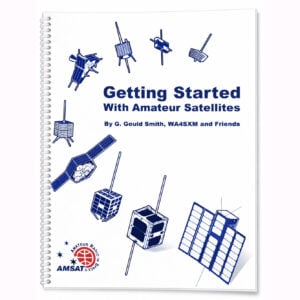
Anyone who joins or renews their AMSAT membership during the promotional period will receive a download link for the latest edition of Getting Started with Amateur Satellites in their membership confirmation email. JOIN TODAY at https://launch.amsat.org/ (Remember! Students join for FREE!)
Voting Continues in 2026 AMSAT Board of Directors Election
AMSAT members are reminded that voting remains open in the 2026 AMSAT Board of Directors election. Three seats on the Board are being filled this year. The three candidates receiving the highest number of votes will be elected to the Board, while the candidates receiving the next highest vote totals will be named First Alternate and Second Alternate, respectively.
Voting opened on July 15, 2026, and will conclude on September 15, 2026. Election results will be announced no later than September 30, 2026.
Current AMSAT members may review the official candidate statements and cast their ballots on the AMSAT 2026 Board of Directors Election website at https://launch.amsat.org/2026-BoD-Election
Members are encouraged to take a few minutes to review the candidates’ statements and cast their ballots. Your participation helps shape the future of AMSAT and its mission to Keep Amateur Radio in Space.
[ANS thanks Douglas Tabor, N6UA, AMSAT Secretary, for the above information]
MARMOTSat Designated Canada-OSCAR 128 (CO-128)
On July 7th, 2026, the MARMOTSat satellite was launched on a Falcon 9 launch vehicle from Vandenberg Space Force Base in California. Developed by the University of Victoria Centre for Aerospace Research, the satellite carries a 2m digipeater and beacon, and a 10m beacon, and DVB-S2 video and ionospheric sounding experiments.
At the request of the University of Victoria Centre for Aerospace Research, AMSAT hereby designates MARMOTSat as Canada-OSCAR 128 (CO-128). We congratulate the University of Victoria Centre for Aerospace Research, thank them for their contribution to the amateur satellite community, and wish them continued success on this and future projects.
CO-128 remains in commissioning following its successful launch. Amateurs interested in assisting with payload commissioning can contact the UVic Propagation Laboratory. Frequency and experiment details are maintained at https://www.propagationlab.ca/satellite/ and https://www.marmotsat.ca. Full experiment schedules are expected later in Q3 2026 once commissioning advances.
[ANS thanks Drew Glasbrenner, KO4MA, AMSAT President and OSCAR Number Administrator, and the CO-128 team for the above information]
ARISS Selects 13 U.S. Organizations for Fall 2026–Spring 2027 Contacts
ARISS has selected 13 educational organizations across the United States to host scheduled amateur radio contacts with ISS crew members from Fall 2026 through Spring 2027. The selected groups are:
- Atrium Health Levine Children’s Hospital (Charlotte, NC)
- EcoTarium (Worcester, MA)
- Challenger Learning Center (Framingham, MA)
- Covington High School (Covington, TN)
- Robert Crippen Elementary School (Porter, TX)
- Paul Duke STEM High School (Norcross, GA)
- Lead-Deadwood High School (Lead, SD)
- North Augusta High School (North Augusta, SC)
- Pinecrest Academy of Northern Nevada (Sparks, NV)
- Sarasota Military Academy High School (Sarasota, FL)
- Watson B. Duncan Middle School (Palm Beach Gardens, FL)
- Woodruff Middle School (Seabrook, NJ)
- West Michigan Aviation Academy (Grand Rapids, MI)
Selections were based on proposals that integrate space and communications concepts into the curriculum. Exact contact dates and crew members will be announced closer to the events. Applications remain open through September 30, 2026, for contacts in the first half of 2027. Details are at https://www.ariss.org/.
[ANS thanks ARISS for the above information]
AMSAT Remove Before Flight Key Tags Now Available Yes, These are the Real Thing!
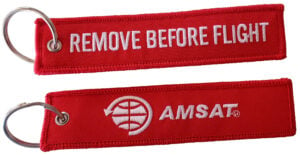
Your $20 Donation Goes to Help Fly a FoxPlus Satellite Includes First Class Postage (Sorry – U.S. Addresses Only) Order Today at https://www.amsat.org/product/amsat-remove-before-flight-keychain
New Tracking Programs Released
Peter Goodhall, MM9SQL, and Carsten Groen, OZ9AAR, have each released tracking software packages this week.
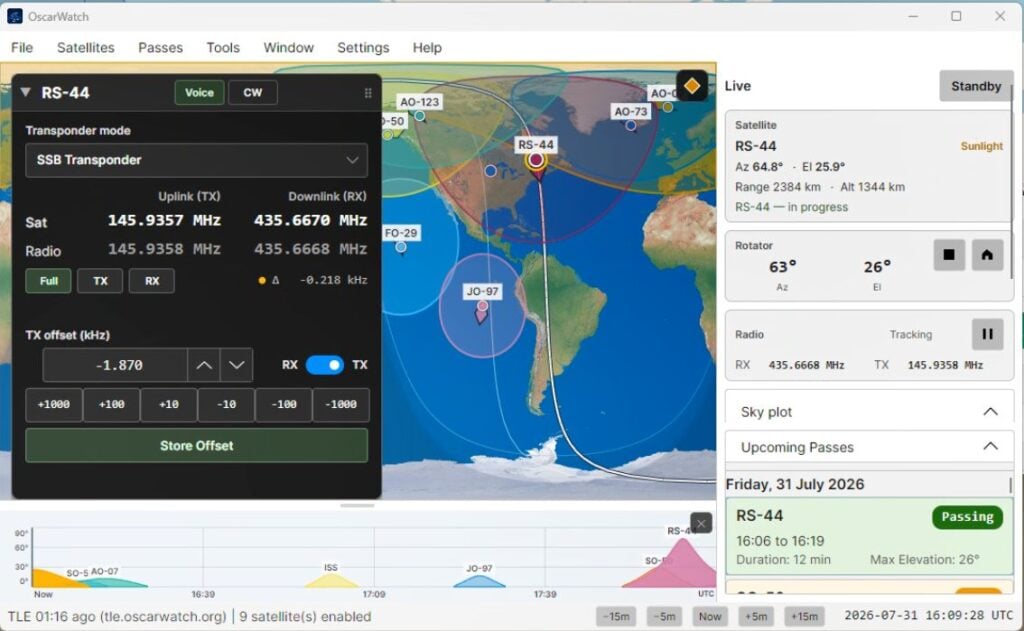
OscarWatch
MM9SQL’s OscarWatch Tracker is now officially out of beta with release 1.0.0. This release features comprehensive FlexRadio SmartSDR integration, expanded HF satellite support, smarter dual-radio tuning, and refreshed user interface layouts. The program interfaces with Yaesu GS-232B, SPID, EasyComm, SAEBRTrack or URC rotor controllers and with Peter’s Cloudlog logging program.
OscarWatch Tracker now fully supports satellite operations for those using FlexRadio SmartSDR with transverters. The release now includes band & panadapter swapping, independent centering of panadapters, band-specific antenna port mapping adding configurable VHF and UHF antenna routing of RX_A/RX_B and transmit antenna assignments, and mode & CTCSS guard rails for FM passes.
OscarWatch now also includes Icom IC-7300 dual-radio support allowing operators to run AO-07 Mode A with 10m HF downlink tracking on the IC-7300 paired with a separate VHF uplink rig. There is also corrected band coverage fixes for the Icom IC-706 series, including 70cm capability for the IC-706MKIIG. In addition, verified 10m HF downlink capability is now incorporated for the Yaesu FT-817 and FT-818 platforms without software band restrictions.
Smarter dual-radio tuning and rig controls have been added, so that those using an SDR for downlink can now automatically sync a separate uplink radio, mirroring the behavior of single-radio Main/Sub tracking in both Normal and Reverse tracking modes.
Various bug fixes and enhancements for handling of Icom 9700 and Kenwood TS-2000 radios, and cosmetic changes to the on-screen display are also incorporated into this first official release of OscarWatch. The program and complete change log may be downloaded from https://github.com/magicbug/
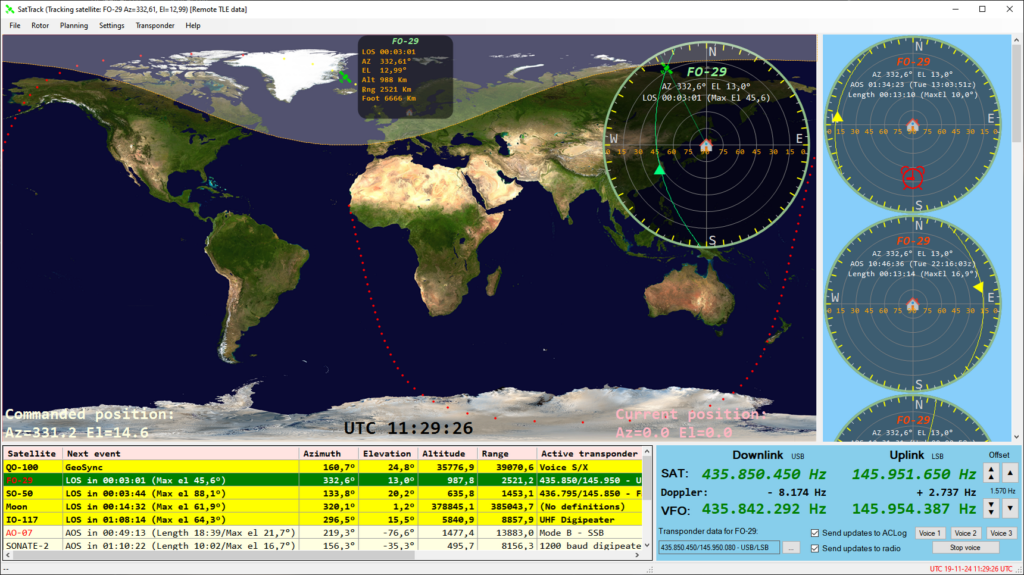
SatTrack
OZ9AAR’s SatTrack is limited to control of the ICOM IC-9700 and some other ICOM radios like IC-910, IC821H and IC-706. It supports Yaesu GS-232B, PstRotator, or URC rotor controllers, and interfaces with N3FJP’s ACLog logging software.
Version 1.0.1.14 now includes support for the new General Perturbations Data in JSON format. There is also an improved internal satellite trajectory/rotor movement planner, for better better utilization of min/max azimuth limits and 180 degree elevation control.
This release also adds a “Simulation” menu that can preview passes and allow the operator to experiment and test the application without moving the antennas. Complete information and program download are available at https://www.moonbounce.dk/
Both programs are currently free to download with donations to the authors greatly appreciated.
[ANS thanks Peter Goodhall, MM9SQL and Carsten Groen, OZ9AAR, for the above information]
HamSCI Meteor Scatter QSO Parties Target the Perseids
The HamSCI citizen-science community is continuing its 2026 series of Meteor Scatter QSO Parties (MSQP), with the Southern Delta Aquariids event running July 29-31 and the marquee Perseids event scheduled for August 12-14. A final 2026 event will coincide with the Geminids meteor shower on December 13-15.
Part special event and part contest, the MSQP aims to generate a large body of contact and reception data to better understand meteor scatter propagation. The effort, originally proposed by HamSCI member McKenzie Denton, KO4GLN, is particularly timely: recent FCC rule changes now permit U.S. amateurs to operate the MSK144 meteor scatter mode on 10 meters, allowing researchers to investigate a key question – which band is better for meteor scatter, 6 meters or 10 meters?
Participation is open to both two-way (transmit and receive) and monitor (receive-only) stations operating from fixed locations. MSK144 is the only mode used, with 50.260 MHz and 28.145 MHz being popular operating frequencies. Stations equipped for both bands are asked to alternate between 6 and 10 meters at 20-minute intervals (xx:00, xx:20, xx:40). Monitor stations should report their decodes via PSKReporter, and all participants are encouraged to submit ADIF logs and WAV recordings of decoded pings after each event to support the research effort. Electronic certificates are planned for participants, and first-time meteor scatter operators are encouraged to self-report their “rookie” status so they can be recognized in the results.
Complete rules and information are available at https://hamsci.org/msqp
[ANS thanks HamSCI and Amateur Radio Newsline for the above information]
The 2026 President’s Club Coin is Now Here! Help Support GOLF and FoxPlus.
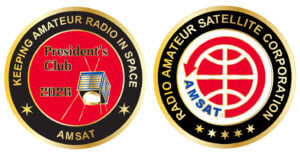
Annual memberships start at only $120
Join the AMSAT President’s Club today and help Keep Amateur Radio in Space! https://www.amsat.org/join-the-amsat-presidents-club/
IARU Region 1 Conference Papers Address Satellite Spectrum Issues
Papers for the IARU Region 1 General Conference, being held in Vienna, Austria, September 19-23, 2026, are now available online, and several are of direct interest to the amateur satellite community.
Among the papers in the VHF+ (C5) section is VI26_C5_11, “UHF Spectrum Situation,” submitted by the Radio Society of Great Britain (RSGB), which addresses AST SpaceMobile’s use of amateur spectrum. In April, the FCC announced that AST SpaceMobile (AST & Science, LLC) will be using the amateur 430 MHz band for 248 satellites in its planned low-Earth-orbit constellation, which aims to provide global cellular broadband communications. Center frequencies are 430.5 MHz, 432.3 MHz, 434.1 MHz, 435.9 MHz, and 439.5 MHz, each with 50 kHz bandwidth.
Another satellite-related paper is VI26_C3_45, the report of the ARSPEX Working Group, a specialised body of IARU Region 1 for Amateur Radio Space EXploration.
The full set of IARU-R1 Conference papers may be found at https://conf.iaru-r1.org/documents/
[ANS thanks AMSAT-UK for the above information]

Recent IARU Amateur Satellite Frequency Coordination Activity
Every satellite intending to transmit in the amateur-satellite service bands is asked to obtain frequency coordination from the International Amateur Radio Union (IARU) before launch. The IARU Satellite Frequency Coordination Panel reviews each application, checks the proposed frequencies against band plans and other coordinated missions, and recommends frequencies intended to minimize mutual interference. The running status of applications – new and updated requests, completed coordinations, and declined requests – is maintained on the AMSAT-UK-hosted status pages at https://iaru.amsat-uk.org/index.php
July proved to be a busy month for new applications. A full review of the panel’s status pages at the end of the month shows activity on eight entries, all on the “formally requested” (in process) list: seven applications newly appearing during the month and one update to a pending request. No coordinations were completed during July – the most recent completion on the pages remains VemanaReddySat of India’s Vemana Institute of Technology, coordinated June 3 – and no requests were declined, with the declined list unchanged since early February.
- Slipper2Sat-2 – Antarikchya Pratisthan Nepal (applied June 16, posted July 2). A 1U CubeSat for disaster assessment whose primary payload is an array of four PNI RM3100 magnetometers intended to detect fluctuations in Earth’s magnetic field for earthquake-precursor research, with the measurements downlinked on amateur frequencies for operators, students, and researchers to receive, decode, and upload to a shared community dataset. The satellite also carries near-infrared and RGB cameras for Normalized Difference Water Index analysis of surface water – an onboard AI algorithm filters out cloud-obscured frames, and selected images will be broadcast in roughly 24-hour periods over the amateur downlink – along with an AX.25 digipeater and magnetorquer-based attitude control. The responsible operator is Sajan Duwal, 9N2SJ.
- Skylark – Western University Institute for Earth and Space Exploration, London, Ontario (applied July 1). A 3U CubeSat flying under the Canadian Space Agency’s CUBICS program, Skylark will collect space-based data on migratory songbirds, waterbirds, and shorebirds by communicating with MOTUS wildlife-tracking transmission units using student-developed amateur radio hardware, extending the MOTUS network while giving students hands-on experience in mission operations and CubeSat design. The spacecraft will carry an AX.25 telemetry beacon receivable by amateurs, and the team plans to collect request messages through a publicly accessible form and transmit them from the satellite at the end of ground station passes as time permits. The responsible operator is Jayshri Sabarinathan, VA3OSR.
- UNNE-1B (aka HADES-E2) – AMSAT-EA (applied February 2, updated July 14). The lone update to a pending application this month reflects another launch change: originally manifested on SpaceX’s Transporter-17, the 1.5P PocketQube is now planning a ride on Transporter-18 in October 2026, with the launch brokered by UARX. UNNE-1B uses the same hardware and software as the original UNNE-1, which still awaits an RFA launch from the UK, and is intended to replace the FM repeater service of SO-124 and SO-125, both expected to decay, since HADES-SA (SO-127) supports only digital transmissions. The satellite offers an SDR-based V/U FM and FSK repeater, opened by squelch level with no tone required, plus FSK digital modes at 50-1200 bps, telemetry up to 1600 bps, a CW beacon, and a CODEC2 digital voice message. AMSAT-EA has announced operating frequencies of 145.925 MHz up and 436.888 MHz down, matching UNNE-1. An educational payload from Universidad de Nebrija in Madrid will send one clue per week in the telemetry as part of a student-built guessing game for amateurs to solve.
Five more applications were posted on July 27, all submitted within a two-day span:
- UTNH-SAJILO-SAT (SanoSat-3) – AMSAT Nepal (applied July 26). The follow-on to SanoSat-1 (Nepal-OSCAR 116) and SanoSat-2, SanoSat-3 keeps the same core mission while swapping the permanent magnet for a magnetorquer-based active detumbling system using the B-dot algorithm. Its primary mission is an amateur digipeater allowing operators to upload short messages for retransmission to all stations in the footprint, joined by a 5-megapixel camera downlinking images as SSDV packets via GFSK, a Morse code identification beacon, and a deployable solar panel demonstration using a custom hinge design. Telemetry and digipeater traffic will be openly available through the SatNOGS network. The responsible operator is Jiten Thapa, 9N1JT.
- HADES-L – AMSAT-EA (applied July 26). An experimental 10 x 5 x 5 cm PocketQube averaging just 175 mW of power generation, HADES-L pairs an unusual uplink with a familiar downlink: its communications transponder proposes an uplink at 28.472 MHz USB with 3 kHz bandwidth – the filing notes that a 29 MHz uplink is uncommon in amateur satellite work and is one of the mission’s main challenges – or alternatively 145 MHz, with a 436.665 MHz FM downlink and no access tone required. The transponder can carry a single FM voice channel or multiple simultaneous CW, FT4, or FT8 signals, with the first Wednesday of each month reserved for digital-mode experiments, and runs a duty cycle of four minutes on in every twelve. Additional experiments include a CODEC2 digital voice beacon, measurement of 30 MHz noise power in the upper ionosphere to validate the link budget, a radiation-measurement payload, evaluation of an electrically short receiving antenna, and validation of the energy-management scheme that makes it all work on so little power; telemetry runs at 800 bps and an uplink power of about 25 watts is recommended. HADES-L plans to launch with UARX from the United States in October 2026 into a 500 x 600 km, 97-degree orbit alongside UNNE-1B. The responsible operator is Jose Elias Diez, EB1AO.
- EagleSat A & B – Military College of Electronics and Mechanical Engineering (MCEME), India (applied July 26). A pair of 1U CubeSats in the first batch of India’s 75 Student Satellites Mission (75SSM), the EagleSats will validate a student-developed CubeSat bus, demonstrate LoRa-based store-and-forward inter-satellite links – on 437.160 MHz between the two spacecraft and on 437.140 MHz with other 75SSM CubeSats – and fly student-designed luminosity sensors and a GNSS receiver feeding the attitude control system. For amateurs, each spacecraft implements a real-time AX.25 digipeater with a 435.170 MHz uplink and 436.547 MHz downlink, plus command-activated Robot36 SSTV demonstrations sent as packetized data over the 9600 bps GFSK downlink, and a beacon on 436.645 MHz invites public reception, with frame format and decoding documentation to be published. Because both satellites share a single ground station at MCEME, only one is commanded into digipeater or SSTV mode at a time. The pair is planning a launch on a Vikram launch vehicle from Sriharikota during September 22-30, 2026, into a 450 km, 60-degree orbit. The responsible operator is Nasser Hussain Dubey, VU3DUB.
- HG3PQSAT – Budapest University of Technology and Economics (applied July 27). Set to become the seventh Hungarian amateur and educational satellite built by university students – following Masat-1, SMOG-P, ATL-1, SMOG-1, MRC-100, and NMHH-1 – HG3PQSAT is a 3P PocketQube (5 x 5 x 15 cm) whose entire development team holds amateur licenses. Its payload list is ambitious: attitude control using both electromagnets and switched-reluctance-motor flywheels, a color imaging camera, GMSK digital telemetry beacons at up to 12.5 kbps, and both FSK and LoRa half-duplex repeaters that receive a signal from the ground and retransmit it seconds later on the same frequency, in the style of classic packet radio. The LoRa repeater is designed so amateurs can work it with nothing more than an omnidirectional antenna – no rotator tracking and no Doppler correction – at no more than 100 mW ERP, while the FSK repeater needs only a handheld FM transceiver, a small Yagi, and a laptop sound card running the team’s public software. A crossband digital repeater with a 437 MHz uplink and 2400 MHz downlink and an S-band LoRa downlink round out the communications suite, with deployable solar panels keeping it all fed. Deployment through Alba Orbital is planned. The responsible operator is Levente Dudas, HA7WEN.
- Solar Flare and Ionosphere Explorer (SoFIE) – Saint Francis University, Pennsylvania (applied July 27). A 3U CubeSat with a citizen-science mission tailor-made for amateurs, SoFIE will investigate how solar flares affect the ionosphere by observing HF radio burst emissions from the Sun while simultaneously collecting ground-based transmissions with a broadband 3-30 MHz receiver. The team is collaborating with the University of Scranton’s HamSCI initiative to coordinate transionospheric experiments with amateurs across multiple HF bands, and all HF data collected during the mission will be made freely available to hams through a HamSCI interface. A secondary 9.303 MHz topside-sounding instrument flies under a separate FCC Part 5 experimental license, while the primary links propose a UHF downlink with 9k6 BPSK AX.25 telemetry and a 1 Mbps QPSK S-band downlink. The filing anticipates a NASA launch into a 500 km polar orbit. The responsible operator is Kevin Suresh, KD3DHW.
Developers planning a mission are reminded to request coordination as early in the design process as possible, while frequencies can still be adjusted in response to the panel’s recommendations. Application forms and contact information are available at https://www.iaru.org/reference/satellites/, and the coordination status list is at https://iaru.amsat-uk.org/index.php
[ANS thanks the IARU Satellite Frequency Coordination Panel for the above information]
New Satellite Distance Records Claimed on AO-7, AO-123, and SO-125
Three newly claimed marks have been added to the AMSAT Satellite Distance Records, headlined by a new Mode A record on AO-7 set just days before this bulletin went to press – proof that a 51-year-old satellite can still deliver record-book DX.
On Wednesday, July 29, at 20:02 UTC, KE9AJ, operating from EN50fn59 in Illinois, worked DJ8EW in JN58wh92 in Germany through AO-7’s Mode A transponder – a 2-meter uplink paired with a 10-meter downlink – at a distance of 7,495 km (4,657 miles). The contact edges the previous Mode A record of 7,454 km, set between VE6WQ and F4DXV on March 23, 2022, by 41 km. Launched on November 15, 1974, AMSAT-OSCAR 7 is the world’s oldest active satellite, and its Mode A transponder harks back to the earliest days of the OSCAR program. The new claim gives KE9AJ a share of both AO-7 transponder records – the current Mode B mark of 8,204.592 km was set between F4DXV and KE9AJ on August 10, 2020 – alongside standing records on AO-91, AO-27, and SO-124.
The other two records share a path, and a distance. Operating the Croatian club station 9A1CAL from JN86dm82ud, 9A6WW twice worked A46UNX in Oman, in LL83gg, for contacts spanning 4,419 km (2,746 miles) – first through AO-123 on August 15, 2025, at 18:19 UTC, and again through SO-125 on October 31, 2025, at 20:08 UTC.
The AO-123 contact raises that satellite’s record by more than 1,800 km over the previous mark of 2,610 km, set between KK7OVF and WD5GRW in November 2024. ASRTU-OSCAR 123 (ASRTU-1), a joint student project of the Harbin Institute of Technology and Amur State University, was launched on a Soyuz vehicle from Russia’s Vostochny Cosmodrome on November 4, 2024, and carries a V/U FM repeater, a UHF SSDV digital image transmitter, and a 10.5 GHz QPSK image downlink.
The SO-125 contact, meanwhile, is the first documented distance record for that satellite – and one that can no longer be beaten. HADES-ICM, a 1.5P PocketQube from AMSAT-EA measuring just 5 x 5 x 8 cm and weighing 400 grams, was launched on SpaceX’s Transporter-13 mission in March 2025 and provided an SDR-based FM voice and FSK digital repeater – 145.875 MHz up, 436.666 MHz down, no tone required, with up to 0.25 watts of downlink power – along with a low-power active graphene radiator experiment from University of Manchester spin-out SmartIR. The satellite re-entered the atmosphere on May 23, 2026, so the Croatia-to-Oman contact, a remarkable haul for a 400-gram QRP satellite, will stand permanently as SO-125’s distance record.
The full list of records may be found at https://www.amsat.org/satellite-distance-records/. Operators who complete a contact exceeding a listed mark, or a notable distance on a satellite or transponder not yet documented, are invited to email details to n8hm at arrl.net. Note that only real-time contacts are considered for distance records; QSOs completed across multiple orbits using store-and-forward techniques are not eligible. Distances are calculated using the calculator at k7fry.com/grid for consistency, and separate records may be claimed for each transponder or band combination a satellite supports, such as Mode A and Mode B on AO-7.
[ANS thanks Paul Stoetzer, N8HM, AMSAT Executive Vice President, 9A6WW, and KE9AJ for the above information]
Zero Retries Digital Conference 2026 Issues Call for Technical Papers
Technical papers are being sought for the Proceedings of the second annual Zero Retries Digital Conference (ZRDC) 2026, to be held Friday, October 16, 2026, at the Roundhouse Conference Center in San Ramon, California. The conference coincides with the first day of Pacificon 2026.
Hosted by the Zero Retries newsletter, ZRDC seeks short (typically 5 to 10 pages, with a 12-page limit) but in-depth explanations of a project, experiment, or new technique. A typical paper describes the problem to be solved, how the solution was built and tested, and what was learned, often including diagrams, data, and code. Topic areas include digital satellite communication, software defined radio, digital voice and data systems, mesh and peer-to-peer wireless networking, APRS, LoRa in amateur radio, HF digital modes, AX.25 and other protocols, and more.
Authors do not need to present at the conference to have their papers included in the Proceedings, and authors retain all rights to their work. In addition to the ZRDC archives, papers will be preserved in the Digital Library of Amateur Radio & Communications (DLARC), a project of the Internet Archive.
The submission deadline is Monday, September 28, 2026, at 23:59 UTC. Papers must be submitted in PDF format via email to zrdcpapers [at] zeroretries.net. Complete details are available at https://www.zeroretries.org/p/conference
[ANS thanks Zero Retries and Amateur Radio Daily for the above information]
Changes to AMSAT TLE Distribution for July 31, 2026
Two Line Elements or TLEs, often referred to as Keplerian elements or keps in the amateur community, are the inputs to the SGP4 standard mathematical model of spacecraft orbits used by most amateur tracking programs. Weekly updates are completely adequate for most amateur satellites. TLE bulletin files are updated daily in the first hour of the UTC day. New bulletin files will be posted immediately after reliable elements become available for new amateur satellites. More information may be found at https://www.amsat.org/keplerian-elements-resources/.
There are no changes to this week’s TLE distribution.
General Perturbations Data Support
AMSAT is pleased to announce that modern forms of what are called General Perturbations data are being disseminated via modern formats including JSON, XML and KVN at https://newark192.amsat.org/gpdata/current/. The reason this change is being made is that we are running out of 5-digit catalog numbers and the TLE format is not viable for satellites launched after July of this year. See https://celestrak.org/NORAD/documentation/gp-data-formats.php for details.
These data are presently considered in beta test for the next two months while hosted on the test server newark192.amsat.org, and we are very open to community feedback at webmaster at amsat.org. Testers may experience outages and errors while we make improvements. We intend to put this into production on our main web server in July as we expect that satellites launched after this summer will require one of the new formats to accommodate longer object numbers. AMSAT will continue to publish TLE bulletins for satellites launched before July 2026 indefinitely.
[ANS thanks Joe Fitzgerald, KM1P, AMSAT Orbital Elements Manager, for the above information]
Buying from DX Engineering?
Add AMSAT’s Getting Started With Amateur Satellites to your order.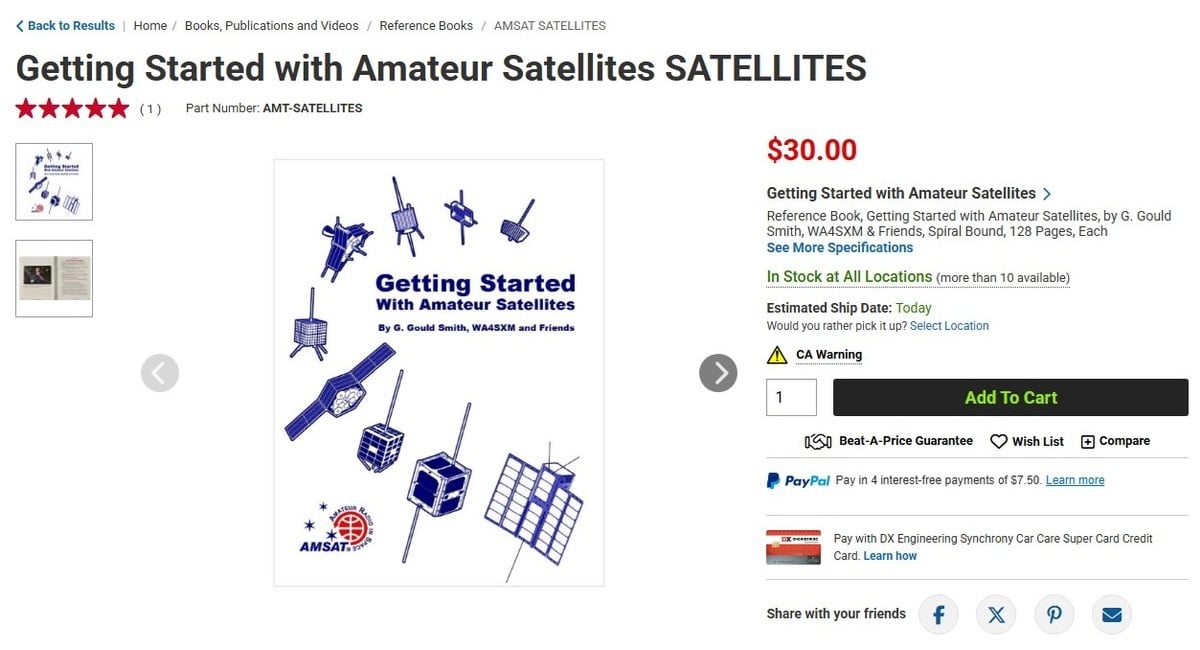 Available for $30 from DX Engineering (free shipping on most orders over $99)
https://www.dxengineering.com/parts/amt-satellites
ARISS News
Amateurs and others around the world may listen in on contacts between amateurs operating in schools and allowing students to interact with astronauts and cosmonauts aboard the International Space Station. The downlink frequency on which to listen is 145.800 MHz worldwide.
Scheduled Contacts
Geneva Christian College, Latrobe, Tasmania, Australia telebridge via IK1SLD
The ISS callsign is presently scheduled to be OR4ISS
The scheduled crewmember is Sophie Adenot KJ5LTN
The ARISS mentor is VK4KHZ
Contact is go for: Mon 2026-08-03 10:00:37 UTC 55 deg
Kenya Space Agency (KSA), Nairobi, Kenya, telebridge via ON4ISS
The ISS callsign is presently scheduled to be OR4ISS
The scheduled crewmember is Sophie Adenot KJ5LTN
The ARISS mentor is IZ2GOJ
Contact is go for: Wed 2026-08-05 11:38:38 UTC 89 deg
Schedule of radio power downs and power ups
COL=Columbus module SM=Service Module
Wed 2026-08-05 11:50 UTC – COL radio power down
Wed 2026-08-05 11:55 UTC – SM radio power down
Thu 2026-08-06 – USOS EVA
Fri 2026-08-07 13:45 UTC – COL radio power up
N/A – SM radio power up
Many times, a school makes a last-minute decision to do a Livestream or runs into a last-minute glitch requiring a change of the URL, but we at ARISS may not get the URL in time for publication. You can always check https://live.ariss.org/ to see if a school is Livestreaming.
As always, if there is an EVA, a docking, or an undocking; the ARISS radios are turned off as part of the safety protocol.
The crossband repeater remains configured in the Columbus Module (145.990 MHz up {PL 67} & 437.800 MHz down). If a crewmember decides to pick up the microphone and turn up the volume, you may hear them on the air—so keep listening, as you never know when activity might occur.
Kenwood D710GA in the Zvezda Service Module – Call sign RSØISS. Please note we’re still in the process of troubleshooting and testing this radio. APRS is currently active on 437.825 MHz. Feel free to check out status reports at https://ariss-usa.org/ARISS_APRS/.
Ham TV is currently transmitting a test signal at 2395.00 MHz.
Note, all times are approximate. It is recommended that you do your own orbital prediction or start listening about 10 minutes before the listed time.
The latest information on the operation mode can be found at https://www.ariss.org/current-status-of-iss-stations.html
The latest list of frequencies in use can be found at https://www.ariss.org/contact-the-iss.html
[ANS thanks Charlie Sufana, AJ9N, one of the ARISS operation team mentors for the above information]
Want to fly the colors on your own grid expedition? Get an AMSAT car flag and other neat stuff from our Zazzle store!
25% of the purchase price of each product goes towards Keeping Amateur Radio in Space
AMSAT Ambassador Activities
AMSAT Ambassadors provide presentations, demonstrate communicating through amateur satellites, and host information tables at club meetings, hamfests, conventions, maker faires, and other events.
August 14-16, 2026
Northeast HamXposition (HamX) & New England Division ARRL Convention
Best Western Royal Plaza & Trade Center
181 Boston Post Road W
Marlborough, MA 01752
W1EME, WD4ASW, WB1FJ
https://hamxposition.org
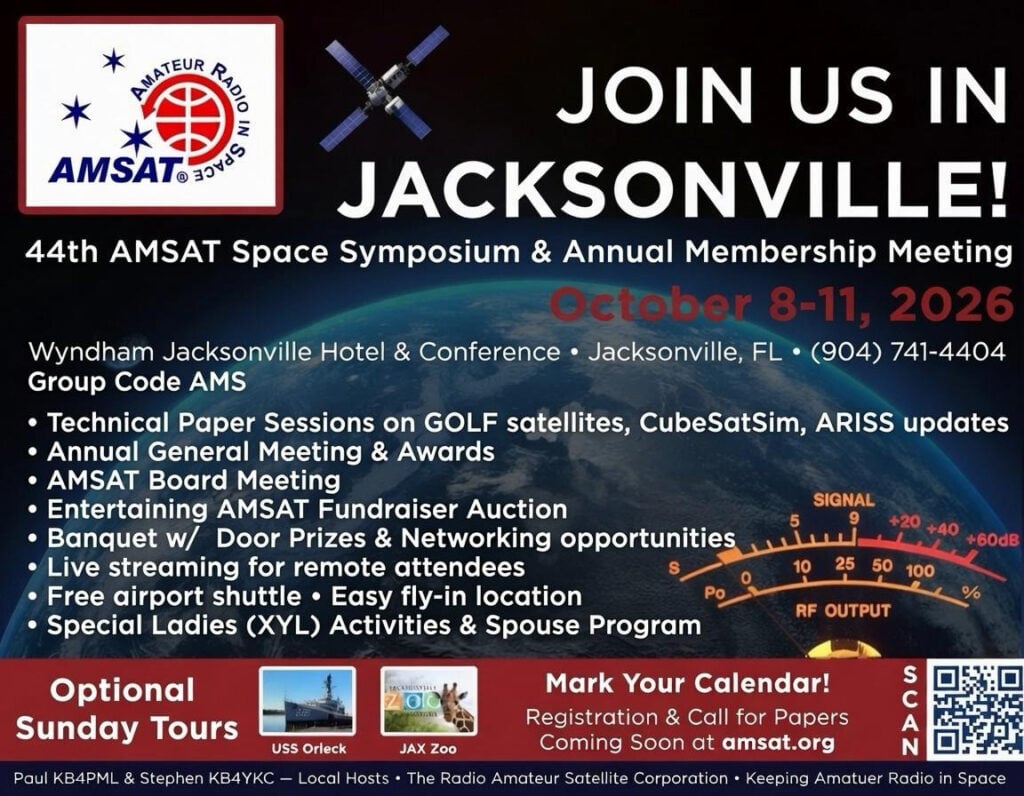
October 8-11, 2026
44th AMSAT Space Symposium and Annual Membership Meeting
Crowne Plaza JAX Airport
14670 Duval Road
Jacksonville, FL 32218
Details to follow
Interested in becoming an AMSAT Ambassador? AMSAT Ambassadors provide presentations, demonstrate communicating through amateur satellites, and host information tables at club meetings, hamfests, conventions, maker faires, and other events. For more information go to: https://www.amsat.org/ambassador/
[ANS thanks Bo Lowrey, W4FCL, Director – AMSAT Ambassador Program, for the above information]
Satellite Shorts from All Over
+ The annual Colorado 14er Event takes place this weekend, August 1-2, 2026, as amateur radio operators activate summits across Colorado, including the state’s famed 14,000-foot peaks. The Summits On The Air (SOTA) activity puts operators in some sought-after mountain grid squares, and satellite operators may find roving activators on the birds during the weekend. Details are available at https://daily.hamweekly.com/2026/06/colorado-14er-event-2026/. (ANS thanks Amateur Radio Daily for the above information)
+ SDRoxide, a new software-defined radio transceiver application featuring a panadapter and dual-VFO operation wrapped in a cyberpunk-styled interface, has been released for macOS, Windows, and Linux. More information is available at https://daily.hamweekly.com/2026/07/sdroxide-sdr-transceiver-panadapter-dual-vfo/. (ANS thanks Amateur Radio Daily for the information)
+ The Russian educational CubeSat UmKA-1 (RS-40S), built by Podolsk School № 29, conducted special transmissions for International Moon Day from July 20–26, 2026. The schedule mixed SSTV (Robot 36 mode on 437.625 MHz FM), audio clips, and text. The event concluded with a short technical broadcast on July 26.
+ NASA completed fueling of the Nancy Grace Roman Space Telescope as preparations continue for a planned Falcon Heavy launch in late August. Roman will operate from the Sun-Earth L2 point, conducting wide-field infrared surveys supporting research into dark energy, dark matter, exoplanets, and galaxy evolution. (ANS thanks NASA for the information)
+ NASA announced that the six-spacecraft SunRISE radio astronomy mission will launch aboard SpaceX Falcon Heavy instead of ULA’s Vulcan. The mission will study low-frequency solar radio emissions using a distributed space-based interferometer, providing new insights into solar activity and space weather. (ANS thanks NASA for the information)
+ Wildfires near Cebreros, Spain, forced precautionary evacuations affecting ESA’s deep-space communications station and nearby NASA facilities. Initial reports indicated no major damage to ESA’s antenna complex, although inspections were delayed until the area became safe. (ANS thanks NASA for the information)
+ Rocket Factory Augsburg continues preparations for the inaugural launch of its RFA ONE launch vehicle from SaxaVord Spaceport in Scotland. Amateur satellite enthusiasts continue to monitor the campaign because future RFA missions are expected to carry PocketQube spacecraft serving the amateur satellite community. Launch remains dependent upon completion of static-fire testing and regulatory approvals. (ANS thanks Rocket Factory Augsburg for the information)
Join AMSAT today at https://launch.amsat.org/
In addition to regular membership, AMSAT offers membership to:
- Societies (a recognized group, clubs or organization).
- Students are eligible for FREE membership up to age 25.
- Memberships are available for annual and lifetime terms.
Contact info [at] amsat.org for additional membership information.
73 and remember to help Keep Amateur Radio in Space!
This week’s ANS Editor,
Paul Stoetzer, N8HM
n8hm [at] amsat.org
ANS is a service of AMSAT, the Radio Amateur Satellite Corporation, 712 H Street NE, Suite 1653, Washington, DC 20002. AMSAT is a registered trademark of the Radio Amateur Satellite Corporation.




![[Valid RSS]](https://www.iz4wnp.it/wp-content/uploads/2026/04/valid-rss-rogers.png "Validate my RSS feed")