
October 4, 2026
In this edition:
- T-4 Days Until Jacksonville Gathering
- 44th AMSAT Space Symposium & Annual General Meeting Schedule
- ERMINAZ-2 Satellites in Orbit
- HADES-L and UNNE-1B will Launch in October
- AO-73 Mode Change
- Volunteer with ARDC in 2027!
- VUCC & DXCC Satellite Standing October 2026
- FCC and HHS Initiate New Proceedings on RF Exposure
- Changes to AMSAT TLE Distribution
- Ambassador Events
- ARISS News
- Satellite Shorts from All Over
The AMSAT(R) News Service bulletins are a free, weekly news and information service of AMSAT, the Radio Amateur Satellite Corporation. ANS publishes news related to Amateur Radio in Space including reports on the activities of a worldwide group of Amateur Radio operators who share an active interest in designing, building, launching and communicating through analog and digital Amateur Radio satellites.
The news feed on http://www.amsat.org publishes news of Amateur Radio in Space as soon as our volunteers can post it.
Please send any amateur satellite news or reports to: ans-editor [at] amsat.org .
Sign up for free e-mail delivery of the AMSAT News Service Bulletins via the ANS List. Join this list at: https://mailman.amsat.org/postorius/lists/ans.amsat.org/
T-4 Days Until Jacksonville Gathering
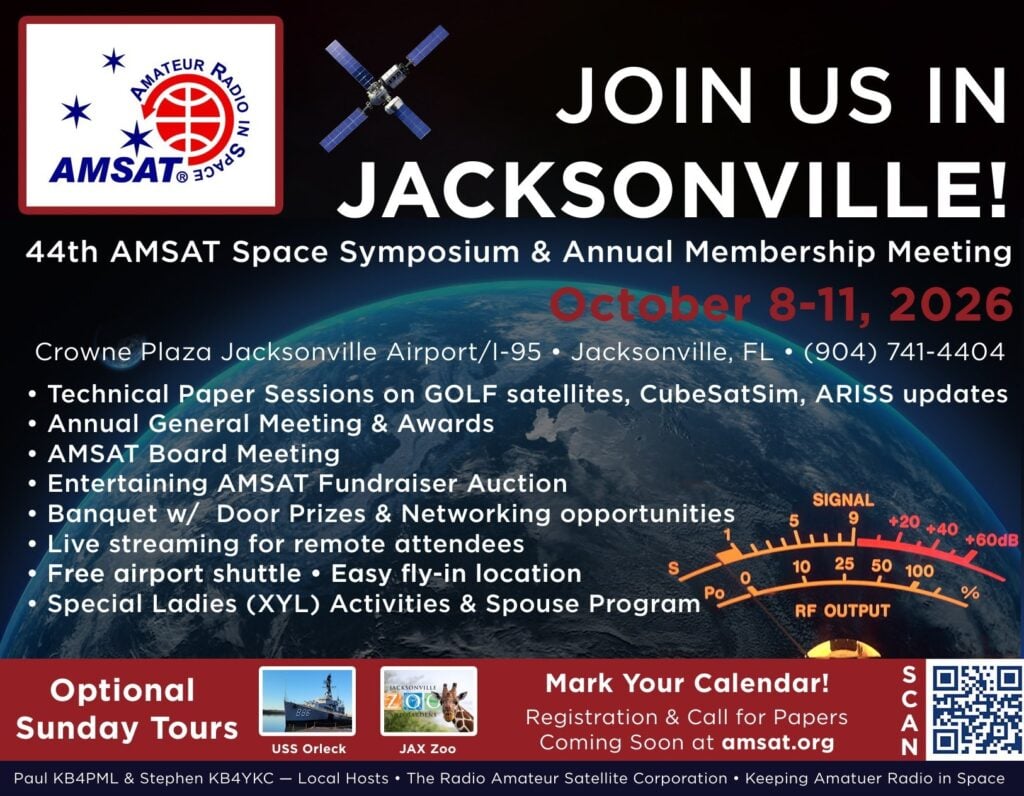
The 44th AMSAT Space Symposium and Annual General Meeting is less than one weeks away, October 8-11, 2026, at the Wyndham Jacksonville Hotel & Conference Center in Jacksonville, Florida.
Registration remains open at https://launch.amsat.org/event-6789663
The weekend opens with the AMSAT Board of Directors meeting on Thursday, October 8, continuing Friday morning, at which the Directors elected in the recently concluded election (see ANS-263) will take their seats.
Symposium presentations begin Friday afternoon and continue through Saturday with the Annual General Meeting at 3:00 p.m. Saturday. The evening banquet (complete with grilled salmon, roasted chicken, green beans, new potatoes and salad) awards, and ham radio door prizes.
Sunday brings the Members Breakfast and optional tours of the USS Orleck and the Jacksonville Zoo, with admission paid at the door.
Although AMSAT’s group code for rooms has expired attendees may still make direct hotel reservations at the Wyndham Jacksonville may be made by phone at 1-800-227-6963.
[ANS thanks the AMSAT Symposium Team for the above information.]
The 2026 President’s Club Coin is Now Here!
Help Support GOLF and FoxPlus.
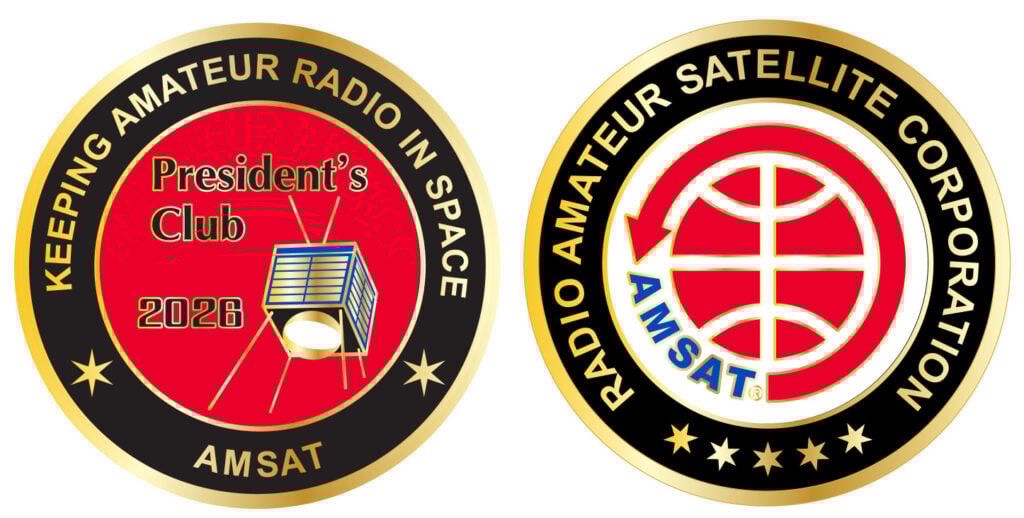
Annual memberships start at only $120
Join the AMSAT President’s Club today and help
Keep Amateur Radio in Space!
https://www.amsat.org/join-the-amsat-presidents-club/
44th AMSAT Space Symposium & Annual General Meeting Schedule
This year’s Symposium has schedule packed with great presentations by the people who make things happen for AMSAT – and You!
All presentations will be livestreamed. You can watch them as they happen on the AMSAT You Tube channel. Dial in https://youtube.com/@amsatna and click on the “Live” to enjoy the show. Presentations will also be saved and available for viewing thereafter.
Thursday, October 8
- 9:00AM to 5:00PM Board of Directors Meeting
- 6:00PM to 8:00PM Pre-Registration Check-in
Friday, October 9
- 9:00AM to 12:00PM Board of Directors Meeting (Closed Session)
- 12:00PM – 1:00PM Lunch Break
- 1:00PM to 5:00PM Presentations (Education session)
- 1:00PM AMSAT Education and CubeSat Simulator Project Update 2026 – Alan Johnston, PhD KU2Y
- 1:30PM New CubeSatSim Features: Pacsat, Simulated Doppler, Dashboard, and Hotspot – Alan Johnston, PhD KU2Y
- 2:00PM Using the CubeSatSim as Command Station Learning Tool – Josh Tate, KF4EAG
- 2:30PM Teaching Technology to Middle/High School Students Using An Amateur Radio Foundation & ARISS Competition As The Goal – Gordon L. Gibby, MD KX4Z
- 3:00PM How to Get 20 High Schools to LEO – Nick Pugh K5QXJ
- 3:30PM ARISS: Celebrating 25 Years of Continuous Operations on ISS—and Beyond! – Frank Bauer KA3HDO
- 6:00PM to 9:00PM Reception and Auction
Saturday, October 10
- 9:00AM to 12:00PM Presentations (Operating session)
- 9:00AM Satellite Observation Station: Keeping Track of Radio Amateur Satellites – Joseph A. DiVerdi, PhD, MBA K0NMR
- 9:30AM CardSat and OrbitDeck – Paul Stoetzer N8HM
- 10:00AM Introducing OsTrax – Orbiting Satellite Tracking for the Next Generation – Jim McCullers WA4CWI
- 10:30AM The Modern OSCARLOCATOR – Paul Stoetzer N8HM
- 11:00AM AMSAT Operations Update – Mark Hammond N8MH
- 11:30AM AMSAT Youth Initiative Progress Report – Frank Karnauskas N1UW
- 11:30AM – 1:30PM Lunch Break
- 1:30PM to 4:00PM Presentations (Engineering session)
- 1:30PM Jovian-1 and FUNcube+ Updates – David Bowman G0MRF
- 2:00 PM Amcom 2.0: Modernizing AMSAT Satellite Command and Control – Heimir Thor Sverrisson W1ANT
- 2:30 PM SDR-Gen2 Status – Ray Roberge and Nick Grabbs WA1CYB / KI5YNG
- 3:00 PM AMSAT Engineering Update – Jerry Buxton N0JY
- 4:00PM to 5:00PM AMSAT Annual Meeting
- 6:00PM to 7:00PM Attitude Adjustment (Social)
- 7:00PM to 10:00PM AMSAT Banquet and Awards Ceremony
Sunday, October 11
- 7:30AM-9:00AM AMSAT Ambassador Breakfast (All are welcome)
[ANS thanks the Symposium Team for the above information.]
ERMINAZ-2 Satellites in Orbit
AMSAT-Deutschland (AMSAT-DL) launched three ERMINAZ-2 nanosatellites on October 2026 on a SpaceX Falcon 9 rocket. The satellites were developed, built, and certified for spaceflight at the satellite laboratory located in the radome of the Bochum Observatory.
Each is a PocketQube 1PQ form factor, 50 x50 x 50 mm, weighing about 250 grams. They are in sun-synchronous orbit at an altitude of 500 km and an apogee of 600 km
Their goal is o promote space knowledge and amateur radio via open-source protocols, telemetry, and image transmissions.
The frequencies and callsigns for the three satellites are as follows:
- ERMINAZ-2U: Operates in the UHF band on 435.900 MHz (Callsign: DP0PQA).
- ERMINAZ-2V: Operates in the VHF band on 145.920 MHz (Callsign: DP0PQB).
- ERMINAZ-2X: Operates in the VHF band on 145.960 MHz (Callsign: DP0PQC).
[ANS thanks AMSAT-DL for the above information.]
AMSAT Remove Before Flight Key Tags Now Available
Yes, These are the Real Thing!
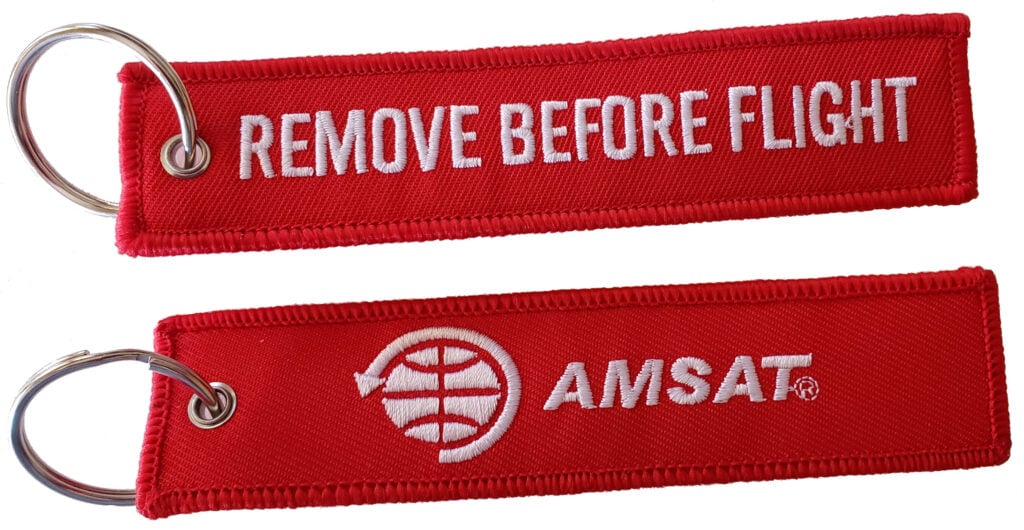
Your $20 Donation Goes to Help Fly a FoxPlus Satellite
Includes First Class Postage (Sorry – U.S. Addresses Only)
Order Today at https://www.amsat.org/product/amsat-remove-before-flight-keychain
HADES-L and UNNE-1B will Launch in October
Felix Paez, EA4GQS reports that AMSAT-EA is launching UNNE-1B and HADES-L on SpaceX’s Transporter 18 mission.
UNNE-1B (HADES-E2) is an improved version of UNNE-1, which is still awaiting launch from the UK with RFA. It implements our usual VHF-to-UHF FSK/FM repeater. The repeater will be active 24/7 once the satellite has been checked and commissioned.
The name UNNE-1 comes from Universidad Nebrija, a private university that has developed a small Arduino-based computer with a guessing game. More details about the game will be published by the university, and we will also add a link to it on our website.
The UNNE-1 frequencies are:
- Uplink: 145.925 MHz FM (no subtone), FSK up to 2400 bps
- Downlink: 436.888 MHz FM voice, FSK 200 bps
HADES-L has a different approach. As has happened to us several times, this has been a very quickly developed satellite, taking advantage of an available launch opportunity. HADES-L implements a 29 MHz USB to 436 MHz FM repeater. The main challenge with this satellite is that, due to the space occupied by the experiment it carries, it only has three solar panels, so power availability is a concern.
Because of this, the repeater is only active for 4 minutes every 12 minutes, and if the energy level is very low, it may remain switched off during some passes. Nevertheless, we think having an uplink in the 29 MHz band is very interesting.
The best way to know whether the repeater is active is to listen to the downlink for the typical FM noise. It is currently configured to activate automatically even without an uplink signal, to make operation easier. This configuration may be changed if circumstances require it.
The HADES-L frequencies are:
- Uplink: 29.472 MHz USB (not 28.472 MHz; there was a typo in the first version of the document sent to IARU)
- Downlink: 436.665 MHz FM voice, FSK telemetry at 800 bps
The HADES-L coordination request was sent to IARU rather late, but we expect to receive the coordination document in the coming days.
Software for both satellites is available here, thanks to Andy UZ7HO:
https://www.amsat-ea.org/proyectos/
[ANS thanks Felix Paez, EA4GQS for the above information.]
AO-73 Mode Change
Following nearly 1 year of continuous operation of the U/V transponder, AO-73 / FUNcube-1 will be switched to transmitting higher power telemetry from apx 14.30 UTC on Sunday 4th October.
The mode change coincides with World Space Week and will allow easier reception of satellite telemetry. Information on World Space Week can be found at https://www.worldspaceweek.org/ .
At present, the eclipse periods experience by AO-73 are quite short, with only 20 minutes per orbit without sunlight. This will allow The AMSAT-UK FUNcube team to assess the state of the battery and electrical power system without significant risk to the satellite.
Launched in Nov 2013, AO-73 is approaching 13 years of successful operations on orbit.
Normal transponder operation will resume on Monday 12th October.
[ANS thanks David Bowman, G0MRF for the above information.]
Need new satellite antennas?
Purchase M2 LEO-Packs from the AMSAT Store.
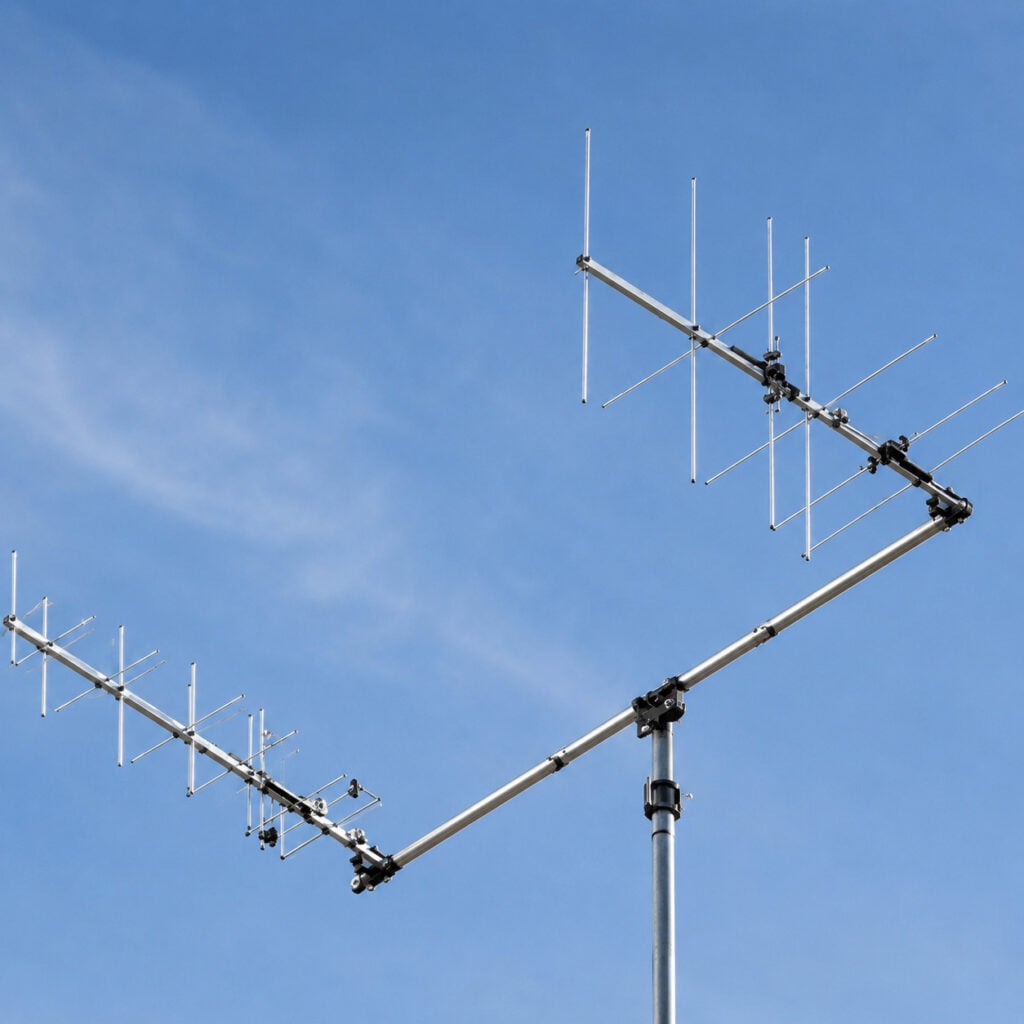
When you purchase through AMSAT, a portion of the
proceeds goes towards Keeping Amateur Radio in Space.
https://amsat.org/product-category/hardware/
Volunteer with ARDC in 2027!
ARDC, Amateur Radio Digital Communications, is now accepting applications for their 2027 volunteer cohort. They’re looking for qualified individuals to contribute their time and expertise across several committees and teams:
- Grants Advisory Committee (GAC) – reviews grant applications.
- Technical Advisory Committee (TAC) – works on 44Net-related projects and policies.
- Grants Evaluation Team (GET) – evaluates and analyzes grant reports.
- Grants Communications Team (GCT) – writes about grant results for the public to learn from.
- Conduct Review Committee (CRC) – helps to evaluate Code of Conduct incident reports. Must concurrently serve in another volunteer role.
Interested in applying? Please complete their application form by October 30, 2026: https://forms.gle/sWBt8TZdKc3VgNgA9. Please also be prepared with a PDF file of your resume or CV.
Alternatively, you can send a message to [email protected] with the requested application information.
Amateur Radio Digital Communications (ARDC) is a private foundation that exists to support amateur radio and digital communication science and technology. We do this through making grants (including support for scholarship programs and research & development projects) and managing 44Net.
For complete information, go to https://www.ardc.net/volunteer-with-ardc-in-2027/ .
[ANS thanks Rebecca Key, KO4KVG ARDC Communications Manager for the above information.]
VUCC & DXCC Satellite Standing October 2026
VUCC Satellite Award/Endorsement Change Summary for September 01, 2026 to October 01, 2026.
| KO4MA | 2100 | 2126 |
|---|---|---|
| W5CBF | 1895 | 2002 |
| JN2QCV | 1180 | 1286 |
| KG0D | 900 | 1023 |
| KQ4DO | 983 | 1003 |
| IK1IYU | 900 | 1002 |
| N0GVK | 899 | 922 |
| N8MR | 809 | 830 |
| KJ7DZ | 700 | 809 |
| F6GLJ | 701 | 805 |
| WD9EWK | 781 | 791 |
| EA3TA | 681 | 700 |
| K3HPA | 453 | 484 |
| N4BAA | New | 471 |
| N4QWF | 376 | 400 |
| KB9DAK | 278 | 290 |
| KT8O | 201 | 216 |
| I3VFJ | New | 202 |
| IK2TPX | 101 | 178 |
| MM0INH | New | 107 |
| IU2VUD | New | 105 |
| HS8MOM | New | 103 |
Congratulations to the new VUCC Satellite holders.
N4BAA
I3VFJ
MM0INH
IU2VUD
HS8MOM
I3VFJ is first VUCC-Satellite holder from JN65.
HS8MOM is first VUCC-Satellite holder from NJ99.
DXCC Satellite Award/Endorsement Change Summary for September 01, 2026 to October 01, 2026.
| IZ1ERR | 113 | 161 |
|---|---|---|
| LA0FA | 138 | 151 |
| WC7V | 125 | 135 |
| TF1A | 119 | 121 |
| N8MR | New | 100 |
Congratulations to the new DXCC Satellite holders.
N8MR
VE6LQ
W2RS
[ANS thanks Jon Goering, N7AZ for the above information.]
FCC and HHS Initiate New Proceedings on RF Exposure
The ARRL is following two new federal proceedings concerning radio frequency (RF) exposure. On September 17, 2026, the FCC and the U.S. Department of Health and Human Services (HHS) initiated parallel comment periods on RF safety issues. Neither inquiry changes the current FCC RF exposure rules that apply to all radio amateurs but could lead to changes in later proceedings if the current rules are found to be deficient.
The FCC’s Public Notice is narrowly focused on specific RF exposure issues remanded to the Commission in 2021 by the U.S. Court of Appeals. The Commission emphasizes that it will give particular weight to submissions reflecting specialized expertise in health and safety matters. The HHS Request for Information broadly seeks evidence and information concerning the potential health effects of electromagnetic fields (EMFs), RF
The Request for Information (RFI) calling on Americans, scientists, physicians, industry, and public health experts to submit evidence and information on the potential health effects of electromagnetic fields (EMFs), radiofrequency (RF) radiation, and wireless radiation exposure.
The RFI will help HHS evaluate the state of the science, compare U.S. and international safety standards and regulatory approaches, identify critical research gaps, and develop practical, evidence-based recommendations for policymakers, families, schools, communities, and public health professionals.
“Wireless technologies are part of daily life, and our science must keep pace,” said HHS Secretary Robert F. Kennedy, Jr. “The MAHA Strategy directed HHS to examine electromagnetic radiation and health research, and we are acting on that directive. I encourage scientists, physicians, industry, public health experts, workers, parents, and citizens to bring us the best available evidence so we can identify the gaps and focus federal research where it is needed most.”
HHS is seeking information on RF/EMF exposures associated with mobile phones, Wi-Fi, smart meters, wireless infrastructure, wearable technologies, wireless medical devices, 5G, 6G, satellite communications, Internet of Things devices, smart homes, smart cities, autonomous vehicles, and other emerging technologies.
The Department is requesting information across several key areas:
- Health experiences and clinical observations.
- Exposure standards and risk assessment.
- Potentially sensitive populations.
- Existing scientific evidence.
- Federal research priorities.
HHS asks respondents to identify the basis for their submissions, including peer-reviewed research, government reports, industry data, clinical observations, or other sources. The Department encourages respondents to submit supporting research, datasets, technical reports, citations, and other relevant evidence whenever available.radiation, and wireless technologies.
Comments on the HHS inquiry are due October 21, with comments on the FCC issues due by October 22.
The current rules governing RF exposure took effect on May 3, 2021, and are discussed in the September 2021 and May 2023 issues of QST. The ARRL website features additional information, including an RF exposure calculator, the RF Safety section from the 100th Edition of The ARRL Handbook for Radio Communications, an explanatory video, FAQs, and more. ARRL has made these resources available to everyone in the amateur radio community without regard to membership. ARRL urges all licensees to stay compliant and safe.
[ANS thanks the ARRL and the HHS for the above information.]
Changes to AMSAT TLE Distribution for October 2, 2026
Two Line Elements or TLEs, often referred to as Keplerian elements or keps in the amateur community, are the inputs to the SGP4 standard mathematical model of spacecraft orbits used by most amateur tracking programs. Weekly updates are completely adequate for most amateur satellites. TLE bulletin files are updated daily in the first hour of the UTC day. New bulletin files will be posted immediately after reliable elements become available for new amateur satellites. More information may be found at https://www.amsat.org/keplerian-elements-resources/.
This week there are no additions or deletions to the AMSAT TLE distribution.
[ANS thanks Joe Fitzgerald, KM1P, AMSAT Orbital Elements Manager for the above information.]
ARISS NEWS
Amateurs and others around the world may listen in on contacts between amateurs operating in schools and allowing students to interact with astronauts and cosmonauts aboard the International Space Station. The downlink frequency on which to listen is 145.800 MHz worldwide.
Scheduled Contacts
University Heights School of Medical Arts, Jonesboro, AR, telebridge via IK1SLD.
The ISS callsign is presently scheduled to be OR4ISS.
The scheduled crewmember is Joshua Kutryk, KJ5BFU.
The ARISS mentor is Charlie Sufana, AJ9N
Contact is go for: Mon 2026-10-05 15:27:07
Wick High School, Wick, United Kingdom, direct via GB4WHS.
The ISS callsign is presently scheduled to be NA1SS.
The scheduled crewmember is Joshua Kutryk, KJ5BFU.
The ARISS mentor is Ciaran Morgan, M0XTD
Contact is go for: Tue 2026-10-06 13:00:34 UTC 25
Successful Contacts
Scuola Media Pio X Artigianelli, Firenze, Italy, direct via IW5CWC, joint contact with Istituto Comprensivo Statale Rita Levi Montalcini Campolongo Maggiore e Campagna Lupia, Campolongo Maggiore – Venezia, Italy, direct via IQ3RW.
The ISS callsign was OR4ISS.
The crewmember was Sophie Adenot, KJ5LTN.
The ARISS mentor was Francesco de Paolis IK0WGF.
Contact was successful Tuesday, 9/29/ 2026 at10:28:57 UTC.
City of Bolgar, Republic of Tatarstan, Russia direct via R4PT.
The ISS callsign was RSØISS.
The crewmember was Anna Kikina, KJ5BFU.
The ARISS mentor was A.R.C. ENERGIA, RV3DR.
Contact was successful Wednesday, 9/30/ 2026 at 11:25 UTC.
Schedule of Radio Power Downs
COL=Columbus omdule; SM=Service Module HamTV is also known as Ham-Video
Fri 2026-10-02 09:00 UTC Expedition 75 – ARISS Series 33 Student Education SSTV Event start
Tue 2026-10-06 15:55 UTC Expedition 75 – ARISS Series 33 Student Education SSTV Event end
Frequency is 437.550 MHz (+/- Doppler)
Mode is Robot36
Transmission 36 seconds on 2 minutes off
The crossband repeater continues to be active (145.990 MHz up {PL 67} & 437.800 MHz down). If any crewmember is so inclined, all they have to do is pick up the microphone, raise the volume up, and talk on the crossband repeater. So give a listen, you just never know.
As always, if there is an EVA, a docking, or an undocking; the ARISS radios are turned off as part of the safety protocol.
Note, all times are approximate. It is recommended that you do your own orbital prediction or start listening about 10 minutes before the listed time.
The latest information on the operation mode can be found at https://www.ariss.org/current-status-of-iss-stations.html
The latest list of frequencies in use can be found at https://www.ariss.org/contact-the-iss.html
[ANS thanks Charlie Sufana, AJ9N, one of the ARISS operation team mentors for the above information.]
LIMITED TIME OFFER!
AMSAT is offering a limited-time promotion for new and renewing members
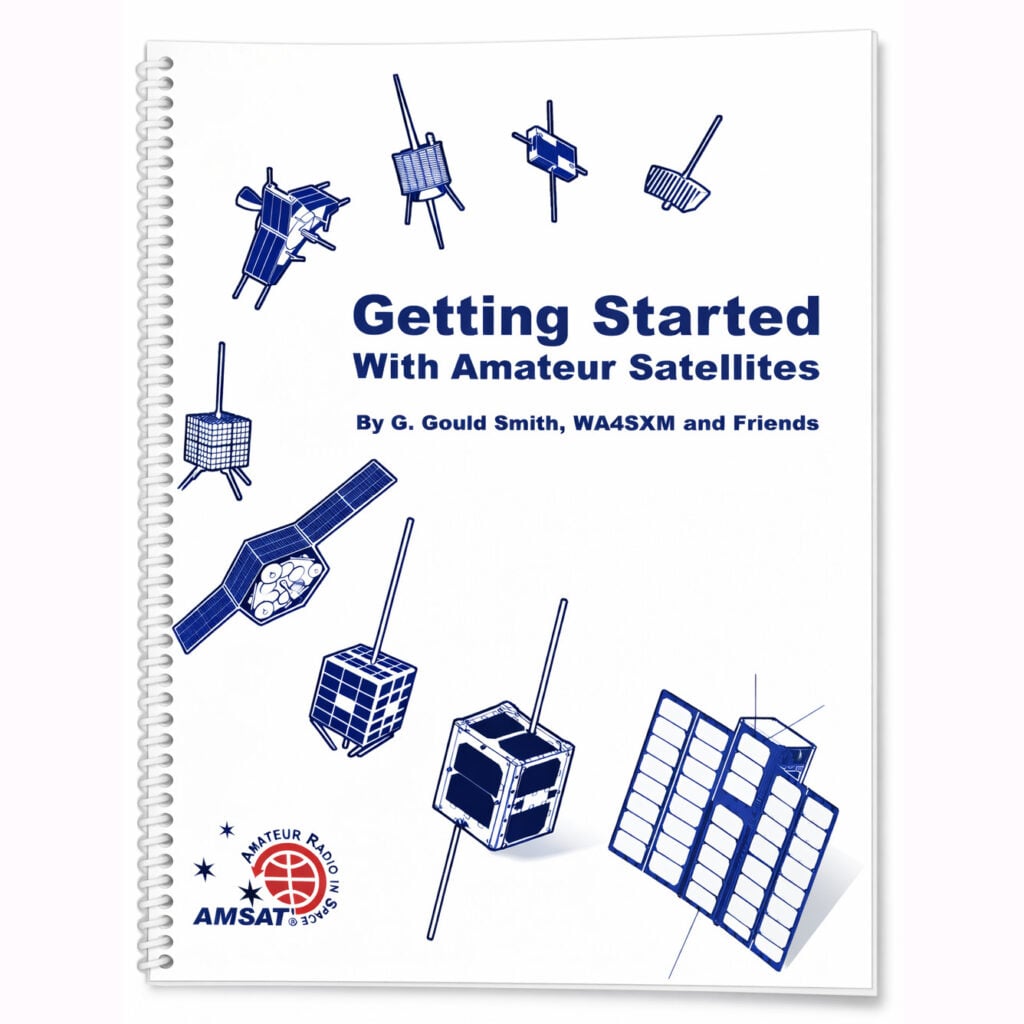
that includes a free digital copy of Getting Started with Amateur Satellites.
The promotion is being offered as AMSAT begins the 2026 membership year.
Anyone who joins or renews their AMSAT membership during the promotional period
will receive a download link for the latest edition of Getting Started with Amateur Satellites
in their membership confirmation email. JOIN TODAY at https://launch.amsat.org/
(Remember! Students join for FREE!)
AMSAT Ambassador Activities
AMSAT Ambassadors provide presentations, demonstrate communicating through amateur satellites, and host information tables at club meetings, hamfests, conventions, maker faires, and other events.
October 8-11, 2026
44th AMSAT Space Symposium and Annual Membership Meeting
Wyndham Jacksonville Hotel and Conference Center
14670 Duval Road
Jacksonville, FL 32218
https://www.amsat.org/2026-amsat-symposium/
November 14, 2026
Southern Arizona Fall Hamfest
Oro Valley Amateur Radio Club
Marana Middle School
11285 W. Grier Rd.
Marana AZ
https://www.tucsonhamradio.org/hamfest
N1UW
[ANS thanks Bo Lowrey, W4FCL, Director – AMSAT Ambassador Program, for the above information.]
Satellite Shorts From All Over
- The next AMSAT Students on the Air activity day is Tuesday, October 6. StOTA encourages licensed student operators to make satellite contacts on the first and third Tuesdays of each month and asks the wider amateur satellite community to make a special effort to welcome young operators onto the satellites. [ANS thanks AMSAT for the above information.]
- On Thursday, October 1, 2026, Spanish launch service provider PLD Space signed a bilateral agreement with the French Space Agency, Centre National d’Études Spatiales (CNES), to advance commercial launch infrastructure at the Guiana Space Centre in Kourou, French Guiana. The partnership establishes a joint technical framework to assess the feasibility of adding a second launch pad at the ELM-Diamant complex to support flight operations for PLD Space’s MIURA 5 and MIURA 9 orbital launch vehicles. The joint initiative aligns with European Space Agency (ESA) efforts under the European Launcher Challenge to diversify access to orbit by integrating commercial launch providers into Europe’s primary spaceport. By expanding launch capacity at ELM-Diamant, CNES and PLD Space aim to increase mission throughput, lower spaceport operational bottlenecks, and establish a multi-user gateway capable of handling both European government payloads and commercial constellation deployments. [ANS thanks satnews.com for the above information.]
- On Wednesday, September 30, 2026, the Federal Communications Commission (FCC) voted 2-1 to codify an order confirming that satellite licensing operations are categorically excluded from environmental review under the National Environmental Policy Act (NEPA). The ruling formally establishes that licensing commercial space systems does not constitute a major federal action requiring environmental impact assessments. The regulatory update applies broadly across the commercial satellite lifecycle. Under the newly approved order, the environmental exclusion covers spacecraft manufacturing launch authorizations, orbital deployment, on-orbit operations, spectrum authorizations, and ground station earth terminals. [ANS thanks satnews.com for the above information.]
Join AMSAT today at https://launch.amsat.org/
In addition to regular membership, AMSAT offers membership to:
- Societies (a recognized group, clubs or organization).
- Students are eligible for FREE membership up to age 25.
- Memberships are available for annual and lifetime terms.
Contact info [at] amsat.org for additional membership information.
73 and remember to help Keep Amateur Radio in Space!
This week’s ANS Editor, Frank Karnauskas, N1UW.
f.karnauskas [at] amsat [dot] org
ANS is a service of AMSAT, the Radio Amateur Satellite Corporation, 712 H Street NE, Suite 1653, Washington, DC 20002.
AMSAT is a registered trademark of the Radio Amateur Satellite Corporation.


![[Valid RSS]](https://www.iz4wnp.it/wp-content/uploads/2026/04/valid-rss-rogers.png "Validate my RSS feed")