AMSAT News Service
ANS-305
November 1, 2026
In this edition:
- AMSAT OSCAR Satellite Status Page – New URL
- Spacewalkers Install Seventh Roll-Out Solar Array; Final Installation Set for November 5
- ARISS SSTV Series 34 Concludes
- UNNE-1B Heard Around the World as AMSAT-EA Commissions Its Newest PocketQubes
- IARU Coordinates HADES-L and PVDX; Three Requests Declined, Four New Applications Filed
- Polish Student CubeSat PUCHACZ Seeks IARU Frequency Coordination
- UMKA-1 Sends Telescope Images by SSTV
- ARISS Opens New U.S. School Contact Proposal Window
- FO-29 Full-Sunlight Season Enters Its Final Weeks
- FO-126 Conducting 5.84 GHz High-Speed Tests
- NASA Details Accelerated Artemis Plan: Earth-Orbit Lander Test in 2027, Lunar Landings in 2028
- HOA Lobbying Group Makes Blocking Amateur Radio Antenna Bill a Top Priority
- Changes to AMSAT TLE Distribution for October 30, 2026
- ARISS News
- AMSAT Ambassador Activities
- Satellite Shorts From All Over
The AMSAT® News Service bulletins are a free, weekly news and information service of AMSAT, The Radio Amateur Satellite Corporation.
ANS publishes news related to Amateur Radio in Space including reports on the activities of a worldwide group of Amateur Radio operators who share an active interest in designing, building, launching and communicating through analog and digital Amateur Radio satellites.
The news feed on https://www.amsat.org publishes news of Amateur Radio in Space as soon as our volunteers can post it.
Please send any amateur satellite news or reports to: ans-editor [at] amsat.org
You can sign up for free e-mail delivery of the AMSAT News Service Bulletins via the ANS List; to join this list see: https://mailman.amsat.org/postorius/lists/ans.amsat.org/
AMSAT OSCAR Satellite Status Page – New URL
The AMSAT IT Team and community volunteers have been working for a number of months to upgrade the AMSAT Status Page. This effort brings new features, a more modern technical implementation, and enables open-source development. One of the biggest changes is coming up on Wednesday, November 4th. The URL will switch to https://status.amsat.org. The API will be reachable at https://status.amsat.org/api/v1 [Overview].
Notification banners have been placed on both sites. The site migration will commence at 1400 UTC on November 4th. The IT Team expects up to two hours before all historical and current data is migrated to the new site. Once the migration is completed, the old site will automatically redirect users to the new one.
The AMSAT community, and others, are welcome and encouraged to engage in the ongoing development activity.
Problems/Issues/Questions/Requests/Suggestions should be submitted (as an issue) to the Github project repo here. You can also reach out in the AMSAT Discord server in the #open-source-dev channel. You may also contact the IT team via e-mail at IT at amsat.org.
[ANS thanks Matthew Alberti, KM4EXS, AMSAT IT Team Lead, for the above information]
LIMITED TIME OFFER!!!
AMSAT is offering a limited-time promotion for new and renewing members that includes a free digital copy of Getting Started with Amateur Satellites. The promotion is being offered as AMSAT begins the 2026 membership year.
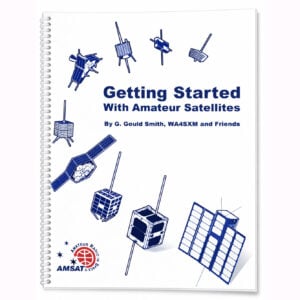
Anyone who joins or renews their AMSAT membership during the promotional period will receive a download link for the latest edition of Getting Started with Amateur Satellites in their membership confirmation email. JOIN TODAY at https://launch.amsat.org/ (Remember! Students join for FREE!)
Spacewalkers Install Seventh Roll-Out Solar Array; Final Installation Set for November 5
NASA astronaut Anil Menon and Canadian Space Agency astronaut Joshua Kutryk, KJ5BFU, completed a 7-hour, 11-minute spacewalk on Thursday, October 29, installing and deploying the seventh of eight International Space Station Roll-Out Solar Arrays (iROSAs) on the station’s port truss. NASA reported the following day that the new array is generating power. The pair are scheduled to go back outside on Thursday, November 5, to install the eighth and final array, completing a power upgrade campaign that began in June 2021.
The spacewalk officially began at 7:57 a.m. EDT (1157 UTC) when the two astronauts switched their suits to battery power inside the Quest airlock. Menon exited first, followed six minutes later by Kutryk, who with that step became the fifth Canadian to walk in space. After reaching the iROSA carrier pallet on the truss, Menon climbed into a foot restraint on the end of the Canadarm2 robotic arm while Kutryk released the bolts holding the folded array in place. Menon, riding the arm, carried the 750-pound (340-kilogram) package to the P4 truss, where the two soft-docked it onto the mounting bracket in front of the station’s original 2A power-channel array at 10:40 a.m. EDT. Three of the four main power connectors were mated before the crew paused for an orbital day pass, since the connections must be made in darkness when the arrays are not generating power. Roll-out began at 12:21 p.m. EDT (1621 UTC), four hours and 23 minutes into the spacewalk, and about 12 minutes later the 63-foot (19-meter) array was fully extended, draping over roughly half of the legacy wing behind it. No motor was involved; the stored energy in the array’s rolled carbon-composite booms did the work, after which Menon drove two tension bolts to pull the blanket taut and mated the final connector during the next night pass.
Running about an hour ahead of the timeline, the spacewalkers then turned to get-ahead tasks for the second excursion, cleaning up the P4 worksite, removing the beams and booms that had secured the seventh array for launch, and releasing the anti-rotation devices and launch locks on the eighth array, which remains stowed on its carrier. The spacewalk ended at 3:08 p.m. EDT (1908 UTC) with airlock repressurization. NASA commentator Rob Navias described the outing as “essentially flawless.” Inside the station, NASA astronauts Luke Delaney, KJ5PPF, and Jessica Watkins operated Canadarm2, while NASA astronaut Nichole Ayers guided the spacewalkers from Mission Control Houston and CSA astronaut Jenni Gibbons served as capcom.
The excursion was the 285th spacewalk conducted in support of station assembly, maintenance, and upgrades, and NASA’s count also made it U.S. Spacewalk 100, the 100th conducted from the Quest airlock without a Space Shuttle docked to the station. The first, by Carl Walz and Daniel Bursch on February 20, 2002, had largely been a checkout of the then-new airlock. “This is USOS EVA 100, which is an incredible milestone,” Menon noted from outside. It was the fourth spacewalk for Menon, who arrived aboard a Soyuz in July and has now logged 26 hours and 31 minutes outside the station, and the first for Kutryk, who follows Chris Hadfield (2001), Steve MacLean (2006), Dave Williams (2007), and David Saint-Jacques (2019) on the short list of Canadian spacewalkers. Menon offered two observations for the ages, remarking “The night is dark and full of wonder” as he opened the airlock’s thermal cover at the start of the spacewalk, and “I can say it is always sunny in space” as it ended.
The two arrays for this round of spacewalks arrived at the station in the trunk of the SpaceX CRS-35 Dragon cargo spacecraft, which launched from Cape Canaveral on October 13. The iROSAs are mounted in front of the station’s eight original solar wings, which have exceeded their 15-year design life and degraded as expected, and each new array produces more than 20 kilowatts even while shadowing part of the older wing behind it. With all eight installed, NASA says the station’s generating capacity will rise from about 160 kilowatts to about 215 kilowatts, an increase of up to 30 percent that will support research and operations through the station’s planned 2030 retirement, including the power needed for its safe and controlled deorbit.
The second outing, U.S. Spacewalk 101 on November 5, will take Menon and Kutryk to the far starboard end of the truss to install the final array on the 3B power channel of the S6 truss segment. That worksite lies beyond the reach of Canadarm2, so the astronauts will have to “leapfrog” the array out to the end of the truss by hand, a more demanding task than Thursday’s robotics-assisted installation. NASA’s live coverage is scheduled to begin at 6:45 a.m. EST (1145 UTC) on NASA+ and the agency’s website.
The spacewalks matter to the amateur radio community for a practical reason. As a standing safety protocol, the ARISS radios aboard the station are powered off whenever a spacewalk, docking, or undocking is underway, so the Columbus Module crossband repeater and the Zvezda Service Module APRS digipeater were silent on Thursday and will be again on November 5. ARISS school contacts are also scheduled around spacewalk days; the ARISS operations calendar currently shows no contacts between the October 30 telebridge contact with The Smile of the Child in Greece (see ARISS News below) and the November 5 spacewalk.
[ANS thanks NASA, the Canadian Space Agency, Spaceflight Now, and Space.com for the above information.]
ARISS SSTV Series 34 Concludes
The second ISS Slow Scan Television event of October has come to a close. ARISS SSTV Series 34, featuring images of ARISS hardware, began on Thursday, October 22, and concluded on Monday, October 26, at 17:45 UTC, giving stations around the world four days of passes to capture the Expedition 75 transmissions.
As with the Series 33 “Student Education” event earlier in the month, images were transmitted from the amateur radio station in the ISS Service Module under the callsign RS0ISS on 437.550 MHz FM using the Robot 36 mode, with each image taking 36 seconds to send followed by a gap of about two minutes. The 70-centimeter downlink meant a Doppler swing of roughly plus or minus 10 kHz across each pass, so stations that stepped their receivers through the pass, or that let their software do it for them, had the best chance of a clean decode. With only a 36-second transmission in each cycle, the event rewarded patience: a station that heard nothing simply waited two minutes for the next frame.
With the SSTV event complete, ARISS-Europe says the Service Module transceiver is being returned to APRS packet operation on 437.825 MHz, where it is expected to remain through the end of the year, except during spacewalks and other periods when the station’s amateur radios are switched off (see the lead story and ARISS News, below). Updates on future SSTV events are posted at https://www.ariss.org/upcoming-sstv-events.html and on the ARISS social media channels.
[ANS thanks ARISS, ARISS-Europe, and AMSAT-UK for the above information.]
UNNE-1B Heard Around the World as AMSAT-EA Commissions Its Newest PocketQubes
Four weeks after launch, AMSAT-EA’s UNNE-1B PocketQube is in orbit, transmitting, and being decoded by ground stations around the world, while the organization works through the commissioning steps that will precede activation of its FM voice and data repeater. The status of its sister spacecraft, HADES-L, which shared the ride, has not yet been publicly reported.
Both satellites launched on SpaceX’s Transporter-18 rideshare mission from Vandenberg Space Force Base at 18:32 UTC on October 1, carried inside OSSIE-D, an orbital transfer vehicle built by the Spanish company UARX. OSSIE-D separated from the Falcon 9 upper stage roughly an hour after liftoff at an altitude of about 520 km. AMSAT-EA reported that UNNE-1B and HADES-L were then ejected from the transfer vehicle on Friday, October 2, at 11:48 UTC, considerably earlier than the days or weeks of orbit stabilization the team had cautioned might be required. The first UNNE-1B packets were received on October 4, and in an October 13 update the team at Universidad Nebrija in Madrid, whose students developed the satellite’s educational payload, said the amateur community had been receiving telemetry steadily since then, including the first packets from the on-board game.
UNNE-1B, also known as HADES-E2, is a 1.5P PocketQube that uses the same hardware and software as the original UNNE-1, whose planned launch aboard RFA One from the United Kingdom has been repeatedly delayed. Its SDR-based FM/FSK repeater listens on 145.925 MHz, accepting FM voice without any access tone along with FSK at 200 bps and AFSK AX.25 and APRS at 1200 or 2400 bps, and downlinks on 436.888 MHz. The repeater launched in mode 0, in which only telemetry is transmitted, and will be switched on by telecommand once in-orbit testing is complete; mode 1 provides the FM repeater for voice and data, and mode 2 a regenerative digital repeater. Once enabled, the UNNE-1B repeater is intended to remain continuously available, activated by carrier squelch. The satellite also transmits a CW beacon and a prerecorded CODEC2 digital voice message.
The educational payload is a deduction game, “Space Cowboy II,” written by Nebrija’s ARIES student group and running on an Arduino board. The satellite sends a telemetry packet, type 10, containing the game status and the number of weeks since release, and will transmit one clue per week; amateurs who collect the clues can attempt to solve the mystery of a lost spacecraft and an encrypted message. The telemetry uses FSK with about 1.64 kHz tone spacing and a 0xBF35 sync word, and decoder details are being published at https://www.nebrija.com/unne1b/en/index.html and on the AMSAT-EA website at https://www.amsat-ea.org/.
HADES-L is the more experimental of the pair. Measuring just 10 x 5 x 5 cm and generating an average of only 175 mW, it carries a transponder with an uplink on the 10-meter band, 29.472 MHz USB with about 3 kHz of bandwidth and no access tone, and an FM downlink on 436.665 MHz. The IARU completed coordination of a 436.665 MHz downlink and uplinks on both 29.472 MHz and 145.875 MHz on October 2 (see the coordination roundup below). Because of the tight power budget, the transponder is designed to operate for only four minutes out of every twelve, and the UHF transmitter switches between +13 dBm and +20 dBm depending on battery charge. AMSAT-EA recommends about 25 watts on the uplink and cautions operators not to overdrive the receiver’s AGC. The transponder can carry a single FM voice channel or several simultaneous CW, FT4, or FT8 signals, and the first Wednesday of each month is reserved for digital-mode experiments. Telemetry and experiment data, including measurements of the 30 MHz noise floor at orbital altitude, a radiation experiment comparing materials used in the spacecraft, and an evaluation of an electrically short receiving antenna, are transmitted at 800 bps.
Reception reports for both satellites are welcomed via the SatNOGS network and the AMSAT-EA website. The two spacecraft join AMSAT-EA’s HADES-SA (SO-127), launched in March, and bring the organization’s active fleet to a size that would have been hard to imagine when its first PocketQube, HADES-D (SO-121), was deployed in late 2023.
[ANS thanks AMSAT-EA, Universidad Nebrija, Felix Paez, EA4GQS, and Mineo Wakita, JE9PEL, for the above information]
IARU Coordinates HADES-L and PVDX; Three Requests Declined, Four New Applications Filed
October brought a steady flow of activity to the IARU Satellite Frequency Coordination Panel’s status pages, hosted by AMSAT-UK at https://iaru.amsat-uk.org/index.php. Since ANS last reviewed the pages at the end of September, the panel has completed two coordinations, declined three requests, and posted four new applications from universities and student groups in Nepal, Louisiana, Utah, and Poland.
Coordination Completed
+ HADES-L – AMSAT-EA (coordinated October 2). The panel coordinated a downlink on 436.665 MHz and uplinks on 145.875 MHz and 29.472 MHz for the 10 x 5 x 5 cm experimental satellite described in the story above. The application, filed in July, proposed the 29 MHz uplink specifically to introduce a new challenge for the amateur community, as the 10-meter band is rarely used for amateur satellite uplinks. Coordination was completed the day after the satellite launched on Transporter-18.
+ PVDX – Brown Space Engineering, Brown University (coordinated October 12). The Perovskite Visuals and Degradation Experiment is a 3U CubeSat with three objectives: flight-testing an open-source, low-cost UHF amateur satellite radio board built around the AT86RF215 transceiver and inspired by the OpenLST design, which the students hope will cut the cost-performance ratio of amateur satellite radios; an outreach program in which primary and secondary students create pixel art using p5.js and receive back a photograph of their art displayed on the side of the satellite against the Earth; and monitoring the degradation of novel perovskite solar cells developed in Brown’s Padture lab. Up- and downlinks were coordinated on 437.765 MHz, using 9600 bps QPSK with convolutional coding, and on 2418.500 MHz, where a 50 kbps DVB-S2 downlink is planned. Launch is planned through Voyager Space from Cape Canaveral in 2027 into a 410 km, 51.6-degree orbit, suggesting deployment from the ISS.
Coordination Declined
The panel declined three requests on October 12, two of them with its reasoning noted on the entry:
+ UTNH-Sat – Universidad Tecnologica Nacional Regional Haedo, Argentina. Reported as a new application in ANS-270, the satellite proposed LoRa telemetry and a 20 wpm CW beacon on 436.850 MHz along with an automatic LoRa ping-response service that would reply to amateurs with their own callsigns, and a radiation-counter payload for educational use. The entry states only that the request has been declined; the application had indicated a planned SpaceX launch from Vandenberg in October.
+ GlobalGirlzSAT – Space Kidz India. A 12U CubeSat described as a space-education and international-collaboration mission carrying an Earth-observation camera, space-domain-awareness cameras, thermal and magnetic experiments, AI computing, materials research, and a drag-sail deorbit demonstration, with VHF, UHF, and S-band downlinks proposed using 9k6 GMSK and FSK for a November 2026 launch from Sriharikota. The panel declined the request “without a clear amateur mission that is fully separated from commercial, scientific and other non-amateur payloads.”
+ VinSat constellation – VinSpace JSC, Vietnam. Four 3U CubeSats intended for a 500 km, 47-degree orbit in the second quarter of 2027, with goals of capacity building for students and young engineers, space-environment study, and evaluation of an in-house payload, proposing a UHF BPSK downlink at 1k2 to 9k6 bps. Although telemetry and image data were to be unencrypted, payload data was to be encrypted, and the panel declined coordination “in the absence of a specific amateur radio mission.”
New Applications
+ Slippers2Sat-2 – Antarikchya Pratisthan Nepal (posted September 28). A 1U CubeSat with a disaster-assessment mission built around an array of four magnetometers intended to detect fluctuations in Earth’s magnetic field as possible earthquake precursors, plus near-infrared and RGB cameras for water-index imagery. The amateur payload is an AX.25 digipeater, and the team plans to downlink its magnetometer data and AI-filtered “good” images for about 24 hours at a time over the amateur downlink so that operators worldwide can receive, reconstruct, and upload them. The team has committed to publish its GMSK telemetry framing, decoding software, and documentation before launch, and proposes 4k8 GMSK and 20 wpm CW on UHF. Launch is planned via Exolaunch on a Falcon 9 from Vandenberg in mid-to-late 2027. More at https://s2s2.antarikchya.org.np/.
+ CAPE-Twiggs CubeSat – University of Louisiana at Lafayette (posted October 11). The responsible operator is Garth Likens, KJ5GYK. The 3U bus accommodates a modular array of “SlimSat” payload cards, and all of the schools involved will have students obtain amateur licenses as they design the hardware. The team proposes UHF and S-band downlinks using chirp spread spectrum (LoRa) with spreading factors adjustable between SF5 and SF12, and promises an open-source protocol with easy-to-use decoding software. No launch details have been provided. More at https://ee.louisiana.edu/research/cape.
+ RadiCAL Sat – Brigham Young University (posted October 12). The responsible operator is David Long, KA6WFX. The 1U CubeSat’s mission is a digital bulletin board system accessible to amateurs worldwide, allowing operators to read and post messages via 9600 baud FSK on UHF, while giving BYU students, who will become licensed as part of the project, experience in building spacecraft and operating amateur satellite links. Launch is planned through Exolaunch on a SpaceX mission from Vandenberg in the second quarter of 2027 into a 520 km polar orbit. More at https://spacecraft.byu.edu/.
+ Puchacz – AGH University of Krakow, Faculty of Space Technologies, Poland (posted October 19). The responsible operator is Jakub Kopec, SP9QBR. The 2U CubeSat from the AGH SatLab student group is presented as an amateur-educational mission under Section 5.4 of the ITU Handbook on Small Satellites, with its command link itself the subject of an experiment to minimize the number of telecommands needed for nominal operations. The amateur payload includes an in-house radio built around the Semtech SX1262 with a fully duplicated RF chain for radiation resilience, LoRa and GFSK transmissions at 19.2 and 38.4 kbps (some using IL2P framing), SSDV image downlinks from an RGB camera, and a “Message of the Day” service that replies to an operator’s ping with their callsign, a counter, and a daily quote. A multispectral camera and an experimental laser communication terminal will use a separate S-band downlink outside the amateur bands. The team proposes a UHF downlink using 125 kHz LoRa and GFSK, with launch planned on a SpaceX mission from Vandenberg no earlier than April 1, 2027, into a 525 km polar orbit. More at https://wiki.satlab.agh.edu.pl/.
[ANS thanks the IARU Satellite Frequency Coordination Panel and AMSAT-UK for the above information.]
AMSAT Remove Before Flight Key Tags Now Available Yes, These are the Real Thing!
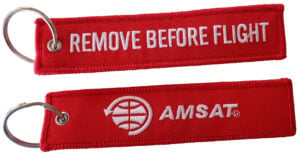
Your $20 Donation Goes to Help Fly a FoxPlus Satellite Includes First Class Postage (Sorry – U.S. Addresses Only) Order Today at https://www.amsat.org/product/amsat-remove-before-flight-keychain
Polish Student CubeSat PUCHACZ Seeks IARU Frequency Coordination
A Polish student satellite with an unusually extensive amateur radio payload has entered the IARU Amateur Satellite Frequency Coordination process.
PUCHACZ is a 2U CubeSat under development by SatLab AGH, a student research group at the AGH University of Krakow’s Faculty of Space Technologies. The IARU coordination status page listed PUCHACZ as its most recently updated application as of October 29. Frequency coordination remains in process.
The amateur radio system is more than a basic telemetry transmitter. Students plan to experiment with a custom command-and-control architecture based on the CubeSat Space Protocol, or CSP. Authenticated telecommands will be transmitted through the spacecraft’s 70-centimeter amateur radio command link, and the project intends to study ways of reducing the amount of uplink time required for routine spacecraft operations. Results are expected to be published for use by other amateur and student satellite projects.
PUCHACZ’s student-developed radio is based around a Semtech SX1262 transceiver with duplicated RF chains for increased resilience. Proposed amateur downlink modes include LoRa with 125 kHz bandwidth and GFSK at 19.2 and 38.4 kbps. Some GFSK transmissions will use IL2P framing.
One of the more interesting planned amateur experiments is image transmission. Pictures from the spacecraft’s RGB camera are expected to be encoded as SSDV and sent in either LoRa or GFSK/IL2P frames. The team says schedules and reception guides for both SX1262 receivers and software-defined radios will be published for amateur operators.
PUCHACZ will also offer a two-way “Message of the Day” experiment for licensed radio amateurs. An operator will be able to send a short packet containing a call sign and Maidenhead locator. The spacecraft will answer with a message containing the operator’s call sign, a count of answered requests, and a daily quotation.
Other experiments include the BEAR radiation payload, containing 12 dosimeters to compare the radiation-shielding properties of several biomaterials, and a custom pulse-power system associated with the DZIDA optical communications payload.
Outside the amateur-satellite service, PUCHACZ carries RGB and multispectral Earth-imaging cameras and DZIDA, an experimental infrared optical communications terminal. SatLab describes DZIDA as a wide-beam pulsed laser downlink intended to demonstrate an energy-efficient optical communications system suitable for small spacecraft. Full-resolution imagery and other non-amateur payload data are planned for a separate S-band link.
The current coordination filing anticipates a SpaceX launch from Vandenberg Space Force Base no earlier than April 1, 2027, targeting an approximately 525 km polar orbit. The university more generally lists the mission’s launch window as 2027.
As with all spacecraft in the IARU coordination process, proposed amateur frequencies and operating plans should not be treated as final until coordination is completed.
[ANS thanks the IARU Amateur Satellite Frequency Coordination panel, AMSAT-UK, and SatLab AGH at the AGH University of Krakow for the above information.]
UMKA-1 Sends Telescope Images by SSTV
Radio amateurs had another opportunity to receive pictures directly from orbit this week as the Russian UMKA-1 CubeSat conducted an SSTV transmission campaign from October 27 through October 29.
The spacecraft transmitted on 437.625 MHz using the Robot 36 SSTV format. Images were scheduled at approximately 200-second intervals, although organizers cautioned that transmissions could be interrupted depending on the state of the spacecraft’s battery.
Two different images were included in the transmission sequence. Both were derived from photographs obtained by UMKA-1’s onboard telescope. The activity was organized in connection with educational activities for students.
The use of SSTV by educational satellites gives students and radio amateurs a particularly accessible way to receive spacecraft data: a suitable UHF receiving station, audio connection, and readily available SSTV decoding software are enough to turn a signal from orbit into a recognizable image.
UMKA-1’s activity came immediately after the International Space Station completed its own multi-day Series 34 SSTV transmission event, making late October an unusually active period for amateur satellite image reception.
[ANS thanks AMSAT Francophone for the above information]
It’s November! Time is running out for the 2026 President’s Club Coin!
Help Support GOLF and FoxPlus.
Annual memberships start at only $120
Join the AMSAT President’s Club today and help Keep Amateur Radio in Space! https://www.amsat.org/join-the-amsat-presidents-club/
ARISS Opens New U.S. School Contact Proposal Window
U.S. schools and educational organizations can now submit proposals for Amateur Radio on the International Space Station contacts planned for the second half of 2027.
The current U.S. proposal window runs from October through December 2026, with applications due December 31, 2026. Successful proposals from this window are expected to be scheduled for contacts taking place between July and December 2027. A second application window covering the same contact period will run from January through March 2027.
Scheduled ARISS contacts allow students to speak directly with an astronaut aboard the International Space Station during an approximately ten-minute radio window. Organizations may propose either a direct contact, in which amateur radio equipment is established at the school, or a telebridge contact using one of ARISS’s dedicated ground stations.
ARISS emphasizes that the radio contact should form part of a broader educational program rather than simply being a one-time event. U.S. proposals are expected to include plans for students to study subjects related to space technology, exploration, communications, wireless technology, or radio science.
Schools selected for a contact are assigned an ARISS Technical Mentor. ARRL and AMSAT can also assist participating organizations in locating a local amateur radio club to provide equipment, expertise, and educational support.
Application schedules differ outside the United States. Schools and youth organizations in Europe, Africa, and the Middle East use application periods organized by ARISS Europe, while other regions apply through their appropriate ARISS regional representatives.
[ANS thanks Amateur Radio on the International Space Station for the above information.]

FO-29 Full-Sunlight Season Enters Its Final Weeks
Operators interested in working one of amateur radio’s longest-lived linear satellites may have only a few more weeks before Fuji-OSCAR 29 (FO-29) returns to periods of eclipse.
FO-29’s batteries have deteriorated over the past 30 years, leaving the satellite dependent on solar power to stay active for more than a few minutes. When its orbit remains continuously illuminated by the Sun, the V/U linear transponder can operate without the scheduled command activations required during portions of the year when the satellite enters Earth’s shadow.
A long period of continuous solar illumination began around May 20 and was projected to continue until approximately mid-November 2026. AMSAT’s current linear-satellite listing still reports FO-29 as being in full sunlight.
FO-29 carries an inverting V/U analog transponder:
* Uplink: 145.900-146.000 MHz, LSB
* Downlink: 435.800-435.900 MHz, USB
* CW beacon: 435.795 MHz
The satellite was launched in 1996 and remains under the control of the Japan Amateur Radio League. Its continued operation three decades later makes it one of the veteran spacecraft of the amateur satellite fleet.
As eclipses begin returning to its orbit, operators should not assume that the transponder will remain available continuously. During eclipse seasons the JARL control team may activate the satellite according to announced schedules when sufficient power is available.
[ANS thanks the Japan Amateur Radio League for the above information.]
FO-126 Conducting 5.84 GHz High-Speed Tests
OrigamiSat-2 (Fuji-OSCAR 126 / FO-126), developed by the Institute of Science Tokyo, is conducting additional high-speed data transmissions on 5.84 GHz. The team has scheduled 500 kbit/s downlinks lasting approximately 10 minutes during selected passes through November 8, 2026. These tests support the satellite’s deployable membrane antenna technology demonstration and promotion of amateur use of the 5.8 GHz band.
FO-126 was launched April 23, 2026, on a Rocket Lab Electron and also carries a UHF downlink on 437.505 MHz (CW and 1200 bps AFSK). Operators interested in the C-band experiments are encouraged to monitor published pass times and share reception reports with the team.
[ANS thanks AMSAT-HB and the OrigamiSat-2 team for the above information.]
NASA Details Accelerated Artemis Plan: Earth-Orbit Lander Test in 2027, Lunar Landings in 2028
NASA Administrator Jared Isaacman, Associate Administrator Amit Kshatriya, and Artemis Program Manager Jeremy Parsons laid out the agency’s plan for returning astronauts to the lunar surface during an October 23 news conference at Kennedy Space Center, confirming that Artemis III will fly a crewed Earth-orbit test of both commercial lunar landers in mid-2027 and that Artemis IV and Artemis V are both targeting crewed landings at the Moon’s south pole in 2028.
Under the revised architecture, Artemis III will no longer attempt a landing. Instead, Blue Origin’s Blue Moon Mark 2 lander will launch first, since it can loiter in Earth orbit for up to 30 days. A four-person crew will follow aboard Orion on the Space Launch System, docking with Blue Moon on the third day of the mission and spending two days attached while the astronauts enter the lander and run through its systems. SpaceX’s Starship Human Landing System will launch on day six with a passive docking adapter; Orion will dock with it for about two hours, though the crew will not go aboard. The flight is intended to wring out the rendezvous and docking operations that both landers will need before anyone commits to a lunar descent.
The two landers will reach the Moon by different routes. For Starship, a fully fueled vehicle will dock with Orion in Earth orbit and push the capsule to the Moon, replacing the original plan to meet in lunar orbit; two crew members will then descend to the surface and return to Orion. That plan depends on in-space propellant transfer, which has not yet been demonstrated. SpaceX expects its first attempt early next year and an uncrewed lunar landing test in late 2027. Blue Origin has dropped propellant transfer from its plan and will instead use three smaller Blue Moon Mark 1 spacecraft as tugs to move its Mark 2 lander to lunar orbit, where it will meet Orion. NASA said it expects both landers to carry crews to the surface by the end of 2028 and that which one lands first is “up in the air.” Each provider must complete an uncrewed landing before a crewed attempt.
Spacesuits remain a schedule risk. With Axiom Space’s suits running behind, NASA has changed its requirements to allow a lighter “sortie” suit that limits the first crews to two excursions of about two hours each on the surface, a tradeoff the agency called acceptable for the initial missions. The lunar south pole remains the target, with water ice in permanently shadowed regions the principal attraction, though Kshatriya acknowledged “we will always debate” the landing site, and Isaacman called the idea of an eventual return to an Apollo landing site “very cool.” A National Academies report released the same week identified four candidate non-polar sites.
The announcement came one day after the Aerospace Safety Advisory Panel raised concerns about lander readiness, the plan for only a single uncrewed landing test per provider, and the first-ever use of cryogenic propellants on the lunar surface. For the amateur radio community, the stakes are familiar: the ARISS-led AREx ground station consortium tracked Orion’s signals during Artemis II earlier this year, and the Artemis III Earth-orbit mission would put a crewed Orion within easy reach of amateur antennas for the better part of two weeks.
[ANS thanks NASA and SpacePolicyOnline.com for the above information.]
HOA Lobbying Group Makes Blocking Amateur Radio Antenna Bill a Top Priority
The Community Associations Institute (CAI), the national lobbying organization for homeowners associations, condominium associations, and the management companies that serve them, has placed opposition to the Amateur Radio Emergency Preparedness Act among its top federal legislative priorities, according to materials from the group’s Congressional Advocacy Summit held in Washington, D.C., in September.
The legislation, H.R. 1094 in the House and S. 459 in the Senate, would prohibit private land-use restrictions, such as HOA covenants, from precluding the installation and operation of amateur radio antennas, bringing them under the same kind of “reasonable accommodation” standard that the FCC’s PRB-1 ruling has applied to state and local governments since 1985. CAI’s summit agenda, which also included FEMA debris-removal funding, condominium safety financing, and repeal of the Corporate Transparency Act, asked members to urge Congress to oppose the bills, which the group says would “fully prohibit” associations from “reasonably regulating” antenna placement. CAI’s stated position is that “community associations work best when residents come together to establish and enforce reasonable rules” and that it opposes federal legislation restricting an association’s ability to require prior approval of radio infrastructure.
Neither chamber has scheduled a vote on the measure, which enjoys bipartisan sponsorship. ARRL, which launched a nationwide grassroots campaign in support of the legislation last year, continues to ask amateurs to contact their representatives and senators, and maintains resources on the issue at https://www.arrl.org/HOA.
The outcome matters to satellite operators as much as to anyone. While the amateur satellite service can be worked with modest equipment, including handheld antennas that no covenant can reach, a permanently mounted array for the linear transponders or a dish for future geostationary and high-orbit payloads is exactly the kind of installation that association approval processes most often delay or deny. The bill’s fate will likely be decided in the remaining weeks of the current Congress, after which it would have to be reintroduced.
[ANS thanks Amateur Radio Daily, Amateur Radio Newsline, the Community Associations Institute, and ARRL for the above information.]
Changes to AMSAT TLE Distribution for October 30, 2026
Two Line Elements or TLEs, often referred to as Keplerian elements or keps in the amateur community, are the inputs to the SGP4 standard mathematical model of spacecraft orbits used by most amateur tracking programs. Weekly updates are completely adequate for most amateur satellites. TLE bulletin files are updated daily in the first hour of the UTC day. New bulletin files will be posted immediately after reliable elements become available for new amateur satellites. More information may be found at https://www.amsat.org/keplerian-elements-resources/.
This week there are no additions or deletions to the AMSAT Keps distribution.
General Perturbations Data Support
AMSAT is pleased to announce that modern forms of what are called General Perturbations data are being disseminated via modern formats including JSON, XML and KVN at https://newark192.amsat.org/gpdata/current/. The reason this change is being made is that we are running out of 5-digit catalog numbers and the TLE format is not viable for satellites launched after July of this year. See https://celestrak.org/NORAD/documentation/gp-data-formats.php for details.
These data are presently considered in beta test for the next few months while hosted on the test server newark192.amsat.org, and we are very open to community feedback at webmaster at amsat.org. Testers may experience outages and errors while we make improvements. We intend to put this into production on our main web server in July as we expect that satellites launched after this summer will require one of the new formats to accommodate longer object numbers. AMSAT will continue to publish TLE bulletins for satellites launched before July 2026 indefinitely.
[ANS thanks Joe Fitzgerald, KM1P, AMSAT Orbital Elements Manager, for the above information.]
Buying from DX Engineering?
Add AMSAT’s Getting Started With Amateur Satellites to your order. Available for $30 from DX Engineering (free shipping on most orders over $99)
https://www.dxengineering.com/parts/amt-satellites
ARISS News
Amateurs and others around the world may listen in on contacts between amateurs operating in schools and allowing students to interact with astronauts and cosmonauts aboard the International Space Station. The downlink frequency on which to listen is 145.800 MHz worldwide.
Scheduled Contacts
No contacts are currently scheduled.
Many times, a school makes a last-minute decision to do a Livestream or runs into a last-minute glitch requiring a change of the URL, but we at ARISS may not get the URL in time for publication. You can always check https://live.ariss.org/ to see if a school is Livestreaming.
As always, if there is an EVA, a docking, or an undocking, the ARISS radios are turned off as part of the safety protocol. Spacewalks to install the station’s final two roll-out solar arrays took place on Thursday, October 29, and are scheduled for Thursday, November 5 (see the lead story above); expect the ARISS radios to be off during those operations.
The crossband repeater remains configured in the Columbus Module (145.990 MHz up {PL 67} & 437.800 MHz down). If a crewmember decides to pick up the microphone and turn up the volume, you may hear them on the air – so keep listening, as you never know when activity might occur.
Kenwood D710GA in the Zvezda Service Module – Call sign RS0ISS. Please note we’re still in the process of troubleshooting and testing this radio. With the SSTV Series 34 event complete, APRS is once again active on 437.825 MHz. Feel free to check out status reports at https://ariss-usa.org/ARISS_APRS/.
HamTV in the Columbus Module (2395.00 MHz) is currently transmitting a test signal. For more information, visit the ARISS Ham TV Live site at https://live.ariss.org/hamtv/.
Note, all times are approximate. It is recommended that you do your own orbital prediction or start listening about 10 minutes before the listed time.
The latest information on the operating mode can be found at https://www.ariss.org/current-status-of-iss-stations.html
The latest list of frequencies in use can be found at https://www.ariss.org/contact-the-iss.html
[ANS thanks Charlie Sufana, AJ9N, one of the ARISS operation team mentors, for the above information.]
Want to fly the colors on your own grid expedition? Get an AMSAT car flag and other neat stuff from our Zazzle store!
25% of the purchase price of each product goes towards Keeping Amateur Radio in Space
AMSAT Ambassador Activities
AMSAT Ambassadors provide presentations, demonstrate communicating through amateur satellites, and host information tables at club meetings, hamfests, conventions, maker faires, and other events.
JARSfest (Johnston Amateur Radio Society Hamfest) – November 7, 2026
The Farm at 95
215 Batten Rd.
Selma, NC 27576
https://jars.net/jarsfest-2026
KF4EAG
Southern Arizona Fall Hamfest – November 14, 2026
Oro Valley Amateur Radio Club
Marana Middle School
11285 W. Grier Rd.
Marana, AZ
https://www.tucsonhamradio.org/hamfest
N1UW
Interested in becoming an AMSAT Ambassador? AMSAT Ambassadors provide presentations, demonstrate communicating through amateur satellites, and host information tables at club meetings, hamfests, conventions, maker faires, and other events. For more information go to: https://www.amsat.org/ambassador/
[ANS thanks Bo Lowrey, W4FCL, Director – AMSAT Ambassador Program, for the above information.]
Satellite Shorts from All Over
+ Peter Goodhall, MM9SQL, released version 1.1.5 of OscarWatch Tracker on October 29. New features include custom SSTV save folders, chroma smoothing for cleaner Robot/PD pictures, an FT4 CQ blocklist, live DXCC logging, audio silence warnings, and improved USB soundcard recovery. The release also includes SSTV sync fixes that prevent noisy Robot 36 pictures from being misidentified as Robot 72. Download: https://github.com/magicbug/OscarWatch-Tracker/releases/tag/v1.1.5 [ANS thanks Peter Goodhall, MM9SQL, for the above information.]
+ With growing use, MM9SQL directed users of OscarWatch Tracker to the dedicated support system at https://oscarwatch.org/support rather than social media for questions and issues. Documentation is available at https://oscarwatch.org/docs/tracker. [ANS thanks Peter Goodhall, MM9SQL, for the above information.]
+ Japan’s Martian Moons eXploration (MMX) spacecraft is on its way to Phobos. The JAXA probe lifted off aboard the tenth H3 rocket from Tanegashima Space Center at 19:41 UTC on October 19, carrying the German-French Idefix rover developed by DLR and CNES. MMX is due to arrive at Mars in the summer of 2027, where it will study both Martian moons from orbit with eight instruments before releasing Idefix onto Phobos around the turn of 2028-2029 from a height of 40 to 100 meters. The rover, which carries a Raman spectrometer and a radiometer, is expected to be the first wheeled vehicle to drive on a Martian moon, in gravity less than one-thousandth of Earth’s and through temperature swings of more than 200 degrees Celsius over Phobos’s seven-hour day. MMX itself will then land to collect at least 10 grams of regolith for return to Earth in 2031, helping to answer whether Phobos and Deimos are captured asteroids or the debris of a giant impact on Mars. [ANS thanks DLR and JAXA for the above information.]
+ Fifty-eight Scouts from the Dan Beard Council in Cincinnati got on the air October 17-18 for Jamboree on the Air, operating from two sites: forty worked the station at the National Voice of America Museum of Broadcasting in West Chester, Ohio, as WC8VOA alongside the West Chester Amateur Radio Club, while eighteen more operated as KY4BSA from a campout at Camp Friedlander in Loveland. For Scouts from Troop 674, the weekend capped three classroom sessions on radio safety, propagation, regulation, and careers, and participation now satisfies a requirement for the Citizenship in the World merit badge. The council’s Radio Scouting Committee, chaired by Shawn Grubb, KE8BBC, has put 255 Scouts and 61 adults on the air across thirteen activations since January and plans Radio merit badge sessions in January and March 2027 and Winter Field Day operations January 23-24. [ANS thanks the Dan Beard Council Radio Scouting Committee and Amateur Radio Daily for the above information.]
+ Roughly one in eighteen U.S. amateurs who apply to renew their licenses never manage to pay the FCC’s $35 fee, according to an analysis of two years of FCC weekly archive data by Rob Rosenberger, K4HST, published October 23 by Amateur Radio Daily. Rosenberger found that an average of 3,901 amateurs per month renewed successfully, 227 per month applied but failed in the payment step, and 783 per month never applied at all. More striking, 92 percent of those who failed a payment once simply walked away rather than try again, and over the two-year period 1,431 callsigns lapsed after payment failures while another 1,221 remain in the grace period. Rosenberger blames a “payment labyrinth” that routes applicants through two FCC portals with two sets of credentials, and urges clubs to reach out to local operators nearing the end of their grace periods using the free PDF callbooks he publishes. The full analysis is at https://daily.hamweekly.com/. [ANS thanks Amateur Radio Daily and K4HST for the above information.]
+ The Radio Club of America will present its 2026 awards and induct seven new Fellows at its annual banquet at the Westin Times Square in New York City on November 21. Fourteen awards will be presented, led by the Armstrong Medal, the club’s highest honor, to Dr. Andrea Goldsmith, the first woman to receive it in the award’s history. Other honorees include Dr. Ajay Poddar (Dr. Arno Penzias Award for basic research in the radio sciences), Audrey McElroy (Carole Perry Young Professional Award, honoring a graduate of RCA’s Youth Activities Program who has gone on to a career in wireless), Jack Winters (Lifetime Achievement Award), and Charles Counselman (Dr. Ulrich Rohde Award for Innovation in Applied Radio Science and Engineering). Details and banquet registration are at https://www.radioclubofamerica.org/. [ANS thanks the Radio Club of America for the above information.]
+ APRS Connect, the messaging-first APRS client that launched on Android in August, is now available for iPhone (iOS 16.4 or later). The free app works over APRS-IS, while connecting a radio and several advanced features are part of a subscription tier with a seven-day trial. Of interest to satellite operators, the app plots the ISS on its map, can connect to Bluetooth LE KISS TNCs or work through a radio’s speaker and microphone using a built-in 1200-baud AFSK modem with VOX keying, and can turn the phone into an IGate or a digipeater. Also new are a coverage map showing where your beacons were heard, a grid-square screen, VoiceOver and TalkBack accessibility, and guided screens for APRS services such as the SMS, email, and Winlink gateways. More information is at https://aprsconnect.com/. [ANS thanks APRS Connect and Amateur Radio Daily for the above information.]
+ A helicopter pilot was killed on the evening of October 15 when his aircraft struck a 150-foot guyed tower behind the Myakka City, Florida, home of well-known contester Dan Street, K1TO, who also owns a tower installation company. The 63-year-old pilot, the only person aboard, had just completed a mosquito-control spraying route when the accident occurred shortly before 9 p.m. in Manatee County, according to the sheriff’s office; the tower, the tallest of three on the property, collapsed. The Wireless Estimator, an industry website, noted that towers under 200 feet are not required by the FAA to be lit or registered in the FCC’s Antenna Structure Registration system and that the towers were in compliance with those rules. The National Transportation Safety Board is investigating and typically issues a preliminary report within about 30 days. [ANS thanks Amateur Radio Newsline and The Wireless Estimator for the above information.]
+ The Radio Society of Great Britain has launched a monthly newsletter for its members aged 25 and under, produced by the society’s Youth Committee. Early issues, which feature members’ accounts of activities ranging from a youth camp in the Austrian Alps to first check-ins on DMR nets along with a calendar of upcoming events, are being posted publicly on the RSGB website, with later editions to be delivered directly to youth members. Story submissions may be sent to Youth Committee chair Leon Shaw, M0VUF, at youth.chair [at] rsgb.org.uk. [ANS thanks Amateur Radio Newsline and the RSGB for the above information.]
Join AMSAT today at https://launch.amsat.org/
In addition to regular membership, AMSAT offers membership to:
- Societies (a recognized group, clubs or organization).
- Students are eligible for FREE membership up to age 25.
- Memberships are available for annual and lifetime terms.
Contact info [at] amsat.org for additional membership information.
73 and remember to help Keep Amateur Radio in Space!
This week’s ANS Editor,
Paul Stoetzer, N8HM
n8hm [at] amsat.org
ANS is a service of AMSAT, the Radio Amateur Satellite Corporation, 712 H Street NE, Suite 1653, Washington, DC 20002. AMSAT is a registered trademark of the Radio Amateur Satellite Corporation.